The difference between modification and accommodation is often misunderstood in education, psychology, language learning, and even everyday communication. At first glance, the difference between modification and accommodation may seem small, but in real-life practice, it creates completely different outcomes.
The difference between modification and accommodation becomes clearer when we observe how people adjust to challenges in schools, workplaces, or social environments.
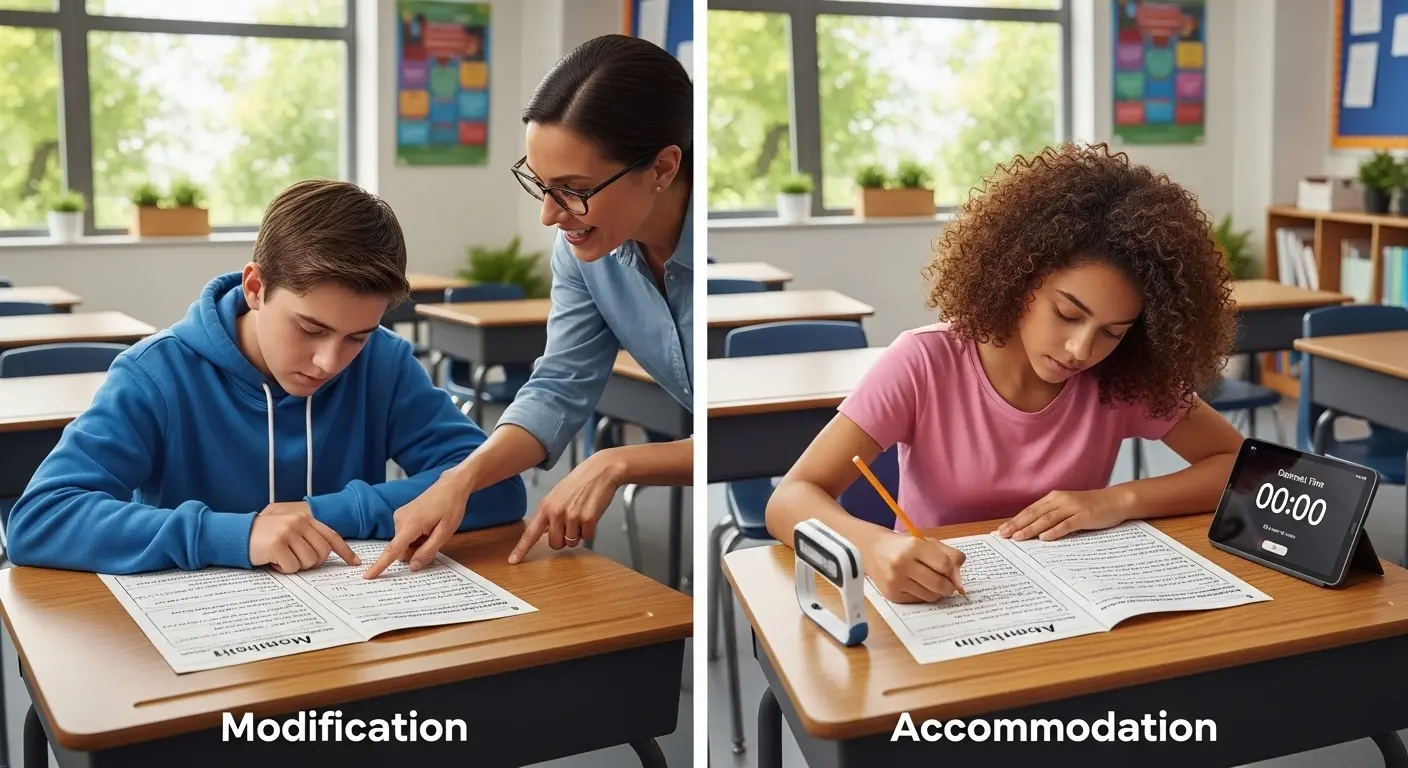
Imagine a classroom where one student struggles with reading while another excels in advanced comprehension. The teacher changes the difficulty of reading material for one student but allows extra time and support for another. These two actions reflect the difference between modification and accommodation.
In simple terms, modification means changing the task itself, while accommodation means changing the way the task is accessed. Understanding the difference between modification and accommodation helps educators, learners, and professionals make fair and effective decisions.
Pronunciation
- Modification
- US: /ˌmɑːdɪfɪˈkeɪʃən/
- UK: /ˌmɒdɪfɪˈkeɪʃən/
- Accommodation
- US: /əˌkɑːməˈdeɪʃən/
- UK: /əˌkɒməˈdeɪʃən/
Now, let’s smoothly move toward a deeper understanding of the topic.
Difference Between Attending and Resident: in (2026)
Key Difference Between Modification and Accommodation
The core distinction is simple:
- Modification changes what a person is expected to learn or do.
- Accommodation changes how a person learns or completes the task without altering expectations.
Modification adjusts the content or difficulty level, while accommodation supports access without changing the standard.
Why Knowing the Difference Matters
Understanding the difference between modification and accommodation is essential for teachers, students, psychologists, and workplace managers. It ensures fairness, inclusivity, and proper support systems. In education, it helps students receive appropriate learning strategies. In workplaces, it promotes equal opportunities for employees with different needs. In society, it builds empathy and reduces discrimination. Without this understanding, support systems may become ineffective or unfair, affecting performance and confidence.
ESG vs Sustainability: in (2026)
H2: Difference Between Modification and Accommodation (10 Key Points)
1. Meaning
- Modification: Changes the content or expectation
- Example 1: A student solves easier math problems instead of grade-level ones.
- Example 2: A simplified exam paper is given.
- Accommodation: Changes the method of access
- Example 1: Extra time is given in exams.
- Example 2: A student uses audio books instead of printed text.
2. Purpose
- Modification: To reduce difficulty
- Example 1: Shortened assignments for struggling learners.
- Example 2: Reduced syllabus content.
- Accommodation: To provide equal access
- Example 1: Providing a wheelchair ramp.
- Example 2: Allowing oral responses instead of writing.
3. Learning Outcome
- Modification: Alters expected outcomes
- Example 1: Student learns fewer chapters.
- Example 2: Different grading standards applied.
- Accommodation: Keeps same outcome
- Example 1: Same exam but with extra time.
- Example 2: Same syllabus with supportive tools.
4. Nature
- Modification: Structural change
- Example 1: Changing curriculum level.
- Example 2: Replacing difficult tasks with easier ones.
- Accommodation: Supportive change
- Example 1: Note-taker provided.
- Example 2: Preferential seating in classroom.
5. Flexibility
- Modification: Less flexible academically
- Example 1: Reduced standards permanently.
- Example 2: Simplified grading system.
- Accommodation: Highly flexible
- Example 1: Extra time only when needed.
- Example 2: Assistive technology use.
6. Target Users
- Modification: Students with significant learning challenges
- Example 1: Special education learners.
- Example 2: Severe cognitive delay cases.
- Accommodation: Students with minor barriers
- Example 1: Dyslexia support.
- Example 2: Hearing-impaired learners using captions.
7. Assessment Impact
- Modification: Changes grading criteria
- Example 1: Reduced passing marks.
- Example 2: Alternative evaluation methods.
- Accommodation: Does not change grading
- Example 1: Extra time in tests.
- Example 2: Quiet room for exams.
8. Implementation
- Modification: Requires curriculum adjustment
- Example 1: New syllabus plan.
- Example 2: Alternative assignments.
- Accommodation: Easy to implement
- Example 1: Providing notes.
- Example 2: Allowing breaks during exams.
9. Legal/Educational Context
- Modification: Often part of special education plans
- Example 1: Individualized curriculum.
- Example 2: Reduced academic expectations legally approved.
- Accommodation: Legal right in inclusive systems
- Example 1: Disability access support.
- Example 2: Exam adjustments without changing standards.
10. Outcome Equality
- Modification: May lead to different outcomes
- Example 1: Different certification level.
- Example 2: Lower academic standard completion.
- Accommodation: Maintains equal outcome opportunity
- Example 1: Same degree earned.
- Example 2: Same certification achieved.
Nature and Behaviour of Both
Modification is adaptive but transformative in nature. It reshapes expectations and outcomes to match learner ability. It is often permanent and structural.
Accommodation is supportive and flexible. It does not alter expectations but removes barriers that prevent performance. It is usually temporary or situational and ensures equal participation.
Why People Get Confused
People often confuse modification and accommodation because both are forms of support. In both cases, learners receive help, extra time, or adjusted materials. However, the key confusion lies in misunderstanding whether the goal is to change content (modification) or access (accommodation). The overlap in educational settings makes them appear similar, but their outcomes are fundamentally different.
Table: Difference and Similarity
| Feature | Modification | Accommodation | Similarity |
| Purpose | Change content | Change access | Both support learners |
| Outcome | Different | Same | Aim for improvement |
| Difficulty | Reduced | Same level | Helps performance |
| Usage | Special curriculum | Accessibility tools | Used in education |
| Flexibility | Limited | High | Adjustable support |
Which is Better in What Situation?
Modification is better when a learner has significant limitations that prevent them from engaging with standard curriculum content. It helps reduce stress and ensures achievable learning goals. For example, students with severe cognitive challenges benefit from modified learning plans.
Accommodation is better when learners can perform the same tasks but face barriers in access or execution. For example, a visually impaired student using screen readers can perform equally well with proper support. Thus, accommodation promotes equality, while modification ensures accessibility for deeper challenges.
Metaphors and Similes
- Modification as a “different road”: Like taking a shorter or easier path to reach a destination.
- Accommodation as a “bridge”: Like a bridge helping you cross the same river without changing the destination.
Connotative Meaning
- Modification
- Positive: Helpful, adaptive, supportive
- Negative: May imply reduced standards
- Neutral: Academic adjustment
- Accommodation
- Positive: Inclusive, fair, empowering
- Negative: Sometimes seen as special treatment
- Neutral: Access support system
Idioms or Proverbs
- “Different strokes for different folks”
- Example: Modification uses different strokes for learners with different abilities.
- “Make room for everyone”
- Example: Accommodation makes room for all learners in the same classroom.
Works in Literature (Examples)
- No major classical literary works are solely focused on these terms, but they are widely discussed in educational psychology literature, including:
- Inclusive Classroom Strategies – Special Education Research Journals (21st century)
- Differentiated Instruction Theory – Carol Ann Tomlinson (Education, 2000s)
- Learning Disabilities and Teaching Strategies – Academic pedagogy studies
Movies Related to Theme (Inclusive Education & Adaptation)
- Taare Zameen Par (2007, India) – Focus on learning differences and educational support
- Front of the Class (2008, USA) – Story of overcoming disability in education
- The Miracle Worker (1962, USA) – Teaching and adapting to disability
Frequently Asked Questions
1. What is the main difference between modification and accommodation?
Modification changes the content; accommodation changes the access method.
2. Does accommodation change grades?
No, it keeps grading standards the same.
3. Who needs modification?
Students with significant learning challenges.
4. Is accommodation temporary?
Yes, it is often situational and flexible.
5. Can both be used together?
Yes, depending on learner needs.
How Both Are Useful for Surroundings
Both modification and accommodation create inclusive environments. They help individuals participate effectively in education, workplaces, and social systems. Modification ensures learning is possible for everyone at their level, while accommodation ensures equal access to opportunities. Together, they reduce inequality, build confidence, and promote fairness in society.
Final Words
Modification and accommodation are not opposing concepts but complementary tools. They both aim to support individuals facing learning or accessibility challenges. Understanding when to modify and when to accommodate is crucial for teachers, institutions, and policymakers. These strategies ensure that no learner is left behind and that education remains fair, flexible, and inclusive for all.
Conclusion
The difference between modification and accommodation is a key concept in education and inclusive practices. Modification adjusts the difficulty or content, while accommodation ensures equal access without changing expectations.
Both play an important role in helping learners succeed in different situations. When used correctly, they create a balanced and supportive learning environment where every individual can perform according to their ability. Understanding this distinction helps educators design better teaching strategies and helps learners receive the right kind of support. Ultimately, both concepts promote fairness, equality, and inclusion in education and society.

Hi, I’m LunarCrest, the author behind GrammarCircle. I’m passionate about language, writing, and helping people understand the finer details of English. Through my work, I focus on explaining grammar rules, word differences, and language concepts in a simple and practical way.