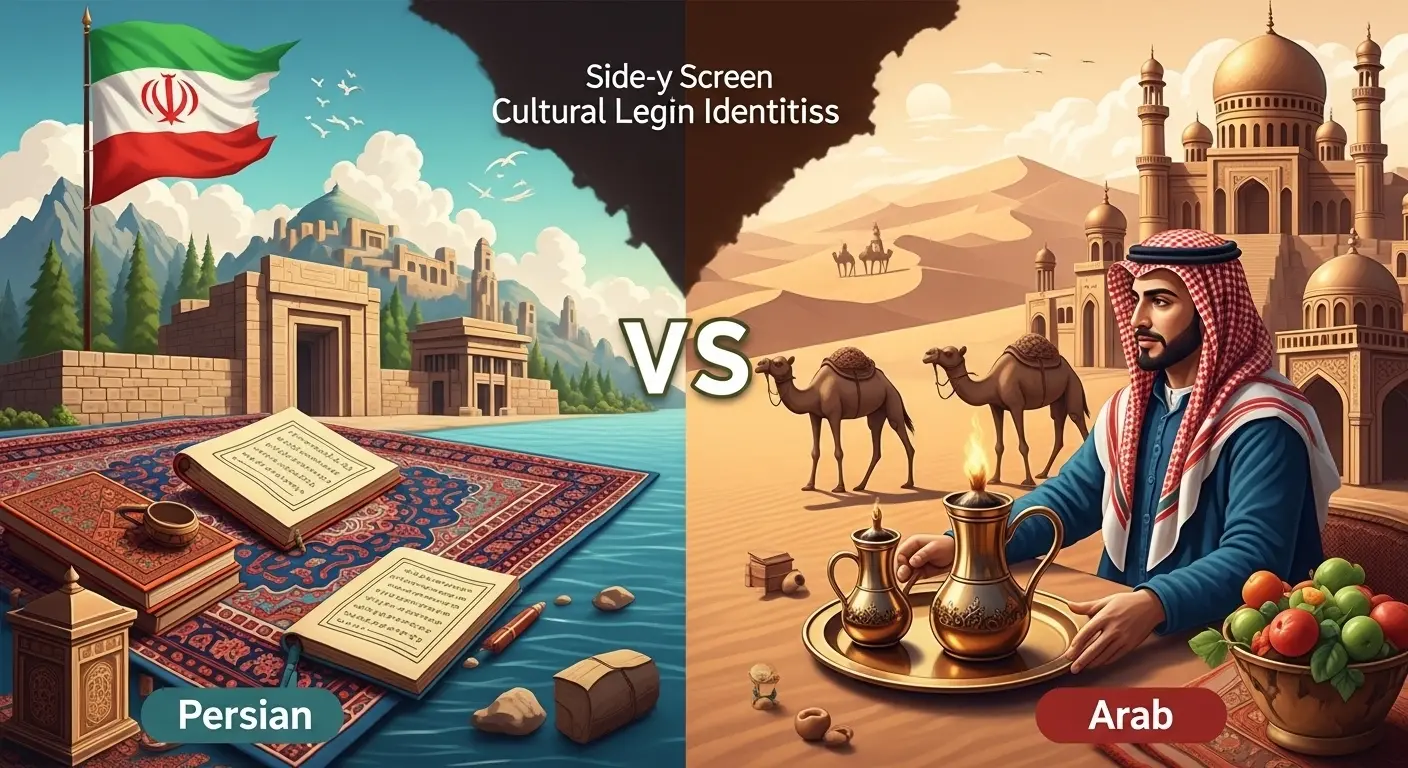
Understanding the difference between Persian and Arab is important for anyone studying Middle Eastern history, language, or culture. Many people mistakenly assume that Persian and Arab mean the same thing, but they are completely different in origin, language, and cultural identity. The difference between Persian and Arab becomes clearer when we look at their historical roots, traditions, and languages.
In everyday conversations, people often confuse the difference between Persian and Arab because both groups come from regions that are geographically close and share some cultural influences. However, the difference between Persian and Arab is deeply rooted in ethnicity, language families, and historical development. For example, Persian culture originates mainly from Iran, while Arab culture spans across many countries in the Middle East and North Africa.
Imagine a traveler visiting Tehran and then Cairo. Both places feel rich in history, but the languages spoken, traditions followed, and even social behaviors differ significantly. This real-world experience highlights why understanding the difference between Persian and Arab is essential in global communication, education, and cultural respect.
Pronunciation of the Words (US & UK)
- Persian
- US: /ˈpɜːr.ʒən/
- UK: /ˈpɜː.ʃən/
- Arab
- US: /ˈær.əb/
- UK: /ˈær.əb/
- Difference Between Hemorrhoids and Polyps: Explained?
Linking Hook
Now that we understand the basic idea and pronunciation, let’s explore the core difference between Persian and Arab in detail, covering language, culture, history, and lifestyle.
Difference Between Persian and Arab
1. Ethnic Origin
- Persians: Indo-European ethnic group primarily from Iran.
- Example 1: Iranians identifying as Persian in Tehran.
- Example 2: Tajik communities in Central Asia.
- Arabs: Semitic ethnic group originating from the Arabian Peninsula.
- Example 1: Saudis in Riyadh.
- Example 2: Egyptians in Cairo identifying as Arab.
- Difference Between Resin and Epoxy: A Complete Guide?
2. Language Family
- Persian: Indo-Iranian branch of Indo-European family.
- Example 1: Farsi spoken in Iran.
- Example 2: Dari spoken in Afghanistan.
- Arabic: Semitic language family.
- Example 1: Modern Standard Arabic in media.
- Example 2: Gulf Arabic spoken in UAE.
3. Writing System
- Persian: Uses modified Arabic script with extra letters.
- Example 1: Persian books in Iran.
- Example 2: Poetry of Rumi in Persian script.
- Arabic: Original Arabic script with 28 letters.
- Example 1: Quran written in Arabic.
- Example 2: Newspapers in Saudi Arabia.
4. Geography
- Persian: Mainly Iran and parts of Afghanistan and Tajikistan.
- Example 1: Tehran (Iran).
- Example 2: Kabul (Dari Persian influence).
- Arab: Spans 22 countries in the Middle East and North Africa.
- Example 1: Egypt.
- Example 2: Morocco.
5. Religion Influence
- Persian: Majority Shia Islam in Iran.
- Example 1: Ashura ceremonies in Iran.
- Example 2: Religious schools in Qom.
- Arab: Mostly Sunni Islam across the Arab world.
- Example 1: Mecca pilgrimage in Saudi Arabia.
- Example 2: Sunni mosques in Jordan.
6. Culture and Traditions
- Persian: Rich in poetry, art, and festivals like Nowruz.
- Example 1: Nowruz celebration.
- Example 2: Persian carpet weaving.
- Arab: Strong tribal traditions and hospitality culture.
- Example 1: Bedouin hospitality.
- Example 2: Traditional Arabic coffee serving.
7. Historical Background
- Persian: Ancient Persian Empire (Achaemenid Empire).
- Example 1: Cyrus the Great.
- Example 2: Persepolis ruins.
- Arab: Rise of Islam in 7th century Arabia.
- Example 1: Prophet Muhammad’s era.
- Example 2: Expansion of Arab Caliphates.
8. Cuisine Differences
- Persian: Balanced flavors with rice, saffron, herbs.
- Example 1: Chelo kebab.
- Example 2: Ghormeh Sabzi.
- Arab: Rich spices, bread-based meals.
- Example 1: Hummus.
- Example 2: Shawarma.
9. Music and Art
- Persian: Classical instruments like santur and tar.
- Example 1: Persian classical music.
- Example 2: Miniature paintings.
- Arab: Oud and darbuka instruments.
- Example 1: Arabic pop music.
- Example 2: Traditional folk dance.
10. Social Structure
- Persian: More urbanized and modern social system.
- Example 1: Tehran metropolitan life.
- Example 2: University culture in Iran.
- Arab: Mix of tribal and modern social systems.
- Example 1: Tribal gatherings in Saudi Arabia.
- Example 2: Urban life in Dubai.
Nature and Behaviour
- Persians: Generally known for poetic expression, artistic mindset, and philosophical thinking. Communication tends to be indirect and expressive.
- Arabs: Known for strong hospitality, honor-based traditions, and direct communication styles in many regions.
Why People Are Confused
People often confuse Persians and Arabs because:
- Both regions are in the Middle East.
- They share Islamic cultural influence.
- The Persian language uses Arabic script.
- The media often generalizes both groups.
This creates misunderstanding, especially among learners who do not study regional history deeply.
Table: Difference and Similarity
| Aspect | Persian | Arab | Similarity |
| Ethnicity | Indo-European | Semitic | Middle Eastern origin |
| Language | Farsi | Arabic | Script overlap |
| Religion | Mostly Shia | Mostly Sunni | Islam influence |
| Culture | Poetic & artistic | Tribal & hospitality-based | Rich traditions |
| Geography | Iran-centered | Multi-country | Regional proximity |
Which is Better in What Situation?
Persian culture is often appreciated in situations that value literature, poetry, and artistic expression. For example, Persian poetry is widely studied in academic and literary fields due to its depth and symbolism. It is also admired in cultural diplomacy and historical research.
Arab culture is highly influential in religious, business, and global communication contexts, especially due to Arabic being the language of the Quran and widely used across multiple countries. In trade, tourism, and international relations in the Middle East, Arabic is extremely valuable.
Both cultures are equally important, but their usefulness depends on the context academic, religious, social, or economic.
Metaphors and Similes
- Persian is often compared to a flowing river of poetry, symbolizing depth and beauty.
- Example: “Her words flowed like Persian poetry.”
- Arab culture is often compared to a desert wind strong and enduring.
- Example: “His hospitality was as vast as an Arab desert.”
Connotative Meaning
- Persian
- Positive: Artistic, refined, poetic
- Negative: Sometimes seen as overly complex
- Neutral: Cultural identity
- Arab
- Positive: Hospitable, strong, resilient
- Negative: Sometimes stereotyped unfairly
- Neutral: Ethnic and linguistic identity
Idioms and Proverbs
- Persian-related: “A Persian heart speaks in poetry.”
- Example: His letter felt like a Persian heart speaking in poetry.
- Arab-related: “Arab hospitality knows no end.”
- Example: We were welcomed with Arab hospitality.
Literature Works
- Persian Literature:
- Shahnameh – Ferdowsi (Epic Poetry, 977–1010 AD)
- Divan-e-Hafez – Hafez (Lyric Poetry, 14th century)
- Arabic Literature:
- One Thousand and One Nights (Folklore, compiled 9th–14th century)
- The Mu’allaqat (Pre-Islamic poetry anthology)
Movies
- Persian/Iranian Influence:
- Persepolis (2007, France/Iran)
- A Separation (2011, Iran)
- Arab World Influence:
- The Message (1976, Syria/Morocco/Lebanon)
- Caramel (2007, Lebanon)
Frequently Asked Questions
1. Are Persian and Arab the same?
No, they are completely different in ethnicity, language, and culture.
2. Do Persians speak Arabic?
No, they speak Farsi, though Arabic is used in religious contexts.
3. Are Arabs and Persians both Muslim?
Yes, but with different sect distributions and cultural practices.
4. Why do they look similar?
Geographical proximity and shared regional influences.
5. Is Iran an Arab country?
No, Iran is a Persian country, not Arab.
How Both Are Useful for Surroundings
Persian culture contributes to global art, literature, and historical studies. It enriches education and creative expression through poetry and philosophy.
Arab culture plays a major role in global religion, trade, energy markets, and diplomacy. The Arabic language is essential for international communication in many countries.
Both cultures help shape global civilization by adding diversity, knowledge, and tradition to human society.
Final Words
Both Persian and Arab identities represent rich, ancient civilizations that have shaped human history in powerful ways. While they are often confused, understanding their differences helps build respect and cultural awareness. Persian culture stands out for its poetic elegance and historical depth, while Arab culture is known for its unity, strength, and widespread global influence. Appreciating both allows us to see the beauty of diversity in language, tradition, and human identity. Learning the difference between Persian and Arab is not just academic, it is a step toward better global understanding.
Conclusion
The difference between Persian and Arab goes far beyond language or geography; it reflects two distinct civilizations with unique identities. Persians, rooted mainly in Iran, represent an Indo-European heritage rich in poetry, philosophy, and ancient empires. Arabs, spread across many countries, share a Semitic linguistic and cultural background strongly influenced by Islam and tribal traditions.
Although both cultures share regional proximity and some overlapping customs, their histories, languages, and social structures are fundamentally different. Understanding the difference between Persian and Arab helps reduce stereotypes and promotes cultural respect. In today’s globalized world, such awareness is essential for education, communication, and international relations. Recognizing these differences allows us to appreciate the depth and beauty of both civilizations.

I’m BeaconRise, the author behind GrammarCircle, where I help readers understand English grammar, language differences, and writing concepts in a simple and practical way. I specialize in explaining confusing words, grammar rules, and “difference between” topics so learners can easily improve their writing and communication skills.