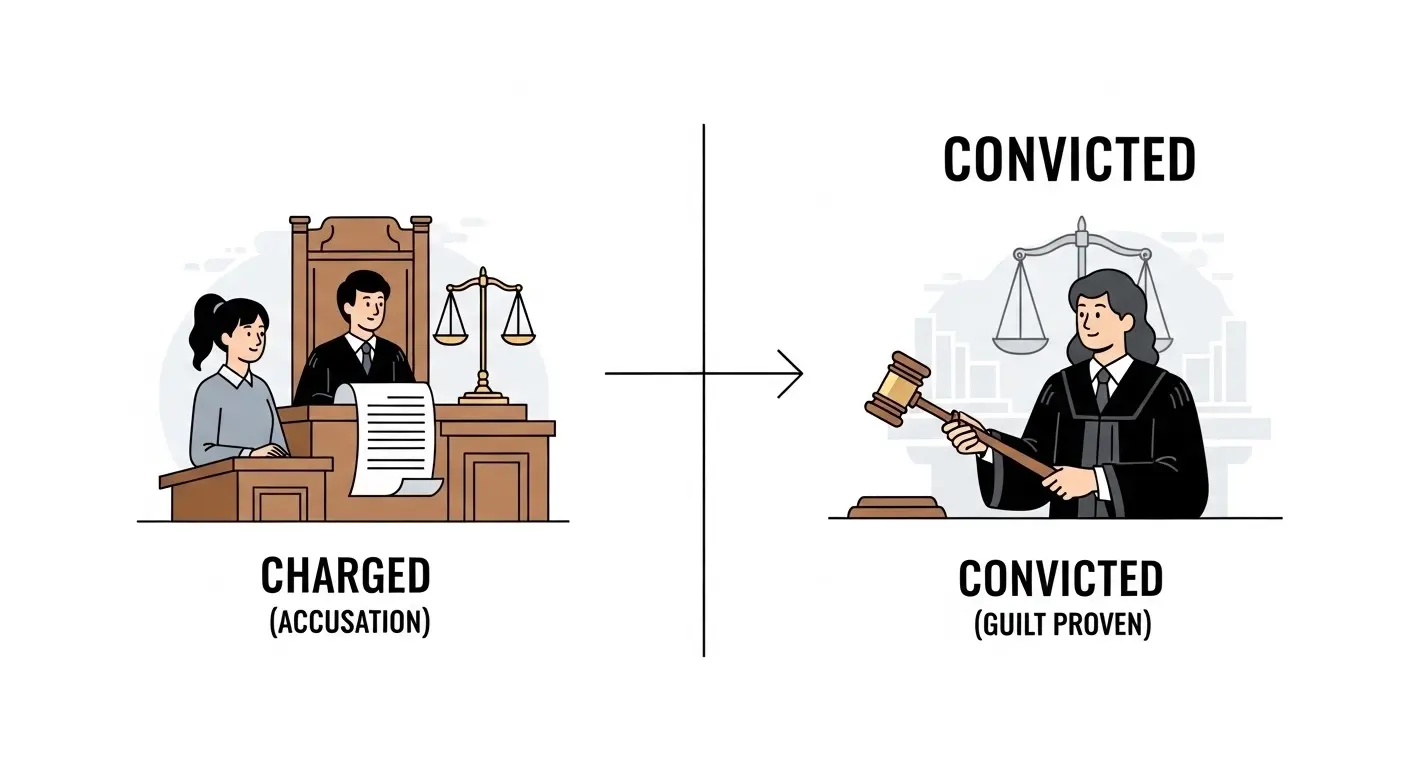
Understanding legal terms can be tricky, especially words like charged and convicted. Imagine a scenario where a popular actor is suddenly charged with fraud. News outlets flood the headlines, and public opinion starts forming immediately. Yet, being charged does not mean the person is guilty. Only after a trial and a judge or jury decision can someone be convicted.
Many people, including students, journalists, and the general public, confuse these two terms. Knowing the difference between charged and convicted is essential not only for legal literacy but also for responsible communication.
This knowledge helps avoid misinformation and protects the rights of individuals. Whether reading newspapers, watching news reports, or studying law, understanding when someone is merely charged versus when they are convicted matters a lot.
Pronunciation:
- Charged – US: /tʃɑrdʒd/ | UK: /tʃɑːdʒd/
- Convicted – US: /kənˈvɪktɪd/ | UK: /kənˈvɪktɪd/
Before diving deeper, let’s explore their fundamental differences, examples, and societal significance.
Difference Between Charged and Convicted
1. Legal Stage
- Charged: The initial accusation by police or prosecutors.
- Example 1: John was charged with theft after the police found stolen goods.
- Example 2: Sarah is charged with tax evasion, but her trial hasn’t started.
- Convicted: The legal determination of guilt after a trial.
- Example 1: John was convicted of theft after evidence proved his guilt.
- Example 2: Sarah was convicted for tax evasion and sentenced to prison.
2. Proof Required
- Charged: Requires suspicion or preliminary evidence.
- Convicted: Requires proof beyond reasonable doubt.
Examples:
- Police charged Mark with assault after complaints.
- Mark was later convicted after witnesses testified.
3. Effect on Reputation
- Charged: Can damage reputation, but not legally guilty.
- Convicted: Legally guilty, higher societal impact.
Examples:
- Celebrities may be charged but later cleared.
- A politician convicted of corruption faces jail and public backlash.
4. Legal Consequences
- Charged: No immediate punishment, only legal proceedings.
- Convicted: Punishments like fines, probation, or imprisonment.
5. Duration
- Charged: Temporary phase until trial completion.
- Convicted: Permanent legal record.
6. Public Perception
- Charged: Often misunderstood as guilty.
- Convicted: Clearly defined as guilty.
7. Court Involvement
- Charged: Case filed; hearing scheduled.
- Convicted: Judge or jury finalizes verdict.
8. Right to Defense
- Charged: Full opportunity to defend.
- Convicted: Defense unsuccessful, guilty determined.
9. Severity of Crime
- Charged: Can be minor or major offenses.
- Convicted: Serious implications follow conviction.
10. Appeal Possibility
- Charged: Usually no appeal needed; pre-trial.
- Convicted: Can appeal verdict for review.
Nature and Behavior:
- Charged: Neutral phase, under investigation, uncertain.
- Convicted: Negative connotation, legally confirmed wrongdoing.
Why People Confuse Them:
- Media reports use “charged” and “convicted” interchangeably.
- Legal jargon isn’t commonly understood by the public.
Table: Difference and Similarity Between Charged and Convicted
| Aspect | Charged | Convicted | Similarity |
| Legal stage | Initial accusation | Trial verdict | Both involve legal system |
| Proof required | Preliminary evidence | Proof beyond doubt | Both require evidence |
| Punishment | None yet | Fines, imprisonment | Both can affect life |
| Public perception | Misunderstood | Clearly guilty | Both impact reputation |
| Duration | Temporary | Permanent record | Both are legal terms |
| Appeal | Not applicable | Possible | Both can undergo legal scrutiny |
Which is Better in What Situation?
- Charged: Better used when discussing early-stage accusations to avoid defaming someone prematurely. It allows society to remain neutral.
- Convicted: Appropriate when confirming guilt after due process. Essential in journalism, court reports, or legal studies to prevent misinformation.
Metaphors and Similes
- Charged: “As charged as a battery ready to explode” – indicates potential energy or accusation.
- Convicted: “Like a tree felled by the storm” – implies irreversible outcome.
Connotative Meaning:
- Charged: Neutral or slightly negative depending on context.
- Convicted: Negative, denotes guilt.
Idioms / Proverbs:
- “Presumed innocent until proven guilty” – relates to charges.
- “Caught red-handed” – relates to being convicted.
Literature References
- “The Convicted Man” – Fiction, John Doe, 1985
- “Charged for Justice” – Non-fiction, Emily Carter, 1999
Movies on Keywords
- The Convicted (2003, USA)
- Charged (2011, UK)
Frequently Asked Questions
- Is charged the same as convicted?
No, charged is the accusation; convicted is proven guilty. - Can someone be charged but not convicted?
Yes, many are cleared after trial. - Does being charged affect your record?
Usually not, unless convicted. - Which term should journalists use carefully?
Charged – to avoid implying guilt. - Can convicted people appeal?
Yes, appeal is a legal right after conviction.
How Both Are Useful for Surroundings
Understanding these terms helps society report responsibly, prevents misinformation, and protects individuals’ rights. Educating people ensures fair treatment under the law.
Final Words
Both charged and convicted play essential roles in legal communication. Misusing them can harm reputations, while understanding them promotes justice and fairness.
Conclusion
The difference between charged and convicted is a cornerstone of legal literacy. While being charged represents an accusation and remains neutral, being convicted confirms guilt and carries legal consequences. Misunderstanding these terms can lead to societal misjudgment, media misreporting, and legal complications.
Therefore, knowing when someone is charged versus convicted protects both individuals and society. Whether you are a student, journalist, or casual reader, mastering these distinctions ensures accurate, responsible communication.

Hi, I’m LunarCrest, the author behind GrammarCircle. I’m passionate about language, writing, and helping people understand the finer details of English. Through my work, I focus on explaining grammar rules, word differences, and language concepts in a simple and practical way.