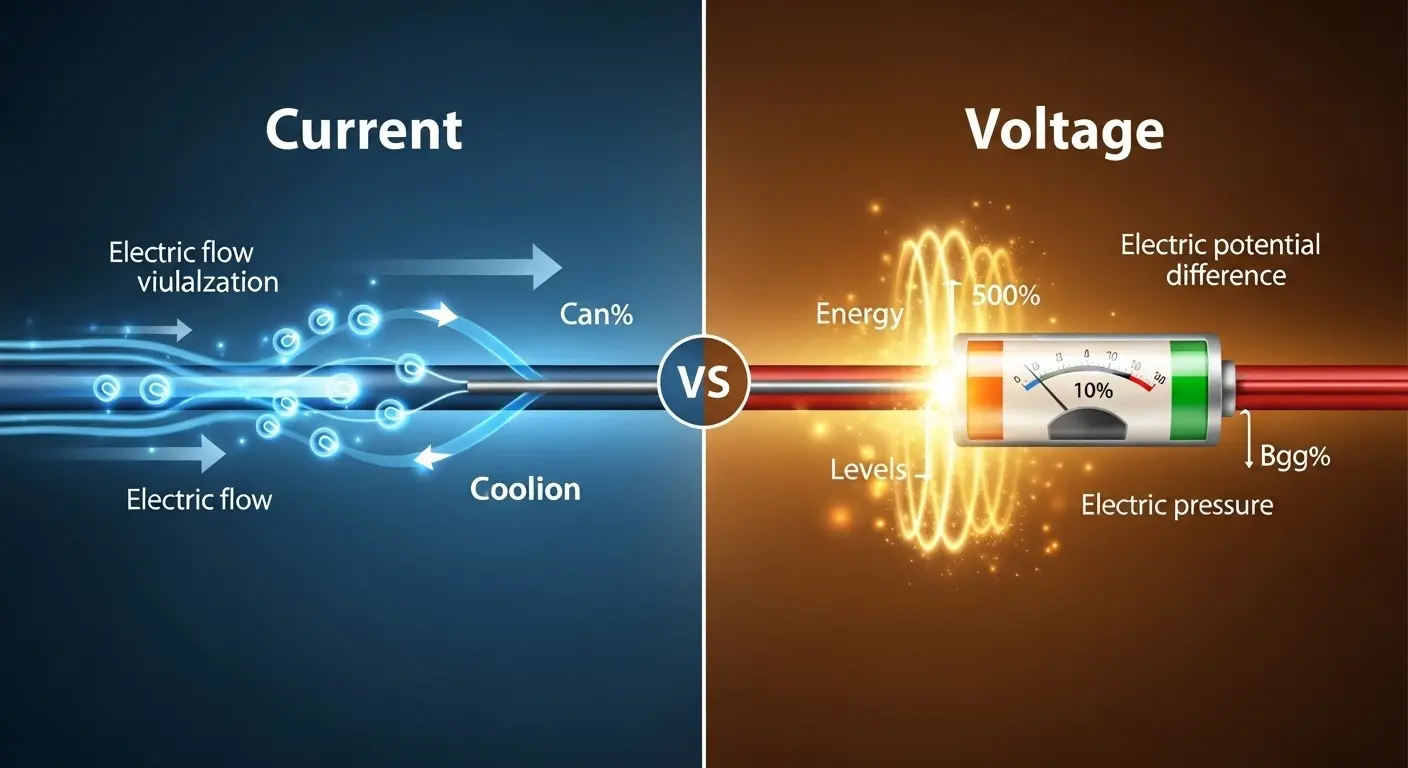
Electricity powers our modern world, from the lights in our homes to the devices in our pockets. But have you ever stopped to wonder what makes it flow? Two fundamental concepts in electricity, current and voltage, play a crucial role in this invisible force.
While people often use these terms interchangeably, understanding the difference between current and voltage is essential for students, engineers, and anyone interested in electronics. Imagine a water park: the water flowing through the slides represents the current, and the pressure pushing it represents the voltage. In daily life, recognizing the difference between current and voltage can help prevent electrical mishaps and improve energy efficiency.
Both current and voltage determine how electricity behaves in circuits, and learning their characteristics ensures safety and efficiency. Let’s explore their definitions, pronunciations, and the detailed distinctions that clarify their roles in the world of electricity.
Pronunciation:
- Current – US: /ˈkɜːrənt/, UK: /ˈkʌrənt/
- Voltage – US: /ˈvoʊltɪdʒ/, UK: /ˈvəʊltɪdʒ/
Linking Hook
To truly grasp electricity, we need to dive into the differences between current and voltage and understand how they affect circuits, devices, and even everyday life.
H2: Difference Between Current and Voltage
1. Definition
- Current: The flow of electric charge through a conductor.
- Example 1: A lamp turns on because current flows through it.
- Example 2: Batteries send current through a toy car to make it move.
- Voltage: The electric potential difference between two points.
- Example 1: A 9V battery has voltage that pushes current through a circuit.
- Example 2: High voltage in power lines ensures electricity reaches homes.
2. Symbol and Unit
- Current: Symbol “I”, measured in amperes (A).
- Example: A phone charger may supply 2A of current.
- Voltage: Symbol “V”, measured in volts (V).
- Example: Household outlets typically provide 120V or 230V.
3. Cause vs Effect
- Current: Effect of voltage applied across a conductor.
- Example: More voltage → more current in a fixed resistor.
- Voltage: Cause that pushes current through a conductor.
- Example: Battery provides voltage; circuit draws current accordingly.
4. Flow or Potential
- Current: Indicates the actual flow of electrons.
- Example: Current flows through wires in a fan.
- Voltage: Indicates potential energy available to move electrons.
- Example: Voltage in a solar panel drives current to a battery.
5. Measurement Device
- Current: Measured using an ammeter.
- Example: Engineers use ammeters to check current in circuits.
- Voltage: Measured using a voltmeter.
- Example: Technicians measure voltage across bulbs to check performance.
6. Direction
- Current: Flows from positive to negative in conventional flow.
- Example: Current moves through a circuit board from V+ to V–.
- Voltage: Exists between two points; no direction of flow.
- Example: Voltage difference between two battery terminals.
7. Energy Role
- Current: Transfers energy to devices.
- Example: Current lights up LEDs.
- Voltage: Provides energy that drives the current.
- Example: Voltage from mains powers home appliances.
8. Nature
- Current: Can be AC (alternating) or DC (direct).
- Example: Phone batteries use DC; wall sockets supply AC.
- Voltage: Can be AC or DC depending on the source.
- Example: Solar panels generate DC voltage; grid provides AC voltage.
9. Behaviour in Circuits
- Current: Increases with more voltage (Ohm’s Law: I = V/R).
- Example: Increasing voltage doubles current if resistance stays constant.
- Voltage: Sets the current based on circuit resistance.
- Example: High voltage lines deliver electricity efficiently over long distances.
10. Safety Concern
- Current: Directly affects risk of electric shock.
- Example: High current through the body can be fatal.
- Voltage: Determines the ability to push current through resistance.
- Example: High voltage can be dangerous even with low current if touched.
Nature and Behaviour
- Current: Dynamic, always involves flow of electrons, fluctuates in AC systems.
- Voltage: Static potential difference, drives current but does not flow itself.
Why People Are Confused
Many confuse current and voltage because they are interdependent; voltage drives current, yet only current can cause actual energy transfer.
Table: Difference and Similarity
| Feature | Current (I) | Voltage (V) | Similarity |
| Definition | Flow of electric charge | Electric potential difference | Both essential in circuits |
| Unit | Ampere (A) | Volt (V) | Measured in standard units |
| Measured by | Ammeter | Voltmeter | Instruments quantify them |
| Cause/Effect | Effect | Cause | Work together in circuits |
| Direction | Has flow direction | No flow direction | Both influence electrical devices |
| Nature | Dynamic | Static | Both can be AC or DC |
| Safety | High current is dangerous | High voltage is risky | Safety precautions needed |
| Energy Role | Transfers energy | Provides energy | Both affect device operation |
| Circuit Behavior | Changes with voltage/resistance | Creates current | Both follow Ohm’s law |
| Examples | Lighting a bulb | Battery voltage | Seen in everyday electronics |
Which Is Better in What Situation?
Current: Best for understanding energy transfer in devices. For instance, electronics rely on precise current for operation.
Voltage: Crucial for long-distance power delivery. High voltage reduces current loss, making electricity transport efficient.
Metaphors and Similes
- Current: “Electricity flows like a river” – simile for continuous movement.
- Voltage: “Voltage is the push behind every spark” – metaphor for driving force.
Connotative Meaning:
- Current: Neutral – represents flow of energy.
- Voltage: Positive – symbolizes potential and power.
Idioms or Proverbs
- “Go with the flow” – refers to current.
- “Power to push through” – refers to voltage.
Works in Literature
- Electrons and Currents (Science textbook, Richard Feynman, 1964) – Non-fiction
- Voltage and Life (Educational book, Jane Thompson, 1982) – Non-fiction
Movies
- Current (2010, USA) – Sci-fi, focused on electricity-based plot
- Voltage (2018, UK) – Drama exploring energy crisis
Frequently Asked Questions
- Is current stronger than voltage? – No, they are different; current is flow, voltage is the push.
- Can voltage exist without current? – Yes, potential can exist even if no current flows.
- Does higher voltage mean higher current? – Only if resistance is constant.
- Which is more dangerous, current or voltage? – Current is directly dangerous; voltage causes it.
- Can we measure both with one device? – No, separate meters are used: ammeter for current, voltmeter for voltage.
How Both Are Useful for Surroundings
- Current: Powers homes, appliances, and devices.
- Voltage: Enables energy transfer over distances efficiently, making renewable energy practical.
Final Words
Understanding current and voltage is vital for anyone dealing with electricity. Their difference is fundamental for safety, energy efficiency, and innovation.
Conclusion
The difference between current and voltage defines how electricity behaves. Current represents flow, while voltage represents potential. Recognizing these distinctions helps prevent electrical hazards, ensures energy efficiency, and deepens understanding of physics principles. In real-world applications, this knowledge powers homes, devices, and industrial machinery safely.
While current focuses on energy transfer, voltage provides the driving force behind it. Both are indispensable in electrical engineering, electronics, and daily life. Mastery of these concepts ensures a safer and more efficient interaction with electricity.

Hi, I’m LunarCrest, the author behind GrammarCircle. I’m passionate about language, writing, and helping people understand the finer details of English. Through my work, I focus on explaining grammar rules, word differences, and language concepts in a simple and practical way.