The difference between domestic and international becomes clear when you imagine booking a flight or ordering a product online. A student traveling within Pakistan to Lahore is dealing with something domestic, while another student flying from Pakistan to the USA is entering an international journey.
The difference between domestic and international is important in travel, trade, business, and education. Many people search for the difference between domestic and international because both terms are widely used in airlines, markets, and communication systems. Understanding the difference between domestic and international helps learners, professionals, and businesses operate more effectively in local and global environments.
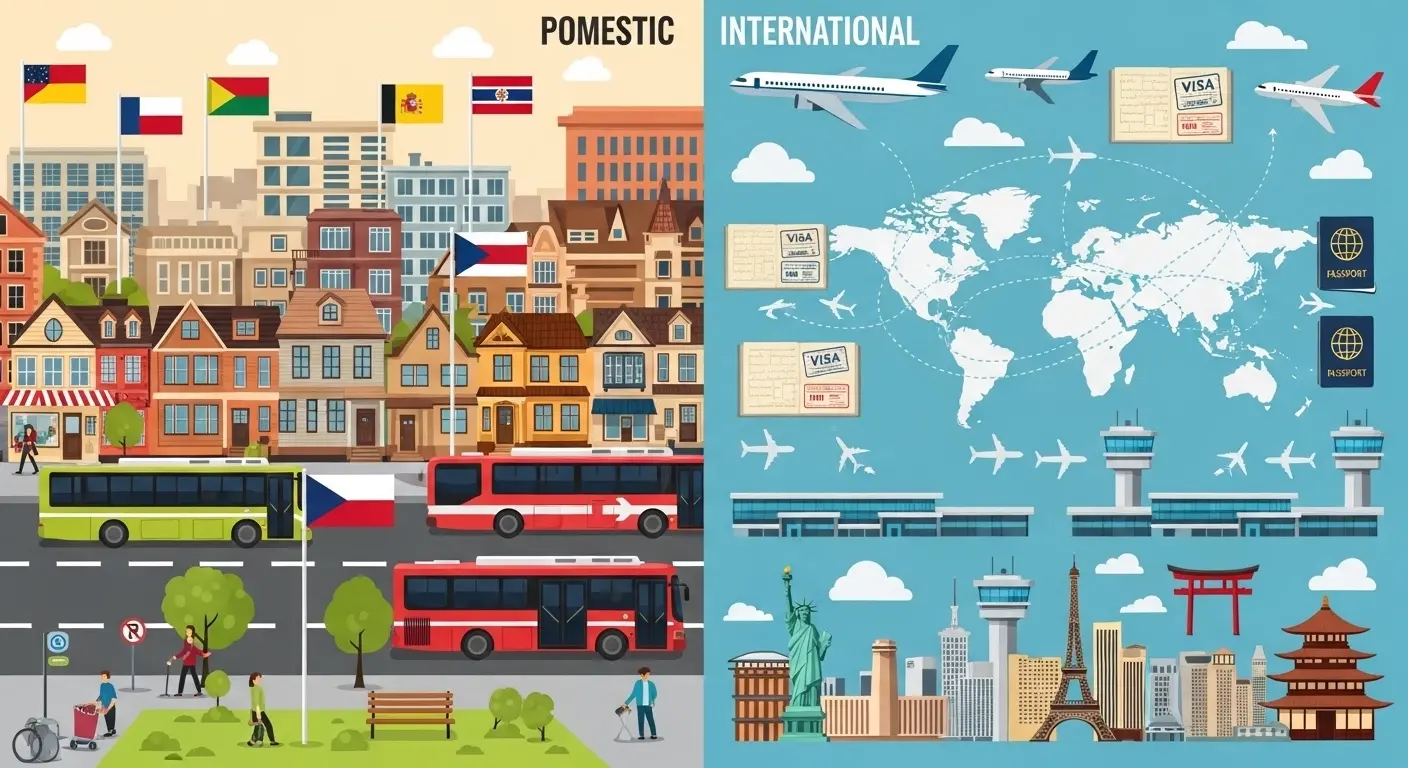
Domestic refers to something within one country, while international refers to between two or more countries. Though they seem similar, their rules, scale, and impact are very different.
US Pronunciation:
- Domestic: /dəˈmɛstɪk/
- International: /ˌɪntərˈnæʃənəl/
UK Pronunciation:
- Domestic: /dəˈmɛstɪk/
- International: /ˌɪntəˈnæʃənəl/
Now let’s explore their detailed differences.
Key Difference Between Domestic and International
The main difference between domestic and international is that domestic activities occur within one country, while international activities involve multiple countries and cross-border systems.
Why Knowing the Difference Between Domestic and International Matters in Society
Understanding the difference between domestic and international is essential in education, business, travel, and politics. It helps in understanding laws, trade regulations, cultural exchange, and global communication. Without this knowledge, people may misunderstand legal systems, pricing, and travel rules.
H2: Difference Between Domestic and International
1. Geographic Scope
- Domestic: Within one country
- Example: Lahore to Karachi travel
- Example: Local Pakistan trade
- International: Between countries
- Example: Pakistan to UAE flight
- Example: USA–China trade
2. Laws and Regulations
- Domestic: One country’s laws apply
- Example: Traffic laws in Pakistan
- Example: Local business rules
- International: Multiple legal systems
- Example: Immigration laws
- Example: Customs regulations
3. Currency
- Domestic: Single currency used
- Example: Pakistani Rupees
- Example: Indian Rupees
- International: Currency exchange required
- Example: USD to PKR
- Example: Euro transactions
4. Travel Requirements
- Domestic: No passport needed
- Example: Domestic flights
- Example: Train travel
- International: Passport and visa required
- Example: Study abroad
- Example: Tourism visa
5. Cost
- Domestic: Usually cheaper
- Example: Local flights
- Example: Internal shipping
- International: More expensive
- Example: Overseas flights
- Example: Import/export charges
6. Communication
- Domestic: Same language commonly used
- Example: Urdu in Pakistan
- Example: Hindi in India
- International: Multiple languages
- Example: English in global business
- Example: Translation services
7. Trade and Business
- Domestic: Local market trade
- Example: Local shops
- Example: National supply chain
- International: Global trade
- Example: Imports from China
- Example: Exports to Europe
8. Time Zones
- Domestic: Same time zone
- Example: Pakistan Standard Time
- Example: UK internal regions
- International: Different time zones
- Example: Pakistan vs USA
- Example: Europe vs Asia
9. Documentation
- Domestic: Minimal documents required
- Example: CNIC for travel
- Example: Local ID cards
- International: Heavy documentation
- Example: Visa forms
- Example: Customs papers
10. Cultural Differences
- Domestic: Shared culture
- Example: National festivals
- Example: Local traditions
- International: Different cultures
- Example: Western vs Asian culture
- Example: Global diversity
Nature and Behaviour of Domestic and International
Domestic systems are simpler, stable, and governed by one authority, making them easier to manage. International systems are complex, diverse, and involve cooperation between multiple countries, requiring coordination and agreements.
Why People Are Confused About Domestic and International
People get confused because both terms are used in travel, business, and education. Airlines, shipping companies, and online services often use both terms side by side, making beginners think they are similar.
Table: Difference and Similarity Between Domestic and International
| Feature | Domestic | International |
| Area | One country | Multiple countries |
| Laws | Single system | Multiple systems |
| Currency | One currency | Exchange required |
| Travel | Easy | Complex |
| Cost | Low | High |
| Language | Same | Different |
| Documents | Simple | Complex |
Which is Better in What Situation?
Domestic systems are better for everyday needs like local travel, education, and small business operations. They are simple, fast, and cost-effective. For example, domestic flights or local trade are ideal for short-distance needs.
International systems are better for global opportunities like higher education, international business, and tourism. They offer wider exposure, better income opportunities, and cultural diversity. For example, studying abroad or exporting goods internationally can expand knowledge and profits.
Metaphors and Similes
- Domestic: “Like a home garden, familiar and safe.”
- International: “Like an open ocean, vast and unpredictable.”
- Simile: “Domestic travel is as easy as walking next door.”
- Simile: “International trade is like crossing endless seas.”
Connotative Meaning
- Domestic: Neutral to positive (comfort, familiarity, simplicity)
- Example: “Domestic life is peaceful and stable.”
- International: Positive and neutral (opportunity, growth, diversity)
- Example: “International exposure builds success.”
Idioms and Proverbs
- “Charity begins at home” (domestic focus)
- Example: Support local businesses first.
- “The world is your oyster” (international opportunity)
- Example: Studying abroad opens global doors.
Literature References
- The World is Flat – Thomas L. Friedman (Non-fiction, 2005)
- Globalization and Its Discontents – Joseph Stiglitz (Non-fiction, 2002)
- Home Fire – Kamila Shamsie (Novel, 2017)
Movies Related to Domestic and International Themes
- Up in the Air (2009, USA)
- The Terminal (2004, USA)
- Slumdog Millionaire (2008, UK/India)
- International (2009, India)
Frequently Asked Questions (FAQs)
1. What is the main difference between domestic and international?
Domestic is within one country, international is between countries.
2. Is international travel more expensive?
Yes, it includes visas, flights, and other costs.
3. Do domestic flights need passports?
No, only national ID is usually required.
4. Why is international trade important?
It connects global markets and increases economic growth.
5. Can domestic businesses become international?
Yes, through expansion and export strategies.
How Both Are Useful for Surroundings
Domestic systems support local economies, job creation, and national stability. International systems enhance global cooperation, cultural exchange, and economic growth. Together, they balance local development and global connectivity.
Final Words
Domestic and international concepts both play important roles in modern life. One strengthens local systems, while the other connects the world. Understanding both helps individuals and businesses grow effectively in today’s global environment.
Conclusion
The difference between domestic and international is based on geography, laws, travel, trade, and cultural interaction. Domestic refers to activities within a single country, offering simplicity, lower cost, and easier management. International refers to cross-border activities involving multiple countries, providing wider opportunities, global exposure, and economic expansion.
Understanding the difference between domestic and international is essential for students, travelers, and business professionals in a globalized world. While domestic systems focus on local stability and convenience, international systems promote diversity and growth. Both are important and interconnected, shaping how nations and individuals interact in today’s modern society.

Hi, I’m LunarCrest, the author behind GrammarCircle. I’m passionate about language, writing, and helping people understand the finer details of English. Through my work, I focus on explaining grammar rules, word differences, and language concepts in a simple and practical way.