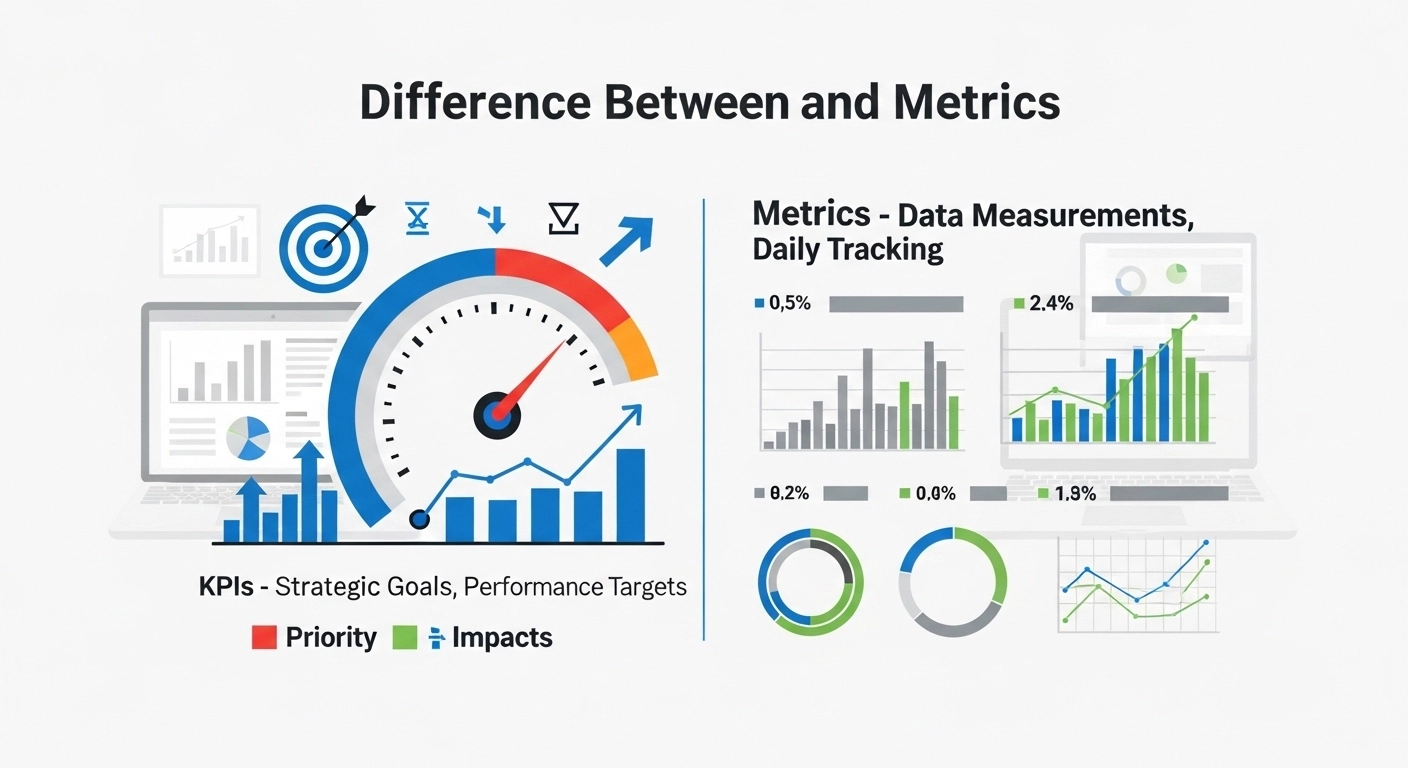
Imagine running a bakery. You want to know how well your business is doing, but looking at every single ingredient or loaf isn’t enough. This is where KPIs and metrics come into play. Metrics are like measuring how many cakes you baked in a day or how many customers visited. KPIs (Key Performance Indicators), however, focus on strategic goals like increasing monthly revenue or improving customer satisfaction.
While both KPIs and metrics involve numbers and tracking, the distinction is crucial for business owners, marketers, and analysts. Knowing the difference between KPIs and metrics allows professionals to make informed decisions, prioritize efforts, and achieve real growth.
Pronunciation:
- KPI – US: /ˌkeɪ.piːˈaɪ/ | UK: /ˌkeɪ.piːˈaɪ/
- Metric – US: /ˈme.trɪk/ | UK: /ˈme.trɪk/
Now, let’s dive deeper and uncover the precise difference between KPIs and metrics to understand their roles better.
Difference Between KPIs and Metrics
1. Purpose
KPIs: Measure progress toward strategic goals.
- Example 1: Increase monthly sales by 20%.
- Example 2: Reduce customer complaints by 10%.
Metrics: Track everyday activities.
- Example 1: Number of website visits per day.
- Example 2: Cakes baked per shift.
2. Strategic vs Operational Focus
KPIs are strategic, guiding decision-making at a higher level.
Metrics are operational, helping track day-to-day performance.
3. Timeframe
KPIs are long-term indicators.
Metrics are short-term measures.
4. Impact
KPIs affect business strategy.
Metrics influence operational tweaks.
5. Actionability
KPIs prompt strategic actions.
Metrics offer insights for minor improvements.
6. Alignment
KPIs align with company goals.
Metrics may not directly link to goals.
7. Measurement Frequency
KPIs are measured periodically (weekly, monthly, quarterly).
Metrics can be tracked daily or hourly.
8. Examples from Marketing
KPIs: Customer retention rate, ROI of campaigns.
Metrics: Click-through rate, page views.
9. Examples from Sales
KPIs: Revenue growth, profit margin.
Metrics: Number of calls made, number of deals logged.
10. Level of Complexity
KPIs are fewer, focused, and strategic.
Metrics are numerous, detailed, and granular.
Nature and Behavior
KPIs: Focused, strategic, high-level, goal-oriented.
Metrics: Detailed, operational, granular, process-oriented.
Why People Are Confused
Many assume metrics and KPIs are interchangeable because both involve numbers, tracking, and analytics. The confusion arises when operational metrics are mistaken for strategic KPIs.
KPIs vs Metrics: Table of Comparison
| Feature | KPI (Key Performance Indicator) | Metric | Similarity |
| Purpose | Strategic goal tracking | Daily operational tracking | Both measure performance |
| Timeframe | Long-term | Short-term | Both rely on data |
| Alignment with Goals | Directly aligned | Not always aligned | Both useful for decisions |
| Frequency | Periodic (weekly/monthly) | Continuous (daily/hourly) | Both monitored consistently |
| Action Required | Strategic actions | Operational adjustments | Both inform improvement |
Which is Better in What Situation?
KPIs are better when focusing on strategic success, like improving overall company revenue, enhancing customer satisfaction, or achieving market share goals. They guide leadership decisions.
Metrics are better for daily operations, like monitoring website traffic, production counts, or social media engagement. They help teams track efficiency and productivity.
Metaphors and Similes
- KPI is like a compass guiding a ship toward its destination.
- Metrics are like the ship’s speedometer, showing how fast it’s moving.
Connotation:
- KPI – Positive (goal-oriented, success-driven)
- Metric – Neutral (informative, descriptive)
Idioms or Proverbs Related
- “Measure twice, cut once” – highlights the importance of metrics.
- “Keep your eyes on the prize” – illustrates KPIs.
Works in Literature
- The Goal – Novel, Eliyahu M. Goldratt, 1984 (business strategy, KPI focus)
- Lean Analytics – Non-fiction, Alistair Croll & Benjamin Yoskovitz, 2013 (metrics vs KPI)
Movies
- Moneyball – 2011, USA (metrics and KPIs in sports)
- The Social Network – 2010, USA (KPIs in business strategy)
FAQs
- What is the main difference between KPIs and metrics?
KPIs track strategic goals; metrics track day-to-day performance. - Can a metric become a KPI?
Yes, if it aligns with strategic objectives. - Are KPIs always numbers?
Mostly, but qualitative KPIs like customer satisfaction scores exist. - Do metrics measure success?
Not directly—they measure performance trends. - Why are both important?
Metrics provide data; KPIs turn that data into meaningful action.
How Both Are Useful for Surroundings
KPIs and metrics allow businesses, organizations, and governments to improve efficiency, monitor performance, and make evidence-based decisions, benefiting employees, consumers, and society.
Final Words for KPIs and Metrics
While metrics provide the foundation, KPIs define direction. Both are indispensable for growth, accountability, and informed decision-making.
Conclusion
Understanding the difference between KPIs and metrics is essential for business professionals, marketers, and analysts. Metrics give a detailed view of daily operations, while KPIs provide strategic direction. Confusing one for the other can mislead decisions and hinder growth.
By distinguishing them, organizations can measure what truly matters, prioritize efforts, and achieve both operational efficiency and long-term success. Ultimately, integrating KPIs and metrics ensures a complete performance management system that drives productivity, accountability, and sustainable results.

I’m BeaconRise, the author behind GrammarCircle, where I help readers understand English grammar, language differences, and writing concepts in a simple and practical way. I specialize in explaining confusing words, grammar rules, and “difference between” topics so learners can easily improve their writing and communication skills.