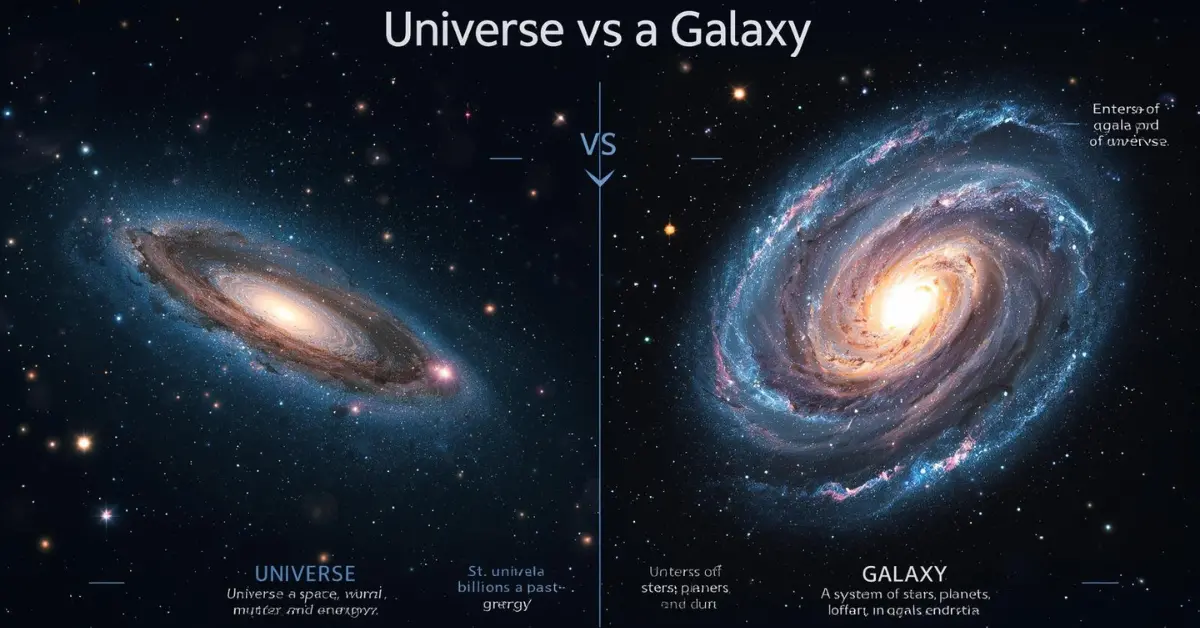
Have you ever gazed at the night sky and wondered about the vastness above us? This curiosity often leads to questions like, “What is the difference between a universe and a galaxy?” The universe (pronounced /ˈjuː.nɪ.vɜːrs/ in US, /ˈjuː.nɪ.vɜːs/ in UK) is the all-encompassing space that contains everything that exists—planets, stars, galaxies, and even time itself. On the other hand, a galaxy (pronounced /ˈɡæl.ək.si/ in US & UK) is a massive system of stars, planets, dust, and gas bound together by gravity.
Imagine looking at a city from above. The universe is like the entire country, while a galaxy is like one city within it. Understanding the difference between universe and galaxy not only satisfies human curiosity but also helps scientists and enthusiasts categorize the cosmos. By learning the distinction, we can appreciate both the grandeur of the universe and the unique beauty of each galaxy.
Let’s dive deeper to explore these cosmic wonders in detail.
Difference Between Universe and Galaxy
1. Definition
- Universe: The universe is the totality of space, time, matter, and energy that exists.
Examples:- The Big Bang marks the beginning of our universe.
- Dark energy affects the expansion of the universe.
- Galaxy: A galaxy is a large system of stars, planets, and dust bound by gravity.
Examples:- The Milky Way is the galaxy that contains our solar system.
- Andromeda is a neighboring galaxy visible from Earth.
2. Size
- Universe: Almost incomprehensibly large, estimated at 93 billion light-years in diameter.
Examples:- Light from the farthest galaxies takes billions of years to reach us.
- The universe includes billions of galaxies.
- Galaxy: Smaller than the universe, usually containing millions or billions of stars.
Examples:- The Triangulum Galaxy is about 60,000 light-years across.
- The Sombrero Galaxy is visible through small telescopes.
3. Composition
- Universe: Composed of all matter, energy, galaxies, stars, and dark matter.
- Galaxy: Composed of stars, planetary systems, gas, dust, and dark matter.
4. Number
- Universe: Only one universe exists (in standard cosmology).
- Galaxy: Billions of galaxies exist within the universe.
5. Origin
- Universe: Originated from the Big Bang about 13.8 billion years ago.
- Galaxy: Formed from gravitational collapse of gas and dust over billions of years.
6. Structure
- Universe: Infinite or extremely vast, with no center.
- Galaxy: Has a structured shape: spiral, elliptical, or irregular.
7. Role
- Universe: Serves as the container for all cosmic entities.
- Galaxy: Hosts stars, planets, and life forms, providing localized structure.
8. Observability
- Universe: Only partially observable due to limits of light travel.
- Galaxy: Individual galaxies can often be seen and studied with telescopes.
9. Dynamics
- Universe: Expanding continuously at an accelerating rate.
- Galaxy: Rotates around its center and interacts gravitationally with nearby galaxies.
10. Human Knowledge
- Universe: Human understanding is limited; much remains theoretical.
- Galaxy: Studied in detail; Milky Way mapping is almost complete.
Nature and Behavior
- Universe: Encompasses everything; constantly expanding; largely mysterious.
- Galaxy: Active with star formation, stellar deaths, and gravitational interactions; observable phenomena like black holes.
Why People Are Confused
Many confuse the universe and galaxy because both deal with cosmic structures. People often use “galaxy” to refer to the “universe” in casual speech, but galaxies are only parts of the universe, not the whole.
Universe vs Galaxy: Table of Difference and Similarity
| Feature | Universe | Galaxy | Similarity |
| Definition | Everything that exists | System of stars & planets | Both are cosmic structures |
| Size | Extremely vast | Smaller than universe | Both vast in human perspective |
| Composition | Matter, energy, galaxies | Stars, planets, dust | Contain matter & energy |
| Number | One | Billions | Both part of space |
| Observability | Partially observable | Often observable | Studied by scientists |
Which Is Better in What Situation?
- Universe: Best when discussing the totality of existence, cosmology, and physics theories. Its scale makes it essential for understanding time, space, and energy interactions.
- Galaxy: Better when discussing astronomy, star systems, and planetary formations. Galaxies provide specific areas of study for stars and potential life.
Use in Metaphors and Similes
- Universe: “Her mind was a universe of ideas,” meaning vast and limitless.
- Galaxy: “He is a shining star in his galaxy,” emphasizing prominence in a group.
Connotative Meaning
- Universe: Neutral to positive; evokes vastness and mystery.
- Galaxy: Positive; suggests beauty, organization, and wonder.
Idioms or Proverbs
- “It’s a whole new universe” – refers to something completely different.
- “Star of the galaxy” – used to highlight excellence or importance.
Works in Literature
- The Universe in a Nutshell – Stephen Hawking, Non-fiction, 2001
- Galaxy of Fear – John Whitman, Sci-fi, 2000
Movies on Keywords
- Galaxy Quest – 1999, USA
- The Universe (Documentary Series) – 2007, USA
Frequently Asked Questions
- Is a galaxy bigger than the universe?
No, a galaxy is only a part of the universe. - Can there be multiple universes?
The multiverse theory suggests it, but it’s not proven. - Do galaxies move within the universe?
Yes, galaxies move due to gravity and universe expansion. - Is the Milky Way the only galaxy?
No, there are billions of galaxies. - Why is the universe hard to understand?
Its vastness, complexity, and unseen dark matter make it challenging.
How Both Are Useful for Surroundings
- Universe: Understanding it helps develop technology, navigation, and physics theories.
- Galaxy: Studying galaxies reveals star life cycles, potential for life, and cosmic evolution.
Final Words
While the universe represents everything that exists, galaxies give structure to this vastness. Both are essential for human curiosity, scientific research, and understanding our place in the cosmos.
Conclusion
The difference between the universe and the galaxy is crucial for students, astronomers, and enthusiasts. A universe contains all that exists, whereas a galaxy is a smaller, structured collection of stars and planets. Recognizing this distinction helps us comprehend the cosmos’ scale, behavior, and mysteries.
Both terms, rich in literal and metaphorical meaning, inspire exploration, imagination, and scientific inquiry. By studying galaxies, we map the universe and understand the origins of stars, planets, and potentially life itself. Understanding these concepts deepens our connection to the cosmos, offering insights into our place in the infinite expanse.

Hi, I’m LunarCrest, the author behind GrammarCircle. I’m passionate about language, writing, and helping people understand the finer details of English. Through my work, I focus on explaining grammar rules, word differences, and language concepts in a simple and practical way.