Imagine a large office building where different companies share the same building but work in completely separate offices. Each company has its own furniture, tools, and employees. This situation closely explains the difference between virtualization and containerization in the world of computing.
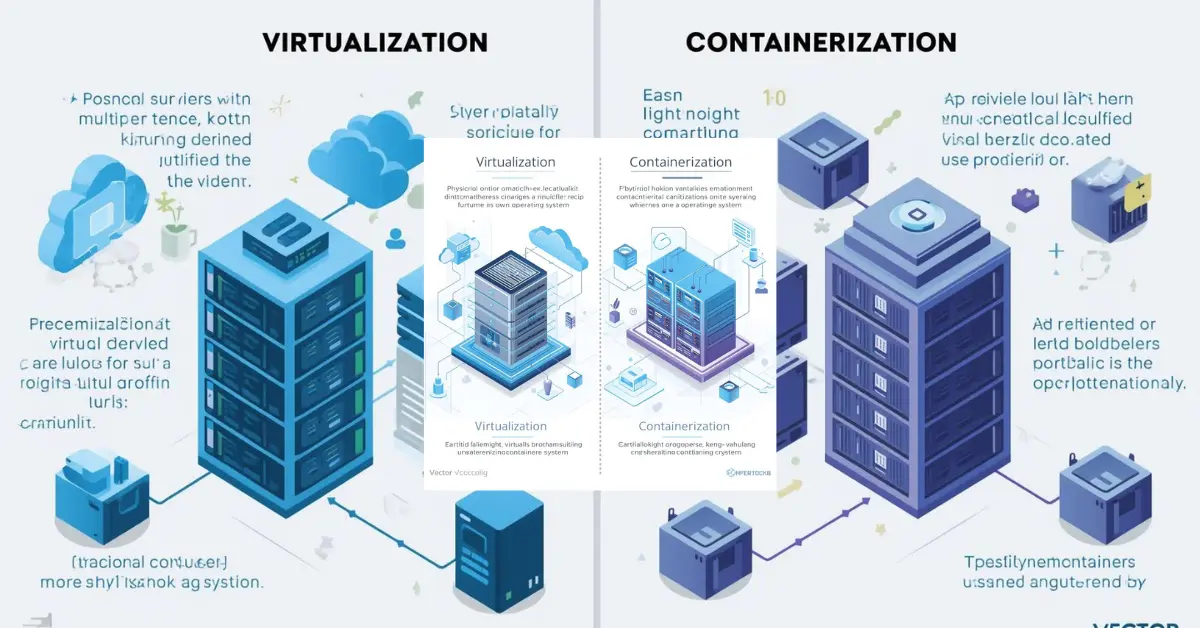
Virtualization creates completely separate virtual machines on one physical server, much like independent offices in a building. Containerization, on the other hand, allows applications to share the same operating system while keeping their environments isolated—similar to coworkers sharing the same office floor but using separate desks and equipment.
Understanding the difference between virtualization and containerization is essential in modern technology because both methods help organizations run multiple applications efficiently on the same hardware. While virtualization focuses on creating full virtual systems, containerization emphasizes lightweight application environments.
The difference between virtualization and containerization becomes especially important in cloud computing, DevOps, and software development. As businesses increasingly rely on digital infrastructure, learning the difference between virtualization and containerization helps both beginners and experts make smarter technology decisions.
Key Difference Between the Both
Virtualization creates full virtual machines with their own operating systems, while containerization runs applications in lightweight containers that share the host operating system.
Why Their Difference Is Necessary to Know for Learners and Experts
Knowing the difference between virtualization and containerization is important because these technologies shape modern digital infrastructure. Businesses, universities, and research institutions rely on them to run applications efficiently.
For learners, understanding these technologies builds a foundation for careers in cloud computing, cybersecurity, and software engineering. For experts, choosing the right approach affects system performance, cost, and scalability.
In society, these technologies support online banking, streaming services, healthcare systems, and education platforms. Without virtualization and containerization, many modern digital services would be slower, more expensive, and harder to manage.
Pronunciation of Both Terms
Virtualization
- US: /ˌvɝː.tʃu.ə.ləˈzeɪ.ʃən/
- UK: /ˌvɜː.tʃu.ə.laɪˈzeɪ.ʃən/
Containerization
- US: /kənˌteɪ.nɚ.ə.laɪˈzeɪ.ʃən/
- UK: /kənˌteɪ.nə.raɪˈzeɪ.ʃən/
Linking Hook
Now that we understand the basic idea, let us explore the difference between virtualization and containerization in greater detail.
H2: Difference Between Virtualization and Containerization
1. Architecture
Virtualization creates full virtual machines that include their own operating systems.
Examples:
- A company runs Windows and Linux virtual machines on the same physical server.
- A university server hosts multiple operating systems for different departments.
Containerization runs applications inside containers that share the host operating system.
Examples:
- Developers run multiple applications using containers on a Linux host.
- A web service runs several microservices in containers.
2. Resource Usage
Virtual machines consume more resources because each has its own operating system.
Examples:
- A server hosting ten VMs needs large memory and storage.
- Enterprises allocate heavy hardware resources for VM environments.
Containers are lightweight and use fewer resources.
Examples:
- Hundreds of containers can run on a single server.
- Startups deploy applications with minimal hardware.
3. Startup Speed
Virtual machines take longer to start because the operating system must boot.
Examples:
- A VM may take several minutes to become ready.
- Data centers schedule VM startup times carefully.
Containers start almost instantly.
Examples:
- A containerized web service starts within seconds.
- Developers quickly launch testing environments.
4. Isolation Level
Virtualization offers stronger isolation because each VM runs independently.
Examples:
- Banks isolate financial systems in separate VMs.
- Security teams test malware safely inside VMs.
Containerization provides lighter isolation.
Examples:
- Developers run multiple applications in containers.
- Microservices architecture uses container isolation.
5. Portability
Virtual machines are portable but larger in size.
Examples:
- A VM image may require several gigabytes of storage.
- Migrating VMs between servers takes longer.
Containers are highly portable.
Examples:
- Containers run consistently across development and production environments.
- Developers share container images quickly.
6. Performance
Virtual machines may have slightly lower performance due to virtualization overhead.
Examples:
- Some CPU power is used for managing VMs.
- Large enterprise systems use optimized hypervisors.
Containers usually provide better performance.
Examples:
- Applications run closer to native system speed.
- Microservices respond faster in container environments.
7. Scalability
Virtualization scales slower due to heavier system requirements.
Examples:
- Launching multiple VMs may take several minutes.
- Enterprises scale infrastructure gradually.
Containerization scales rapidly.
Examples:
- Cloud platforms create containers instantly during traffic spikes.
- Microservices automatically scale based on demand.
8. Deployment Method
Virtual machines require complex setup processes.
Examples:
- System administrators configure OS, storage, and network.
- Enterprises manage VM images carefully.
Containers simplify deployment.
Examples:
- Developers deploy applications with a single container image.
- Continuous integration pipelines use containers for automation.
9. Security Approach
Virtualization uses full operating system isolation.
Examples:
- Government systems run sensitive workloads in VMs.
- Security teams isolate risky applications in virtual machines.
Container security focuses on application isolation.
Examples:
- Containers use security policies to control access.
- DevOps teams monitor container activity closely.
10. Typical Use Cases
Virtualization is common in traditional enterprise infrastructure.
Examples:
- Legacy enterprise applications run on VMs.
- IT departments use virtualization for server consolidation.
Containerization is popular in cloud-native development.
Examples:
- Microservices architecture uses containers.
- Continuous deployment pipelines rely on container technology.
Nature and Behaviour of Both
Virtualization behaves like a complete computing environment. It focuses on system-level abstraction and allows multiple operating systems to run on one physical machine.
Containerization behaves as an application-level solution. It isolates applications but still depends on the host operating system, making it lightweight and fast.
Why People Are Confused About Their Use
People often confuse virtualization and containerization because both technologies allow multiple workloads to run on the same physical server. They also improve efficiency and resource usage. Additionally, modern cloud platforms sometimes combine both technologies, which makes the difference less obvious to beginners.
Table: Difference and Similarity Between Virtualization and Containerization
| Aspect | Virtualization | Containerization | Similarity |
| Operating System | Each VM has its own OS | Containers share host OS | Both isolate workloads |
| Resource Usage | High | Low | Both improve efficiency |
| Speed | Slower startup | Faster startup | Both run multiple apps |
| Size | Large VM images | Small container images | Both portable |
| Use Case | Traditional infrastructure | Cloud-native apps | Both used in cloud computing |
Which Is Better in What Situation?
Virtualization is better when organizations need strong security and the ability to run multiple operating systems. Enterprises running legacy applications or testing different OS environments benefit from virtualization.
Containerization is better when speed, scalability, and efficient resource usage are required. Modern software development, especially microservices and DevOps pipelines, relies heavily on containers because they deploy applications quickly and consistently.
Metaphors and Similes
- Virtualization is like building separate houses on the same land.
- Containerization is like apartments sharing the same building.
- Virtual machines work like independent computers inside a computer.
- Containers run like lightweight boxes carrying applications.
Connotative Meaning
Virtualization
- Positive: flexibility, system independence
Example: “The company used virtualization to run different systems efficiently.” - Neutral: technical infrastructure
Example: “Virtualization is common in data centers.”
Containerization
- Positive: speed, efficiency, modern technology
Example: “Containerization helped the startup scale quickly.” - Neutral: software deployment method
Example: “Containerization is used in DevOps environments.”
Idioms or Proverbs Related to the Words
Direct idioms are rare, but related expressions exist.
- “Don’t put all your eggs in one basket.”
Example: Companies use virtualization to distribute workloads. - “Think outside the box.”
Example: Developers use containerization to create flexible systems.
Works in Literature Featuring the Keywords
- Virtualization in Cloud Computing — Technical guide, Rajkumar Buyya, 2013
- Containerization with Docker — Technology guide, Nigel Poulton, 2017
- The Art of Virtualization — Computer science book, various authors, 2015
Movies Related to the Concepts
- The Matrix (1999, USA) – explores simulated virtual environments similar to virtualization ideas
- Tron (1982, USA) – depicts digital worlds inside computers
Frequently Asked Questions
1. What is the main difference between virtualization and containerization?
Virtualization creates full virtual machines, while containerization runs lightweight application containers.
2. Which technology is faster?
Containerization is usually faster because containers start quickly.
3. Can virtualization and containerization work together?
Yes, many cloud platforms run containers inside virtual machines.
4. Which is more secure?
Virtualization generally provides stronger isolation.
5. Which is better for modern applications?
Containerization is preferred for microservices and cloud-native development.
How Both Are Useful for Surroundings
Virtualization and containerization help businesses reduce hardware costs and energy consumption. They allow organizations to run multiple applications efficiently on fewer servers, which reduces electricity usage and environmental impact. They also support online services used in education, healthcare, and communication.
Final Words for Both
Virtualization and containerization are essential technologies that support the digital world. Each serves a different purpose, but together they create powerful and efficient computing systems.
Conclusion
Understanding the difference between virtualization and containerization helps individuals and organizations make informed technology choices. Virtualization focuses on creating full virtual systems with independent operating systems, while containerization provides lightweight environments for running applications quickly and efficiently.
Both technologies improve resource utilization, scalability, and flexibility in modern computing environments. As businesses continue to rely on cloud computing and software automation, the importance of these technologies will only grow. By learning how they differ and where each one works best, developers, IT professionals, and students can better understand the foundation of modern digital infrastructure.

I’m BeaconRise, the author behind GrammarCircle, where I help readers understand English grammar, language differences, and writing concepts in a simple and practical way. I specialize in explaining confusing words, grammar rules, and “difference between” topics so learners can easily improve their writing and communication skills.