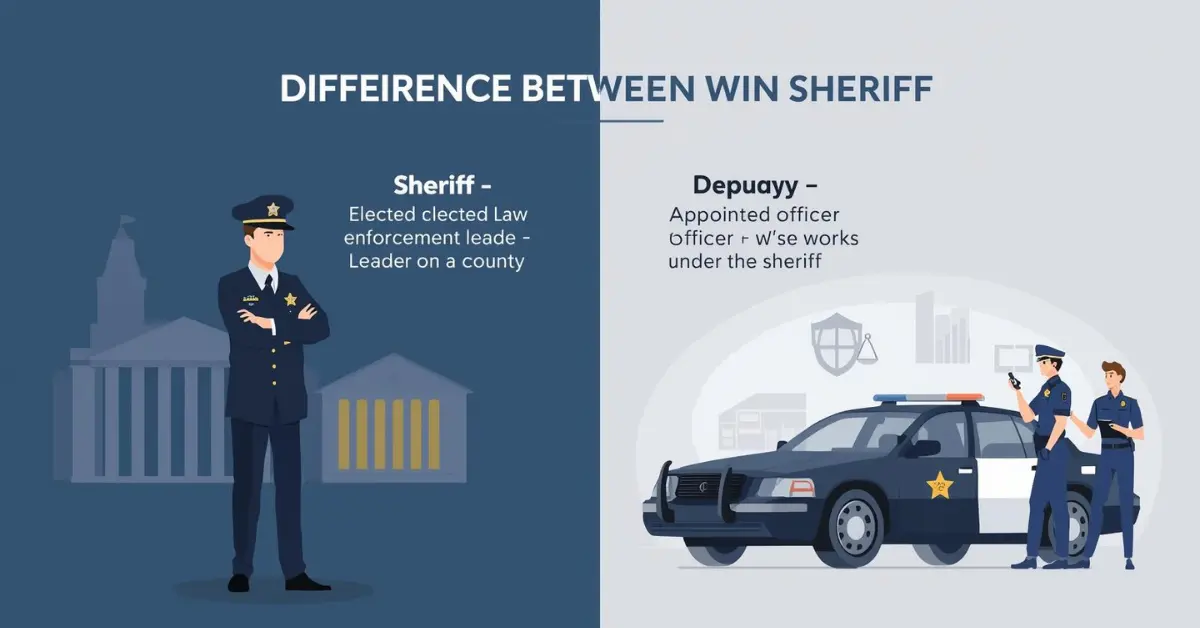
Imagine a small town in the heart of Texas. The streets are quiet, but law and order must be maintained. Here, the sheriff is the highest-ranking law enforcement officer responsible for the entire county, while a deputy serves under the sheriff, assisting in daily duties and enforcement.
Understanding the difference between deputy and sheriff helps clarify who holds decision-making power and who supports operations. Many people confuse the two, especially when watching movies or reading crime novels.
By exploring the difference between deputy and sheriff, we can appreciate how law enforcement operates efficiently and safely in our communities. This knowledge is vital for learners, writers, and experts in law and civic studies alike.
Pronunciation:
- Deputy: /ˈdɛpjʊti/ (US & UK)
- Sheriff: /ˈʃɛrɪf/ (US & UK)
Understanding this distinction sets the stage for exploring their responsibilities, behavior, and societal importance.
Difference Between Deputy and Sheriff
Here are 10 key differences explained with examples:
- Rank & Authority
- Sheriff: The highest-ranking officer in a county; can make executive decisions.
- Example 1: The sheriff decided to implement a new neighborhood patrol program.
- Example 2: During emergencies, the sheriff coordinates all law enforcement agencies.
- Deputy: Works under the sheriff, follows orders, limited authority.
- Example 1: A deputy arrests a suspect under the sheriff’s direction.
- Example 2: Deputies manage routine traffic control.
- Sheriff: The highest-ranking officer in a county; can make executive decisions.
- Election vs Appointment
- Sheriff: Typically elected by the public.
- Example 1: The town voted for a new sheriff last November.
- Example 2: Sheriffs often campaign like politicians.
- Deputy: Usually appointed or hired by the sheriff.
- Example 1: The sheriff appointed a deputy to oversee the evening shift.
- Example 2: Deputies cannot run for sheriff unless elected separately.
- Sheriff: Typically elected by the public.
- Jurisdiction
- Sheriff: Entire county jurisdiction.
- Example 1: The sheriff oversees all law enforcement in the county.
- Example 2: County-wide investigations fall under the sheriff.
- Deputy: Assigned specific areas or tasks within the county.
- Example 1: A deputy patrols a designated neighborhood.
- Example 2: Deputies investigate minor incidents in their sector.
- Sheriff: Entire county jurisdiction.
- Decision-Making
- Sheriff: Makes strategic and administrative decisions.
- Example 1: Sheriff decides to allocate resources to rural areas.
- Example 2: Sheriff approves departmental policies.
- Deputy: Follows directives, executes operational tasks.
- Example 1: Deputy enforces parking rules according to sheriff’s guidelines.
- Example 2: Deputy files reports on incidents to the sheriff.
- Sheriff: Makes strategic and administrative decisions.
- Salary & Benefits
- Sheriff: Higher salary due to responsibility.
- Example 1: The sheriff earns more than deputies due to administrative duties.
- Example 2: The sheriff’s benefits include county-funded security.
- Deputy: Lower pay, fewer administrative benefits.
- Example 1: Deputies receive standard law enforcement pay.
- Example 2: Deputy overtime depends on sheriff’s orders.
- Sheriff: Higher salary due to responsibility.
- Public Interaction
- Sheriff: Often interacts with media and public officials.
- Example 1: Sheriff held a press conference about a county-wide alert.
- Example 2: Sheriff attends community safety meetings.
- Deputy: Regular community engagement in patrol or support roles.
- Example 1: Deputy attends neighborhood watch meetings.
- Example 2: Deputy assists citizens with minor complaints.
- Sheriff: Often interacts with media and public officials.
- Training & Experience
- Sheriff: Usually extensive law enforcement experience required.
- Example 1: The sheriff had 20 years in police work before election.
- Example 2: Experienced in crisis management and leadership.
- Deputy: Trained for operational duties; less experience needed.
- Example 1: New deputy completes academy training before active duty.
- Example 2: Deputies shadow experienced officers initially.
- Sheriff: Usually extensive law enforcement experience required.
- Legal Authority
- Sheriff: Authority over deputies, courts, and county jails.
- Example 1: Sheriff authorizes arrests and manages county jail operations.
- Example 2: Sheriff issues warrants in certain jurisdictions.
- Deputy: Limited authority; operates under sheriff’s jurisdiction.
- Example 1: Deputy delivers court summons.
- Example 2: Deputy serves legal notices in the county.
- Sheriff: Authority over deputies, courts, and county jails.
- Representation in Media
- Sheriff: Often shown as the central authority figure.
- Example 1: Movies depict sheriffs making tough moral decisions.
- Example 2: Literature shows sheriffs leading town protection.
- Deputy: Shown as supporting or side characters.
- Example 1: Deputy assists in high-speed chases.
- Example 2: Deputy provides backup to the sheriff.
- Sheriff: Often shown as the central authority figure.
- Public Perception
- Sheriff: Seen as leader, decision-maker, or symbol of authority.
- Example 1: Citizens rely on sheriff for safety advice.
- Example 2: Sheriff represents law enforcement in public events.
- Deputy: Viewed as diligent enforcer of laws.
- Example 1: Deputy is respected for handling emergencies efficiently.
- Example 2: Deputy gains recognition for community service.
- Sheriff: Seen as leader, decision-maker, or symbol of authority.
Nature and Behaviour
- Sheriff: Authoritative, strategic, responsible for long-term planning.
- Deputy: Practical, action-oriented, focused on day-to-day enforcement.
Why People Are Confused
Many confuse deputy and sheriff because movies, TV shows, and books often portray deputies performing high-level decisions, overshadowing the sheriff’s role.
Comparison Table
| Feature | Sheriff | Deputy | Similarity |
| Rank | Highest in county | Works under sheriff | Both law enforcement officers |
| Authority | Full administrative control | Limited authority | Both enforce laws |
| Election/Appoint | Elected | Appointed by sheriff | Both require legal training |
| Jurisdiction | Entire county | Assigned area | Both operate in counties |
| Public Interaction | High-level, media-focused | Community engagement | Both interact with citizens |
| Pay & Benefits | Higher | Lower | Both receive law enforcement pay |
| Decision Making | Strategic | Operational | Both implement law policies |
| Legal Authority | Courts, jails, deputies | Executes sheriff orders | Both carry law enforcement powers |
| Media Representation | Central figure | Supporting figure | Both appear in media |
| Perception | Leader, symbol | Enforcer, helper | Both respected in society |
Which is Better in What Situation?
- Sheriff: Best in administrative, leadership, or crisis management roles. For example, managing a county-wide emergency or coordinating multiple law enforcement units.
- Deputy: Best in operational, fieldwork, and community support. Deputies are essential in traffic enforcement, arrests, and day-to-day policing.
Metaphors and Similes
- Sheriff: “The sheriff of the town” → symbolizes ultimate authority.
- Deputy: “Faithful deputy” → symbolizes loyal support.
Connotation:
- Sheriff → Positive (leadership, trust)
- Deputy → Neutral to Positive (helpful, reliable)
Idioms / Proverbs
- “Every sheriff has his deputy” → implies leaders always have supporters.
- Example: In the project team, every leader has a deputy to handle tasks efficiently.
Works in Literature
- The Sheriff of Nottingham – Historical Fiction, Anonymous, 1883
- A Deputy’s Tale – Crime Fiction, John Harris, 1999
Movies
- Sheriff of Tombstone (1941, USA)
- Deputy Dawg (1960, USA – animated)
FAQs
- Can a deputy become a sheriff?
Yes, by running in a county election. - Are deputies always under a sheriff?
Yes, they operate under the sheriff’s authority. - Do sheriffs work in cities?
Usually, they work in counties; city law enforcement has police chiefs. - Which has more power legally?
Sheriff, due to executive authority. - Why are they often confused in media?
Media often exaggerates deputies’ roles.
How Both Are Useful for Surroundings
- Sheriff: Maintains county-wide law, public safety, and jail administration.
- Deputy: Handles daily enforcement, patrols, community support, and immediate response.
Final Words for Both
Understanding the difference between deputy and sheriff ensures appreciation for their unique roles. Both are essential for law enforcement and community safety.
Conclusion
The difference between deputy and sheriff lies in rank, authority, duties, and public perception. Sheriffs lead, make decisions, and manage entire counties, while deputies support, enforce laws, and ensure smooth daily operations. Recognizing their distinction clarifies media portrayals, improves civic knowledge, and helps learners and experts appreciate law enforcement structure.
If you’re watching a crime movie, reading a novel, or studying law, understanding who does what in a county ensures accurate comprehension and respect for these essential public servants. Both roles, though different, are interdependent, maintaining law, order, and societal trust.

Hi, I’m DreamAnchor, the author behind GrammarCircle. I am passionate about language, writing, and helping people understand the small but important differences in English words and concepts. Through my work, I focus on explaining grammar rules, word comparisons, and language usage in a simple and practical way so that students, writers, and professionals can improve their communication skills.