Imagine Sarah, a business executive, who wants to advance her career. She finds herself torn between pursuing a DBA (Doctor of Business Administration) or a PhD (Doctor of Philosophy). Both are prestigious doctoral degrees, but they serve very different purposes.
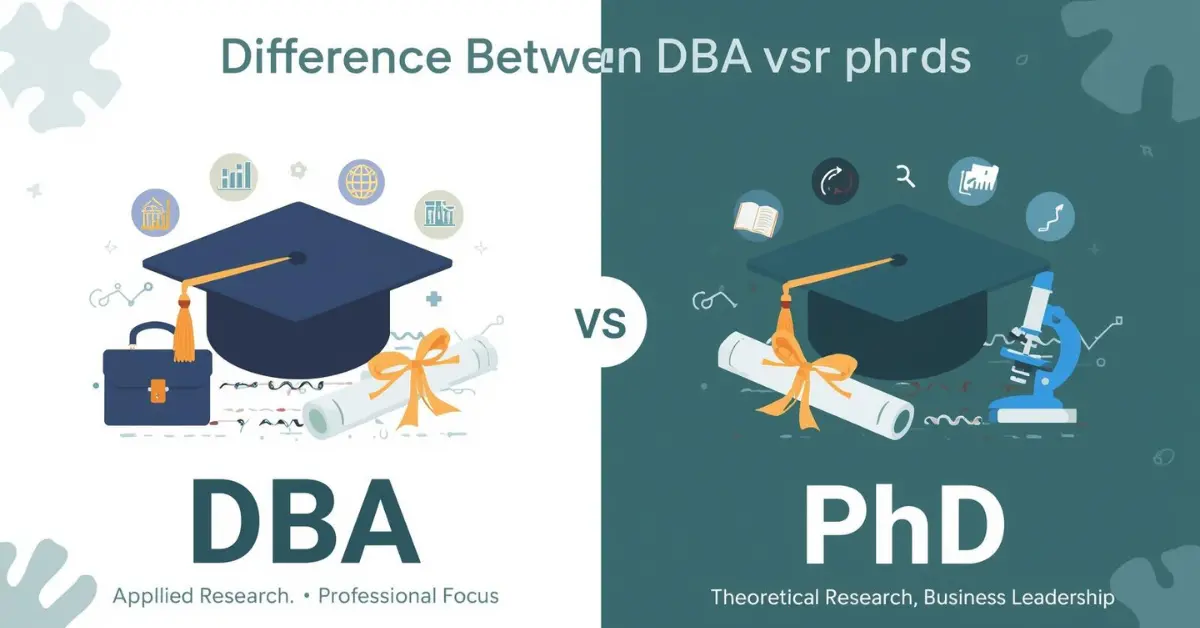
The difference between DBA and PhD often confuses learners and professionals because both involve research, critical thinking, and a deep understanding of a field. However, while a PhD focuses on theoretical knowledge and contributing to academic literature, a DBA emphasizes applying research to solve real-world business problems.
Understanding the difference between DBA and PhD is crucial for making career choices, guiding students, and shaping organizations. In this article, we will explore this distinction, pronunciation, key differences, and practical applications of both degrees.
Pronunciation:
- DBA: /ˌdiː.biːˈeɪ/ (US & UK)
- PhD: /ˌpiː.eɪtʃˈdiː/ (US & UK)
Let’s dive deeper to uncover the nuances and significance of these degrees in real-world scenarios.
H2: Key Difference Between DBA and PhD
1. Purpose of the Degree
- DBA: Focused on applying research to practical business problems.
- Example 1: A DBA student implements a new marketing strategy for a company.
- Example 2: Research on improving operational efficiency in a multinational firm.
- PhD: Focused on generating new theoretical knowledge.
- Example 1: A PhD student develops a new economic model.
- Example 2: Research on abstract concepts in organizational behavior.
2. Nature of Research
- DBA: Applied research, solving practical issues.
- Example: Case studies in a corporate project.
- PhD: Theoretical and conceptual research.
- Example: Developing frameworks for future academic studies.
3. Career Path
- DBA: Senior management, consulting, business leadership.
- Example: CEO of a startup.
- PhD: Academia, research institutions, scholarly publishing.
- Example: University professor.
4. Duration of Study
- DBA: Typically 3–5 years.
- Example: Part-time while working.
- PhD: Typically 4–7 years.
- Example: Full-time research track.
5. Curriculum Focus
- DBA: Practical applications, case studies, leadership skills.
- PhD: Theory, methodology, academic publications.
6. Dissertation Approach
- DBA: Solves real-world business problems.
- PhD: Contributes original knowledge to the field.
7. Student Profile
- DBA: Experienced professionals seeking practical expertise.
- PhD: Academically oriented candidates aiming for research careers.
8. Industry vs Academia
- DBA: Direct impact on corporate strategies.
- PhD: Expands knowledge for academic purposes.
9. Networking Opportunities
- DBA: Industry connections and business networks.
- PhD: Academic peers, conferences, and publications.
10. Outcome and Recognition
- DBA: Leadership roles, consultancy, applied expertise.
- PhD: Research recognition, scholarly publications, teaching roles.
Nature and Behavior
- DBA: Action-oriented, practical, solution-focused.
- PhD: Inquiry-driven, analytical, knowledge-expanding.
Why People Are Confused
Both involve research, use similar terminologies, and require high academic rigor, making learners question which fits their career goals.
Table: Difference and Similarity Between DBA and PhD
| Feature | DBA (Doctor of Business Admin) | PhD (Doctor of Philosophy) | Similarity |
| Purpose | Practical business application | Theoretical knowledge | Both are doctoral degrees |
| Research Type | Applied | Conceptual/Theoretical | Requires research skills |
| Career Focus | Industry leaders, consultants | Academia, researchers | High-level expertise |
| Duration | 3–5 years | 4–7 years | Both require dedication and commitment |
| Dissertation | Solves real problems | Generates new knowledge | Must defend a dissertation |
| Curriculum | Practical cases, leadership | Academic theory, methodology | Critical thinking required |
| Student Profile | Experienced professionals | Academic-focused individuals | Commitment to study |
| Networking | Industry connections | Academic networks | Opportunity for growth |
| Outcome | Leadership, consultancy | Academic publishing | Respected in respective fields |
| Focus | Action-oriented | Knowledge-oriented | Doctoral level rigor |
Which is Better in What Situation?
- DBA: Ideal for professionals wanting to implement strategic solutions in business. It’s perfect for executives seeking leadership roles or consultants aiming to influence corporate practices.
- PhD: Best for scholars and researchers who aim to create theoretical frameworks, teach at universities, or publish in academic journals.
Metaphors and Similes
- DBA: “A DBA is like a captain steering a ship through real-world challenges.”
- PhD: “A PhD is like a scientist discovering new stars in the universe of knowledge.”
Connotative Meaning:
- DBA: Positive, practical, action-oriented.
- PhD: Positive, intellectual, knowledge-driven.
Idioms/Proverbs Related:
- “Knowledge is power” – applies to both DBA and PhD; DBA applies knowledge, PhD generates knowledge.
- “Practice makes perfect” – DBA, emphasizing application.
Works in Literature
- The DBA Handbook, John Smith, 2015, Business Education
- The Philosophy of Research, Mary Johnson, 2012, Academic Guide
Movies Inspired by the Concepts
- The Social Network (2010, USA) – Entrepreneurship, DBA-like problem-solving
- A Beautiful Mind (2001, USA) – Theoretical genius, PhD concept
Frequently Asked Questions
- What is the main difference between DBA and PhD?
- DBA is applied research; PhD is theoretical research.
- Which is better for business leadership?
- DBA focuses on practical leadership.
- Can a PhD work in corporate settings?
- Yes, but usually in research or strategic planning roles.
- Is a DBA easier than a PhD?
- Not easier; DBA is practical, PhD is theoretical.
- Do both require a dissertation?
- Yes, but DBA solves practical problems, PhD contributes new knowledge.
How Both Are Useful for Surroundings
- DBA: Helps improve businesses, enhance economy, and provide actionable insights.
- PhD: Contributes to education, scientific progress, and policy-making.
Final Words
Both DBA and PhD are prestigious degrees, but the choice depends on your career goals. A DBA prepares you to solve practical problems in the corporate world, while a PhD equips you to contribute to knowledge and research in academia.
Conclusion
Understanding the difference between DBA and PhD is essential for students, professionals, and society. While both degrees require dedication, research skills, and intellectual rigor, they serve different purposes.
The DBA focuses on applying theory to real-world problems, making it ideal for business leaders. The PhD emphasizes generating new knowledge, perfect for academics and researchers. By recognizing these distinctions, learners can make informed decisions that align with their career aspirations and contribute meaningfully to society.

I’m BeaconRise, the author behind GrammarCircle, where I help readers understand English grammar, language differences, and writing concepts in a simple and practical way. I specialize in explaining confusing words, grammar rules, and “difference between” topics so learners can easily improve their writing and communication skills.