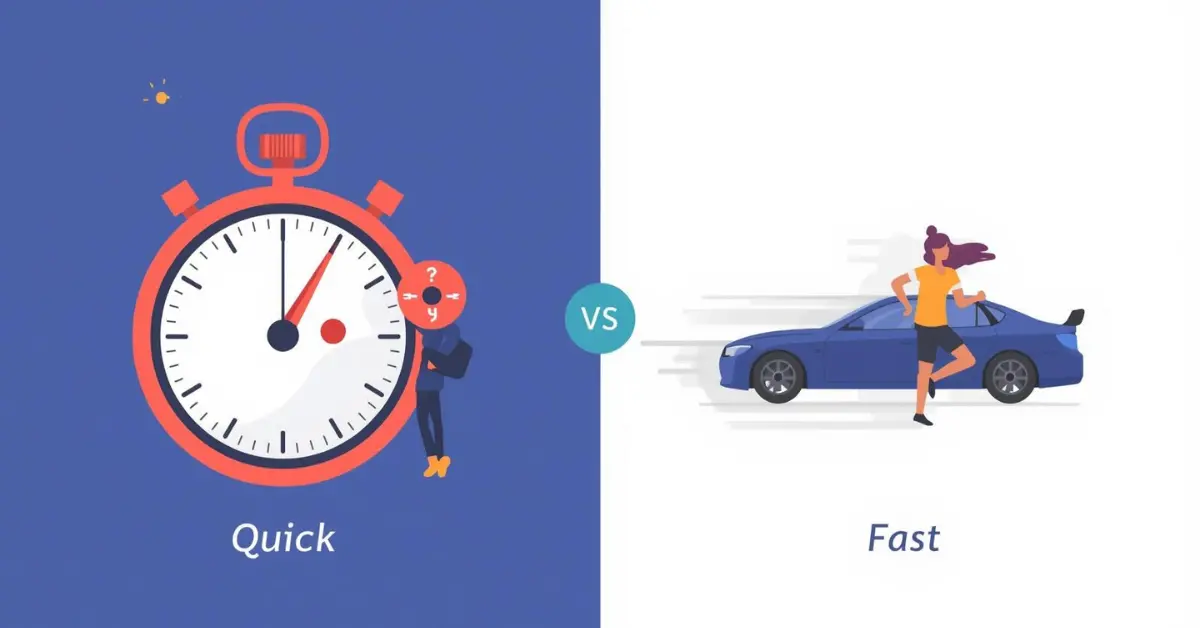
Have you ever watched a cheetah dart across the savannah or seen a barista quickly serve a coffee in a busy café? These real-world scenarios perfectly illustrate the difference between quick and fast. While people often use them interchangeably, understanding the distinction can sharpen your communication and enhance clarity.
Quick often emphasizes speed in response or action, while fast focuses on high velocity or rate of movement. Knowing the difference between quick and fast is essential not just for learners but also for experts who want precise language use in writing or speech.
By the end of this article, you’ll understand not only the subtle nuances of quick and fast but also how they impact expression in society and everyday life.
Pronunciation:
- Quick – US: /kwɪk/, UK: /kwɪk/
- Fast – US: /fæst/, UK: /fɑːst/
Understanding these nuances acts as a bridge to exploring their differences more deeply.
Difference Between Quick and Fast
10 Key Differences Between Quick and Fast
- Meaning & Usage
- Quick: Refers to promptness or speed in doing something.
Example 1: She gave a quick reply to the email.
Example 2: He made a quick decision to avoid the accident. - Fast: Refers to high speed of motion or travel.
Example 1: The train is very fast and reaches the city in two hours.
Example 2: He runs fast in every competition.
- Quick: Refers to promptness or speed in doing something.
- Time vs Motion
- Quick is often about short time duration.
Example 1: I need a quick shower before work.
Example 2: The quick turnaround helped the project succeed. - Fast is about speed of movement.
Example 1: The fast car zoomed past the highway.
Example 2: She swims fast in competitions.
- Quick is often about short time duration.
- Mental vs Physical
- Quick can refer to mental reactions.
Example 1: He’s a quick thinker during debates.
Example 2: Quick learners adapt faster to change. - Fast usually refers to physical speed.
Example 1: The fast cheetah chased its prey.
Example 2: Fast athletes often win races.
- Quick can refer to mental reactions.
- Temporary vs Continuous
- Quick is often short-term or momentary.
Example 1: Take a quick glance at the chart.
Example 2: She made a quick note of the meeting points. - Fast implies continuous or sustained speed.
Example 1: The fast train maintained its speed for hours.
Example 2: He runs fast consistently.
- Quick is often short-term or momentary.
- Intensity
- Quick is about immediacy, not intensity.
Example 1: A quick response shows attentiveness.
Example 2: He gave a quick nod of agreement. - Fast can imply high intensity or force.
Example 1: The fast river current swept everything away.
Example 2: The fast wind bent the trees.
- Quick is about immediacy, not intensity.
- Adjective Placement
- Quick often appears before nouns.
Example 1: He made a quick decision.
Example 2: She gave a quick smile. - Fast can appear after linking verbs.
Example 1: The car is fast.
Example 2: She runs fast.
- Quick often appears before nouns.
- Figurative Use
- Quick is used metaphorically for mental agility.
Example 1: He has a quick wit.
Example 2: Quick thinking can save lives. - Fast can describe strong attachment or loyalty.
Example 1: He is fast friends with everyone.
Example 2: They have a fast bond with the community.
- Quick is used metaphorically for mental agility.
- Collocations
- Quick → quick glance, quick decision, quick response.
- Fast → fast car, fast runner, fast lane.
- Confusion Source
People confuse them because both indicate speed, but one is about time/action (quick), and the other is about velocity (fast). - Cultural/Language Impact
- Quick is valued in professional and social settings for efficiency.
- Fast is admired in sports, technology, and transportation for performance.
Nature and Behavior
- Quick: Flexible, adaptive, mentally agile, reactive.
- Fast: Powerful, continuous, measurable, often physical.
Table of Differences and Similarities
| Feature | Quick | Fast | Similarity |
| Focus | Speed of action | Speed of movement | Both indicate speed |
| Duration | Short-term | Sustained | |
| Type | Mental & physical | Mostly physical | |
| Usage in speech | Before nouns, adverbs | After linking verbs | Both are adjectives/adverbs |
| Figurative meaning | Mental agility | Intensity, loyalty | Both can be metaphorical |
| Examples | Quick decision, quick glance | Fast car, fast runner |
When to Use Quick and Fast
Quick: Use when emphasizing efficiency, rapid decision-making, or brief actions. For example, in workplaces, a quick response can prevent delays.
Fast: Use when emphasizing movement, velocity, or performance. Athletes, vehicles, and technology often use “fast” to show speed and power.
Use in Metaphors and Similes
- Quick: “As quick as a flash” – mental agility or brief action.
- Fast: “Runs as fast as the wind” – physical speed or motion.
Connotative Meaning:
- Quick → Neutral/Positive: quick learner, quick response.
- Fast → Positive: fast car, fast athlete; Negative: fast decision (rash).
Idioms and Proverbs
- Quick: “Quick on the draw” → ready to act swiftly.
Example: He was quick on the draw during the negotiation. - Fast: “Make fast friends” → form a strong attachment quickly.
Example: They made fast friends on their first trip.
Keywords in Literature
- Quick → “Quick Change” (Drama, Paul Coates, 1995)
- Fast → “Fast Food Nation” (Non-fiction, Eric Schlosser, 2001)
Keywords in Movies
- Quick → “Quick” (Action, 2020, USA)
- Fast → “Fast & Furious” (Action, 2001, USA)
FAQs
- Can quick and fast be used interchangeably?
Rarely. Quick is for action/time; fast is for speed/motion. - Is “quickly” the same as “fast”?
No, quickly emphasizes speed of action; fast emphasizes speed of movement. - Which is better for describing mental ability?
Quick is better. - Which is better for physical speed?
Fast is more appropriate. - Why do learners get confused?
Both indicate speed, but context (action vs motion) changes meaning.
How Both Are Useful for Surroundings
Quick thinking saves time, improves efficiency, and resolves problems. Fast movement enhances performance in sports, transport, and emergency situations. Both improve daily life when applied correctly.
Final Words
Understanding the difference between quick and fast elevates your English proficiency, helps you communicate clearly, and ensures that you choose the right word in every scenario.
Conclusion
While “quick” emphasizes promptness and mental agility, “fast” focuses on speed and performance. By mastering their usage, writers, speakers, and learners can communicate more effectively.
Recognizing context, connotation, and collocations ensures precision, If in literature, conversation, or professional writing. Using both words accurately also enhances clarity, prevents misunderstandings, and enriches language skills. In everyday life, the difference impacts how we perceive action and motion, making your English both fluent and nuanced

Hi, I’m LunarCrest, the author behind GrammarCircle. I’m passionate about language, writing, and helping people understand the finer details of English. Through my work, I focus on explaining grammar rules, word differences, and language concepts in a simple and practical way.