In our fast-paced modern world, terms like mental and psychological are often used interchangeably. Imagine a student struggling before an important exam. We might say they are facing mental stress, or that their psychological state is fragile.
Both phrases seem similar, but their usage and meaning subtly differ. Understanding the difference between mental and psychological is crucial, not only for students but also for professionals in health, education, and social work.
The words are deeply linked to how we perceive thoughts, emotions, and behaviors. By exploring the difference between mental and psychological, we can communicate more clearly and address well-being more effectively.
Pronunciation:
- Mental: /ˈmen.təl/ (US & UK)
- Psychological: /ˌsaɪ.kəˈlɒdʒ.ɪ.kəl/ (UK), /ˌsaɪ.kəˈlɑː.dʒɪ.kəl/ (US)
Understanding these terms opens the door to better mental health awareness and a clearer grasp of human behavior. Let’s dive deeper into their distinct meanings and uses.
H2: Difference Between Mental and Psychological
1. Definition
- Mental: Relates to the mind, intellect, or cognitive functions.
- Example 1: He has a strong mental ability to solve complex problems.
- Example 2: Meditation can improve your mental focus.
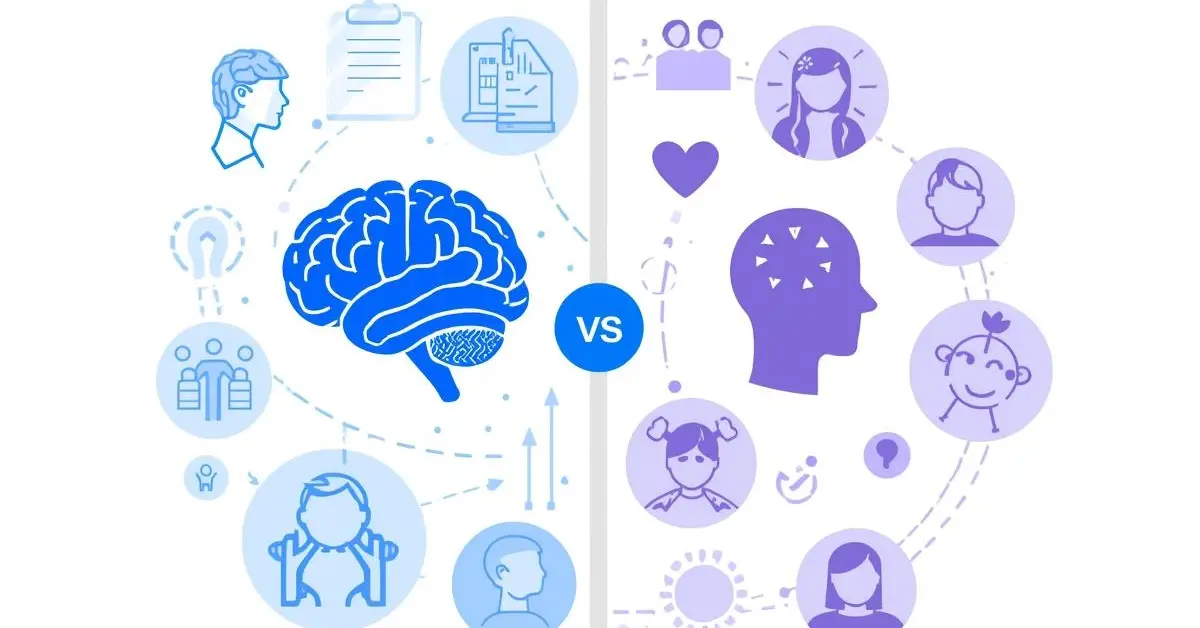
- Psychological: Relates to the mind but specifically focuses on emotions, behaviors, and thought patterns.
- Example 1: She has a psychological fear of public speaking.
- Example 2: Psychological counseling helped him cope with anxiety.
2. Scope
- Mental: Broad scope covering thinking, memory, and reasoning.
- Example: Mental arithmetic; mental planning.
- Psychological: Narrower, often linked to emotional and behavioral processes.
- Example: Psychological assessment; psychological trauma.
3. Observable vs Internal
- Mental: Often visible through performance or intellect.
- Psychological: More internal, focusing on hidden emotional states.
Examples:
- Mental: Solving puzzles tests your mental capacity.
- Psychological: Therapy explores psychological issues like phobias.
4. Usage in Medical Fields
- Mental: Refers to conditions like mental fatigue, mental disorders.
- Psychological: Refers to therapy, counseling, and behavioral studies.
5. Emotional Link
- Mental: Less emotionally oriented, more cognitive.
- Psychological: Highly linked to feelings and mental health.
6. Duration
- Mental: Can be temporary (mental block) or long-term (mental capacity).
- Psychological: Often long-term, affecting behavior over time.
7. Measurement
- Mental: IQ tests, memory exercises.
- Psychological: Psychological assessments, personality tests.
8. Context of Use
- Mental: Education, intellect, skill improvement.
- Psychological: Therapy, counseling, stress management.
9. Societal Understanding
- Mental: Easily recognized and talked about publicly.
- Psychological: Often stigmatized or misunderstood.
10. Interchangeability Confusion
- People confuse them because both relate to the mind.
- Mental often implies brain capacity, psychological implies behavior and emotions.
Nature and Behavior
- Mental: Analytical, cognitive, and logical. Example: Solving math problems requires mental focus.
- Psychological: Emotional, behavioral, and sensitive. Example: Coping with grief requires psychological support.
Why People Are Confused
Both words describe the mind. Mentalism is often seen as general intelligence, while psychology deals with deeper emotional and behavioral aspects. Misuse happens in casual conversations, media, and even professional settings.
Table: Differences and Similarities
| Feature | Mental | Psychological | Similarity |
| Focus | Cognition, intellect | Emotions, behavior | Both relate to the mind |
| Usage | Education, intellect | Therapy, behavior | Can describe human condition |
| Measurement | IQ, memory tests | Counseling, assessments | Both assessed in psychology |
| Emotional Link | Low | High | Both influence well-being |
| Scope | Broad | Narrow | Both affect life decisions |
Which Is Better in What Situation?
- Mental: Best for learning, problem-solving, and cognitive tasks. For example, students preparing for exams need strong mental focus.
- Psychological: Best for emotional well-being, therapy, and understanding behaviors. For instance, counseling addresses psychological stress and trauma.
Use in Metaphors and Similes
- Mental: “Sharp as a mental blade”
- Psychological: “Fragile as a psychological glass”
Connotative Meanings
- Mental: Neutral to positive. Example: Mental strength, mental agility.
- Psychological: Neutral to negative. Example: Psychological distress, psychological trauma.
Idioms and Proverbs
- “A sound mind in a sound body” (mental health)
- “Mind over matter” (mental strength)
- “It’s all in your head” (psychological perception)
Works in Literature
- The Mentalist (Novel, Patrick Jane, 2005) – Psychological thriller
- Psychological Games (Fiction, Eric Berne, 1964) – Non-fiction, psychology
Movies
- A Beautiful Mind (2001, USA) – Focus on mental and psychological struggles
- Inside Out (2015, USA) – Psychological and emotional journey
FAQs
- Are mental and psychological the same?
No, mental relates to intellect; psychology relates to emotions and behavior. - Can mental issues be psychological?
Yes, mental conditions often have psychological components. - Which is more serious, mental or psychological?
Both can be serious depending on context; psychology often impacts behavior long-term. - Can therapy improve mental capacity?
Therapy mainly improves psychological well-being, which indirectly supports mental performance. - Why is the distinction important?
Using the correct term ensures clear communication in education, medicine, and counseling.
How Both Are Useful for Surroundings
- Mental clarity helps in productivity, decision-making, and education.
- Psychological understanding fosters empathy, emotional health, and societal harmony.
Final Words
Understanding the difference between mental and psychological empowers communication, education, and personal well-being. Recognizing the nuances allows society to address intellect and emotions effectively.
Conclusion
The distinction between mental and psychological is subtle yet significant. While mental relates to intellect, reasoning, and cognitive functions, psychology focuses on emotions, behavior, and thought patterns. Both are crucial for personal development, mental health, and societal well-being.
By understanding the difference, educators, counselors, and professionals can provide more effective support. In everyday life, knowing when to use mental or psychological information enhances clarity and empathy. Ultimately, both terms are intertwined, shaping how we perceive ourselves and interact with others.

I’m BeaconRise, the author behind GrammarCircle, where I help readers understand English grammar, language differences, and writing concepts in a simple and practical way. I specialize in explaining confusing words, grammar rules, and “difference between” topics so learners can easily improve their writing and communication skills.