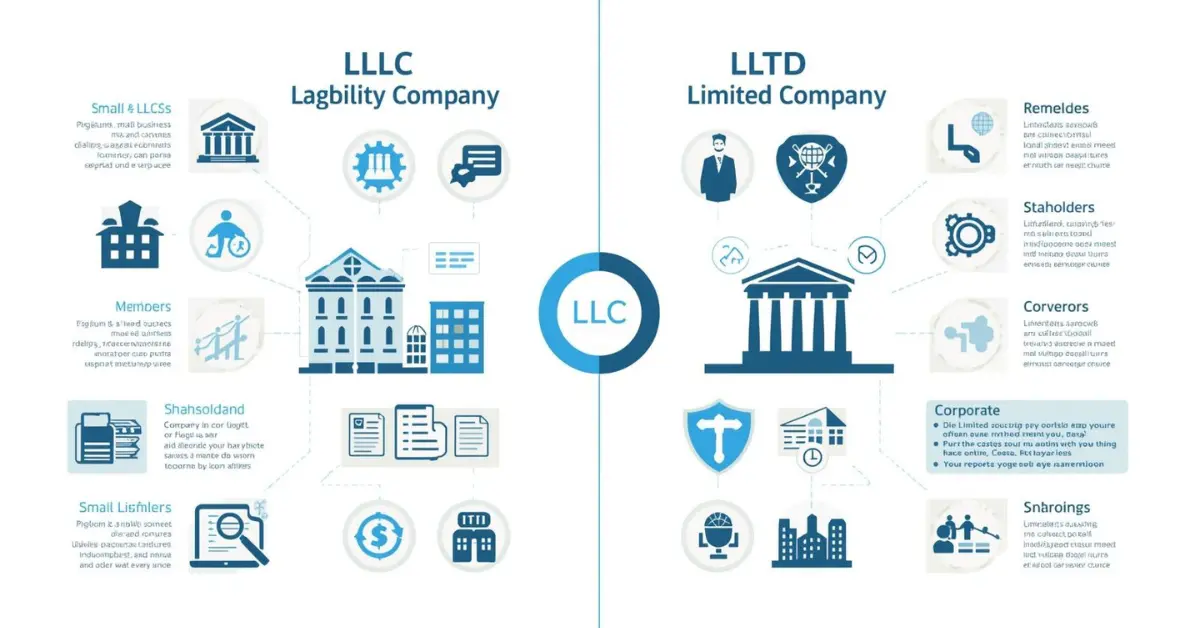
Starting a business often comes with a maze of legal terms, and two of the most commonly confused ones are LLC and LTD. Imagine two friends, Sara in the US and Tom in the UK, both planning to start tech companies. Sara’s advisor recommended registering as an LLC, while Tom suggested forming an LTD.
Though they sounded similar, the underlying legal structures, taxation, and liability rules were different. Understanding the difference between LLC and LTD isn’t just for lawyers—it helps entrepreneurs make informed decisions, ensuring protection of personal assets, smooth operations, and compliance with local regulations. The terms LLC and LTD may seem interchangeable, but knowing the difference between LLC and LTD can save future business headaches and provide clarity in contracts, investments, and global collaborations.
Pronunciation:
- LLC – US: /ˌɛl ˌɛl ˈsi/ | UK: /ˌɛl ˌɛl ˈsi/
- LTD – US: /ˌɛl ˌtiː ˈdiː/ | UK: /ˌɛl ˌtiː ˈdiː/
Understanding these nuances will lead us into the detailed distinctions that separate LLC and LTD, helping you choose the best structure for your business.
H2: Difference Between LLC and LTD
Here are 10 key points highlighting the difference between LLC and LTD, with examples:
1. Legal Structure
- LLC: Flexible structure allowing one or multiple owners. Example: Sara’s tech startup in California was an LLC, protecting her personal assets. Example 2: A freelance consultant forms a single-member LLC to separate business and personal finances.
- LTD: Shareholder-owned company, limited liability for members. Example: Tom’s e-commerce firm in London became an LTD to allow investors. Example 2: A UK software firm registers as LTD to attract venture capital.
2. Liability
- LLC: Owners are protected; personal assets are safe from company debts. Example: If Sara’s LLC owed $50,000, her house remained secure. Example 2: Freelancers avoid personal liability through LLC registration.
- LTD: Shareholders’ liability is limited to their shares. Example: Tom loses only the money he invested in LTD. Example 2: Investors are not liable beyond shareholding in a UK LTD.
3. Taxation
- LLC: Can choose pass-through taxation; profits taxed at personal level. Example: Sara reports profits on a personal tax return. Example 2: Small businesses save tax with LLC flexibility.
- LTD: Company taxed separately; dividends taxed again for shareholders. Example: Tom’s LTD pays corporate tax before distributing dividends. Example 2: LTD profits taxed at company level, then shareholders pay tax.
4. Management
- LLC: Members can manage or appoint managers. Example: Sara manages her LLC directly. Example 2: LLC allows hiring a professional manager without altering ownership.
- LTD: Managed by a board of directors; shareholders may not handle day-to-day. Example: Tom appoints a board for operational decisions. Example 2: Investors elect directors in an LTD.
5. Compliance Requirements
- LLC: Minimal paperwork; simple annual reporting. Example: Sara files a basic annual report. Example 2: LLC keeps compliance simple for startups.
- LTD: More formal filings; must submit annual accounts and returns. Example: Tom submits accounts to Companies House in the UK. Example 2: LTD must maintain detailed shareholder records.
6. Ownership Transfer
- LLC: Can be flexible; may require member approval. Example: Sara’s LLC allows a friend to join as co-owner. Example 2: Selling LLC interest can be informal.
- LTD: Share transfers follow formal legal procedures. Example: Tom sells shares through official documentation. Example 2: LTD ownership transfer requires company approval.
7. Raising Capital
- LLC: Limited options; investors may prefer structured companies. Example: Sara struggled to get venture capital in LLC. Example 2: Banks may hesitate to fund LLC compared to LTD.
- LTD: Easier to attract investors and issue shares. Example: Tom’s LTD issued shares to raise £100,000. Example 2: LTD can list shares privately.
8. Global Recognition
- LLC: Widely known in the US, less recognized in UK/EU. Example: Sara’s US clients understand LLC. Example 2: UK investors may not immediately understand LLC structure.
- LTD: Recognized in UK, Europe, and Commonwealth countries. Example: Tom’s LTD gained credibility with European partners. Example 2: LTD widely used for international business.
9. Formation Costs
- LLC: Generally cheaper to establish. Example: Sara’s filing cost $200. Example 2: Single-member LLC formation is inexpensive.
- LTD: Slightly higher costs due to formal registration. Example: Tom spent £500 registering LTD. Example 2: LTD requires professional accounting setup.
10. Duration and Continuity
- LLC: May dissolve upon member exit unless specified. Example: Sara leaves, LLC may need restructuring. Example 2: Single-member LLC ends if owner exits.
- LTD: Perpetual existence; continues despite changes in shareholders. Example: Tom sells shares, company continues. Example 2: LTD provides stable long-term operations.
Nature and Behavior
- LLC: Flexible, informal, owner-managed, tax-friendly for small businesses.
- LTD: Formal, structured, investor-oriented, compliant with corporate laws.
Why People Are Confused
Both limit liability, involve company formation, and sound similar. Differences in taxation, management, and jurisdiction make the choice tricky.
Comparison Table: LLC vs LTD
| Feature | LLC | LTD | Similarity |
| Legal Structure | Member-owned | Shareholder-owned | Both offer limited liability |
| Liability | Limited to assets | Limited to shares | Owners protected from debts |
| Taxation | Pass-through optional | Corporate tax + dividend tax | Profits taxed |
| Management | Member or manager-managed | Board of directors | Management needed |
| Compliance | Minimal paperwork | Formal filing and accounts | Must follow law |
| Ownership Transfer | Flexible | Formal | Ownership can change |
| Raising Capital | Limited | Easier | Can raise funds |
| Global Recognition | US-focused | UK/Europe/Commonwealth | Recognized as legal entity |
| Formation Cost | Low | Moderate | Requires registration |
| Continuity | May dissolve with members | Perpetual existence | Company existence recognized |
Which is Better in What Situation?
LLC: Ideal for small businesses, freelancers, and startups in the US seeking flexibility, simple taxes, and limited liability.
LTD: Best for investor-backed ventures, UK/European businesses, or companies seeking formal structure, credibility, and perpetual continuity.
Metaphors, Similes, and Connotations
- LLC: Often seen as a “safety net” for entrepreneurs. Positive: flexible, protective. Example: “Starting an LLC is like wearing a seatbelt—it keeps you safe from unexpected crashes.”
- LTD: Viewed as a “corporate ship” navigating the market. Neutral/positive: structured, stable. Example: “An LTD stands firm like a lighthouse amidst turbulent business seas.”
Idioms/Proverbs:
- “Don’t put all your eggs in one basket” – reflects LLC’s asset protection.
- “A stitch in time saves nine” – mirrors LTD’s formal compliance avoiding future issues.
Works in Literature:
- LLC: Rarely mentioned explicitly; discussed in business nonfiction (e.g., Start Your LLC, Rick Bell, 2018)
- LTD: Appears in UK business case studies (e.g., The Rise of Ltd Companies, James Grey, 2015)
Movies:
- The Social Network (2010, US) – depicts LLC-style startup formation.
- The Intern (2015, US) – shows the corporate LTD environment.
Frequently Asked Questions
- What is the main difference between LLC and LTD?
LLC offers flexible member management; LTD has formal board management. - Which is safer for personal assets?
Both provide limited liability protection. - Can an LLC become an LTD?
Yes, but it requires legal restructuring. - Which is better for raising investment?
LTD, as it allows issuing shares to investors. - Are taxes different for LLC and LTD?
Yes, LLC often has pass-through taxation, LTD is taxed at corporate level.
How Both Are Useful for Surroundings
LLC encourages small entrepreneurs, fostering local economic growth. LTD structures promote investor confidence and stable employment, contributing to broader economic development.
Final Words
Choosing between LLC and LTD depends on jurisdiction, scale, investors, and business goals. Awareness of differences ensures legal protection, tax efficiency, and operational clarity.
Conclusion
Understanding the difference between LLC and LTD is crucial for entrepreneurs, investors, and professionals worldwide. LLCs offer flexibility, simplicity, and protection for small businesses in the US. LTDs provide structure, credibility, and investor-friendly frameworks, particularly in the UK and Europe.
Recognizing these differences prevents legal confusion, ensures tax compliance, and supports strategic business growth. In a global economy, knowing whether an LLC or LTD is appropriate can shape a company’s success, protect stakeholders, and align operations with local laws and investor expectations.

Hi, I’m DreamAnchor, the author behind GrammarCircle. I am passionate about language, writing, and helping people understand the small but important differences in English words and concepts. Through my work, I focus on explaining grammar rules, word comparisons, and language usage in a simple and practical way so that students, writers, and professionals can improve their communication skills.