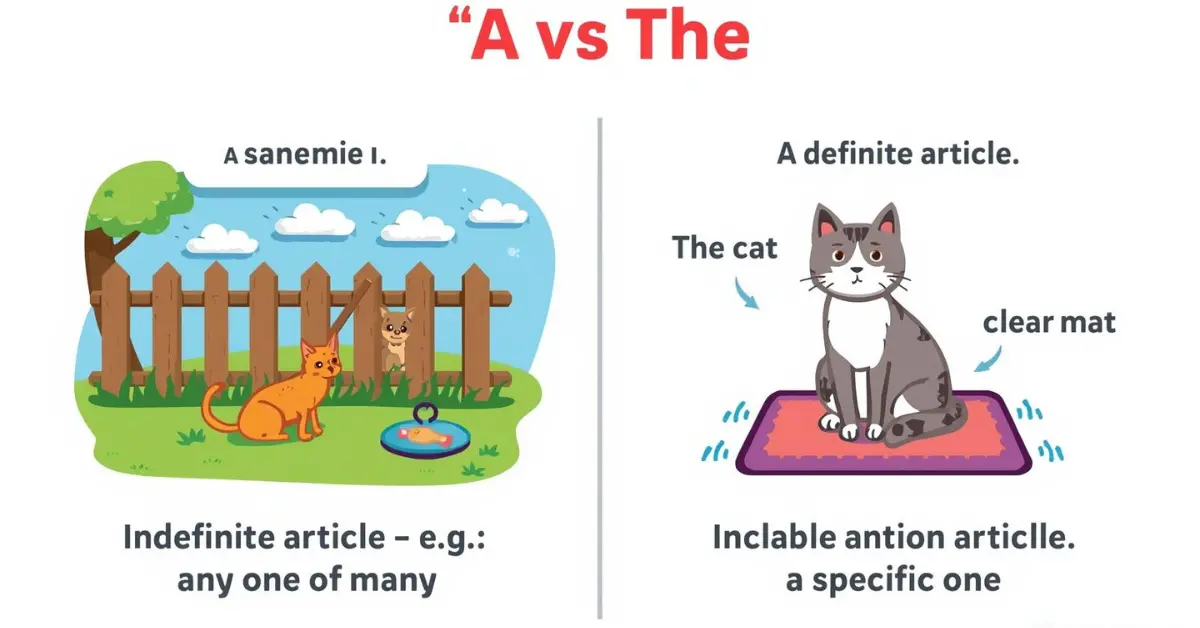
Understanding the difference between a and the is one of the most fundamental aspects of mastering English. Imagine walking into a bookstore and saying, “I want a book about gardening.” The shopkeeper might bring you any book because “a” refers to any one of many possibilities. Now, if you say, “I want the book about gardening,” the shopkeeper immediately knows the exact book you mean.
This small change in articles completely alters meaning, context, and clarity. Many learners of English struggle with the difference between a and the, especially when speaking or writing. Grasping their proper usage not only improves communication but also enhances your understanding of subtle nuances in English conversation and literature. In this article, we’ll explore the difference between a and the, pronunciation, usage, and practical importance in society.
Pronunciation:
- A: /ə/ (before consonants) or /eɪ/ (emphasis) — US & UK similar
- The: /ðə/ (before consonants), /ðiː/ (before vowels) — US & UK similar
Before diving deeper, let’s see why these small words matter so much in real-world communication.
H2: Difference Between the Keywords
Here are the 10 key points of difference between a and the, with examples for each:
- Definite vs. Indefinite Reference
- A introduces something for the first time; it’s indefinite.
- Example: I saw a dog in the park.
- Example: She bought a dress yesterday.
- This refers to something specific and known.
- Example: I saw the dog again today.
- Example: She returned the dress she bought.
- A introduces something for the first time; it’s indefinite.
- Singular vs. Plural Use
- A is only used with singular nouns.
- Example: He ate a sandwich.
- Example: She wrote a letter.
- The can be used with singular or plural nouns.
- Example: The sandwiches are on the table.
- Example: The letters arrived today.
- A is only used with singular nouns.
- Introducing vs. Referring Back
- A introduces new information.
- Example: I saw a movie last night.
- Example: She adopted a cat.
- This refers back to something already mentioned.
- Example: The movie was amazing.
- Example: The cat is sleeping now.
- A introduces new information.
- Specificity
- A is non-specific.
- Example: I need a pen.
- Example: He wants a car.
- This is specific.
- Example: I need the pen on the desk.
- Example: He wants the car his friend owns.
- A is non-specific.
- Common vs. Unique
- A is used with common items.
- Example: She saw a bird.
- Example: He bought a notebook.
- This is used for unique entities.
- Example: The sun is bright today.
- Example: The president gave a speech.
- A is used with common items.
- General Statements vs. Specific Cases
- A often generalizes.
- Example: A teacher should be patient.
- Example: A doctor must be kind.
- The focus is on particular instances.
- Example: The teacher in my class is strict.
- Example: The doctor who treated me was excellent.
- A often generalizes.
- Geographical Use
- A rarely appears in geographical names.
- Example: I visited a city in Europe.
- The is used with rivers, oceans, and plural place names.
- Example: The Nile is long.
- Example: The Philippines is beautiful.
- A rarely appears in geographical names.
- Idiomatic Expressions
- A appears in general idioms.
- Example: It’s a piece of cake.
- Example: She is a breath of fresh air.
- It appears in specific idioms.
- Example: The ball is in your court.
- Example: He is the apple of her eye.
- A appears in general idioms.
- Before Professions and Roles
- A introduces roles.
- Example: She is a teacher.
- Example: He is a chef.
- The points to a known person in that role.
- Example: The teacher I met yesterday was helpful.
- Example: The chef at that restaurant is famous.
- A introduces roles.
- Emphasis and Tone
- A keeps tone neutral or casual.
- Example: I bought a gift for her.
- Example: He needs a chance.
- This adds emphasis and importance.
- Example: I bought the gift she wanted.
- Example: He needs the chance of a lifetime.
- A keeps tone neutral or casual.
Nature and Behavior of “A” and “The”
- A: Indefinite, general, flexible; creates openness in language.
- The: Definite, specific, precise; adds clarity and certainty.
Why People Are Confused
Many learners struggle because context changes meaning. Beginners often use a when the is needed, causing ambiguity. In spoken English, emphasis and tone further complicate usage.
Difference and Similarity Table
| Feature | A | The | Similarity |
| Specificity | Indefinite | Definite | Both are articles |
| Noun type | Singular only | Singular & Plural | Modify nouns |
| Introduction | New info | Known info | Precede nouns |
| Emphasis | Neutral | Emphasized | Used in statements |
| Idioms | General | Specific | Appear in expressions |
Which is Better in What Situation?
- A works best when introducing new objects, people, or ideas. It keeps language neutral and general, perfect for storytelling or explaining concepts.
- The is ideal when referring to a particular item, idea, or event. It brings clarity and authority, essential in instructions, news, or formal writing.
Metaphors and Similes
- A: “A storm in a teacup” — general comparison.
- The: “The calm before the storm” — specific imagery.
Connotative Meaning
- A: Neutral/positive — Example: A friend is kind.
- The: Neutral/strong — Example: The decision changed history.
Idioms/Proverbs
- A: “A stitch in time saves nine.”
- The: “The early bird catches the worm.”
Literature References
- A: A Tale of Two Cities (Novel, Charles Dickens, 1859)
- The: The Great Gatsby (Novel, F. Scott Fitzgerald, 1925)
Movies
- A: A Beautiful Mind (2001, USA)
- The: The Godfather (1972, USA)
Frequently Asked Questions
- When should I use “a” vs “the”?
- Use a for new, unspecified items; the for specific, known items.
- Can “a” be plural?
- No, a is singular only.
- Is “the” always necessary before proper nouns?
- No, only for unique entities like rivers or institutions.
- Why do English learners misuse articles?
- Context and specificity confuse beginners; exposure helps.
- Do “a” and “the” change meaning dramatically?
- Yes, choosing the wrong article can alter clarity and intent.
How Both Are Useful in Surroundings
Articles guide attention, distinguish items, and provide clarity. Using a and the correctly helps in classrooms, workplaces, and media, making communication precise.
Final Words
A and the may seem small, but their impact is huge. Mastery improves writing, speaking, and comprehension. Using them well reflects linguistic precision and cultural literacy.
Conclusion
The difference between a and the is essential in English. While a introduces general or unknown items, the refers to known, specific ones. Learners often confuse them due to context sensitivity. Understanding their use helps in storytelling, formal communication, and literature appreciation.
Recognizing their subtle nuances improves clarity, avoids ambiguity, and strengthens writing skills. In essence, a and the are the building blocks of meaningful English expression, making them indispensable for learners, writers, and professionals alike.
If you want, I can also design a visual infographic summarizing “Difference Between A and The” for SEO and social media use. It would be highly shareable and learner-friendly.
Do you want me to create that next?

Hi, I’m DreamAnchor, the author behind GrammarCircle. I am passionate about language, writing, and helping people understand the small but important differences in English words and concepts. Through my work, I focus on explaining grammar rules, word comparisons, and language usage in a simple and practical way so that students, writers, and professionals can improve their communication skills.