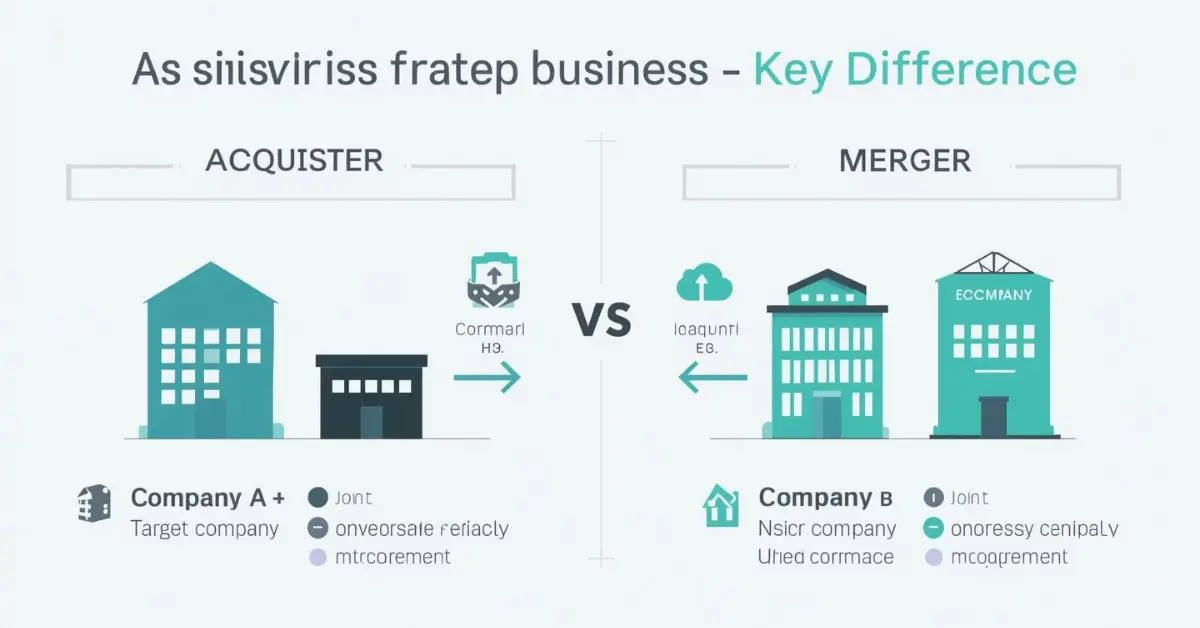
In the fast-paced corporate world, understanding the difference between acquisition and merger is crucial for both professionals and students. Imagine two companies: one, a small tech startup, and another, a large multinational, joining forces. Did the bigger company acquire the smaller one, or did they merge as equals? This scenario highlights the subtle but significant difference between acquisition and merger.
While an acquisition occurs when one company purchases another, a merger involves the combination of two companies to form a new entity. Many people confuse these terms, yet knowing the difference between acquisition and merger can shape strategic business decisions, investment plans, and even stock market performance. In today’s competitive market, mastering this distinction ensures better understanding of corporate behavior and financial outcomes.
Pronunciation
- Acquisition: /ˌækwɪˈzɪʃ.ən/ (US & UK)
- Merger: /ˈmɜːrdʒər/ (US), /ˈmɜːdʒə/ (UK)
Now that we understand the terms, let’s dive into their key differences and applications in real-world business.
Difference Between Acquisition and Merger
1. Definition
- Acquisition: One company purchases another.
- Example 1: Google acquiring YouTube (2006, US).
- Example 2: Facebook acquiring Instagram (2012, US).
- Merger: Two companies combine to form a new entity.
- Example 1: Exxon and Mobil merged to form ExxonMobil (1999, US).
- Example 2: Daimler-Benz and Chrysler merged to form DaimlerChrysler (1998, Germany/US).
2. Nature of Control
- Acquisition: The acquiring company has full control.
- Example: Amazon acquiring Whole Foods (2017, US) – Amazon controls decisions.
- Merger: Control is shared between both companies.
- Example: Glaxo Wellcome and SmithKline Beecham merged to form GlaxoSmithKline (2000, UK) – shared management.
3. Size of Companies Involved
- Acquisition: Usually a larger company acquires a smaller one.
- Example: Microsoft acquiring LinkedIn (2016, US).
- Merger: Companies are typically of similar size.
- Example: Royal Dutch Petroleum and Shell Oil (1907, Netherlands/UK).
4. Financial Strategy
- Acquisition: Often a strategic purchase to expand market share.
- Example: Disney acquiring Pixar (2006, US).
- Merger: Aims at combining resources for mutual growth.
- Example: HP and Compaq merger (2002, US).
5. Legal Status
- Acquisition: The target company may continue as a subsidiary or be absorbed.
- Example: eBay acquiring PayPal (2002, US).
- Merger: Creates a new legal entity.
- Example: Chevron and Texaco merged to form ChevronTexaco (2001, US).
6. Impact on Brand Identity
- Acquisition: Target company may lose its original identity.
- Example: LinkedIn retained the brand but under Microsoft (US).
- Merger: Usually results in a combined brand.
- Example: Pricewaterhouse + Coopers & Lybrand = PwC (1998, UK/US).
7. Employee Effect
- Acquisition: Employees of the acquired company may face layoffs.
- Example: Yahoo acquired Tumblr (2013, US).
- Merger: Often results in shared workforce, though redundancies may occur.
- Example: Bank of America and Merrill Lynch merger (2008, US).
8. Stock Market Effect
- Acquisition: Stock price of the target company may rise sharply.
- Example: Whole Foods’ stock surged post Amazon acquisition (US).
- Merger: Both companies’ stocks may fluctuate depending on perceived benefits.
- Example: ExxonMobil stock reacted to merger news (1999, US).
9. Cultural Integration
- Acquisition: Cultural adaptation is often top-down.
- Example: Google imposing corporate culture on YouTube (US).
- Merger: Cultural integration is collaborative.
- Example: GlaxoSmithKline merging corporate values (UK).
10. Decision-Making Process
- Acquisition: Decisions are mainly by the acquiring company.
- Example: Facebook’s strategic decisions on Instagram (US).
- Merger: Requires joint decision-making.
- Example: DaimlerChrysler’s shared board decisions (Germany/US).
Nature and Behavior
- Acquisition: Aggressive, strategic, fast-moving, often competitive.
- Merger: Collaborative, planned, consensual, aiming for synergy.
Why People Are Confused
The terms are often used interchangeably in media and casual conversation because both involve corporate combinations, but the control dynamics and legal outcomes differ.
Acquisition vs Merger: Comparison Table
| Feature | Acquisition | Merger |
| Definition | One company buys another | Two companies combine as equals |
| Control | By acquiring company | Shared control |
| Company Size | Larger acquires smaller | Usually similar in size |
| Legal Status | Target may remain or dissolve | Creates a new legal entity |
| Brand Impact | Target may lose identity | New combined brand |
| Employee Effect | Possible layoffs | Shared workforce, some redundancy |
| Stock Market Effect | Target stock rises | Both fluctuate |
| Cultural Integration | Top-down | Collaborative |
| Decision Making | Acquirer decides | Joint decision-making |
| Strategy | Market expansion | Mutual growth |
Which Is Better in What Situation?
- Acquisition: Best when a company wants to quickly gain market share, acquire technology, or eliminate competition.
- Merger: Ideal when two companies seek synergy, cost reduction, or resource pooling without dominance by one entity.
Metaphors, Similes, and Connotation
- Acquisition: Often compared to “a lion capturing its prey” (negative-neutral) – powerful, dominant.
- Merger: Like “two rivers joining to form a bigger stream” (positive) – cooperative and harmonious.
Idioms/Proverbs:
- “Bite off more than you can chew” – relates to aggressive acquisitions.
- “Two heads are better than one” – relates to mergers.
Works in Literature
- Acquisition and Corporate Strategy – John Smith (Business, 2010)
- Mergers and Alliances in Modern Firms – Anne Brown (Economics, 2015)
Movies on Keywords
- The Social Network (2010, US) – Focus on acquisitions in tech
- Barbarians at the Gate (1993, US) – Corporate mergers and acquisitions
FAQs
- Are acquisitions always hostile?
- No, they can be friendly or negotiated.
- Do mergers mean both companies share ownership?
- Yes, typically, they form a new combined entity.
- Can a small company acquire a larger one?
- Rare, but possible with investor backing.
- Which is more common in tech?
- Acquisitions, due to quick access to technology and talent.
- Do mergers affect company culture?
- Yes, both companies must integrate cultures carefully.
How Both Are Useful for Society
- Acquisition: Drives innovation, consolidates resources, improves services.
- Merger: Strengthens industries, creates stable employment, increases market efficiency.
Final Words
Understanding the difference between acquisition and merger empowers professionals, investors, and students to make informed business decisions. Each plays a unique role in economic growth and corporate strategy.
Conclusion
Acquisition and merger are fundamental strategies in the corporate world. While acquisitions involve dominance and control, mergers focus on equality and synergy. Both impact the economy, workforce, and stock markets differently.
Knowing their differences helps companies strategize effectively, reduces confusion in media reports, and guides investors toward informed choices. Mastery of these terms is crucial for learners and experts alike, ensuring clarity in analyzing corporate behavior.

Hi, I’m DreamAnchor, the author behind GrammarCircle. I am passionate about language, writing, and helping people understand the small but important differences in English words and concepts. Through my work, I focus on explaining grammar rules, word comparisons, and language usage in a simple and practical way so that students, writers, and professionals can improve their communication skills.