In the world of logistics, warehouses, and shipping, the terms skid and pallet are often used interchangeably. However, understanding the difference between skid and pallet is essential for anyone in supply chain management or even small-scale businesses handling goods.
Imagine a bustling warehouse: workers moving goods stacked on wooden structures, some with bottom boards and some without. These structures help in handling, storing, and transporting materials efficiently. Here, the terms skid and pallet come into play.
Both are platforms used to lift and move goods, but each has unique features that make it suitable for specific scenarios. Knowing the difference between skid and pallet not only ensures safety but also optimizes storage space and reduces transportation costs. Whether you’re a logistics expert or a beginner, learning this difference is crucial.
Pronunciation:
- Skid: US /skɪd/, UK /skɪd/
- Pallet: US /ˈpælɪt/, UK /ˈpælɪt/
Let’s dive deeper into their differences and understand why this knowledge is indispensable.
Difference Between Skid and Pallet
Here are 10 key points that differentiate a skid from a pallet:
- Structure
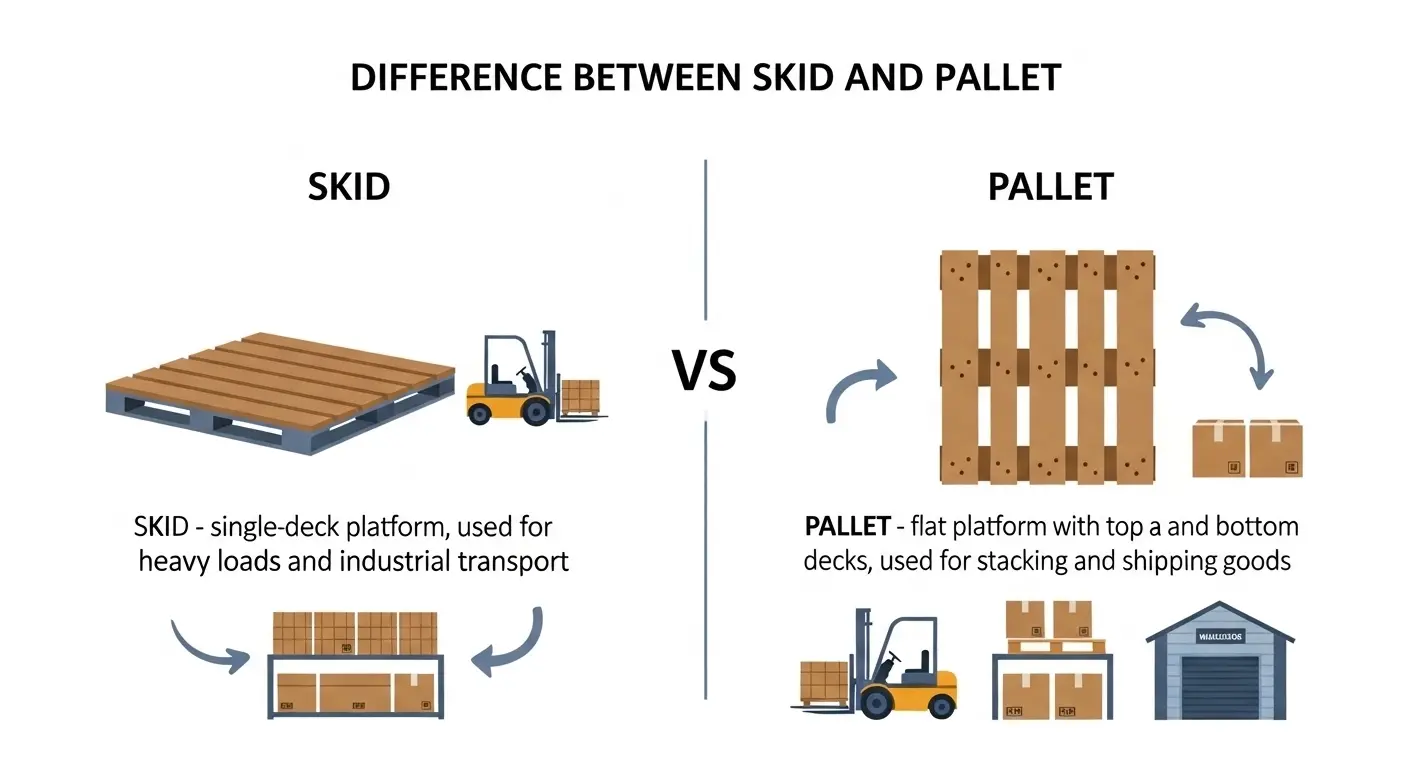
- Skid: Has no bottom deck boards; consists of top boards supported by stringers.
- Example 1: Heavy machinery is often placed on skids for forklift handling.
- Example 2: Large steel pipes are transported on skids.
- Pallet: Has both top and bottom boards, forming a complete deck.
- Example 1: Boxes of cereals are stacked on pallets for supermarket delivery.
- Example 2: Bottled water crates are transported on pallets.
- Skid: Has no bottom deck boards; consists of top boards supported by stringers.
- Stability
- Skid: Less stable due to absence of bottom deck boards.
- Pallet: More stable, ideal for stacking multiple units.
- Weight Capacity
- Skid: Handles heavier machinery and industrial items.
- Pallet: Best for lighter, packaged goods.
- Mobility
- Skid: Often moved with specialized forklifts or cranes.
- Pallet: Easily moved with standard forklifts or pallet jacks.
- Design Purpose
- Skid: Industrial use, meant for heavy-duty operations.
- Pallet: Warehousing, retail, and general shipping.
- Material
- Skid: Usually made of solid wood or metal.
- Pallet: Can be wood, plastic, or even metal for food and pharma industries.
- Cost
- Skid: More expensive due to robust design.
- Pallet: Relatively cheaper and widely available.
- Reusability
- Skid: Highly durable and reused multiple times.
- Pallet: May wear out faster; some are disposable.
- Stacking
- Skid: Not ideal for stacking due to lack of bottom support.
- Pallet: Can be safely stacked for efficient warehouse space usage.
- Industry Preference
- Skid: Manufacturing and heavy industries prefer skids.
- Pallet: Retail, shipping, and logistics favor pallets.
Nature and Behavior:
- Skid: Heavy-duty, rigid, designed for industrial loads; less flexible in stacking.
- Pallet: Versatile, easy to handle, stackable, suitable for general shipping.
Why People Get Confused:
Many assume skid and pallet are the same because both are platforms for moving goods. The confusion arises due to overlapping uses in warehouses where both structures are seen side by side.
Comparison Table – Skid vs Pallet
| Feature | Skid | Pallet | Similarity |
| Bottom Boards | Absent | Present | Both support goods |
| Stability | Less | High | Both used for transport |
| Weight Capacity | High | Moderate | Both carry loads |
| Material | Wood, Metal | Wood, Plastic, Metal | Both can be made of wood/metal |
| Cost | Expensive | Affordable | Both are investment in logistics |
| Reusability | Highly durable | Moderate | Both can be reused |
| Stacking | Not ideal | Stackable | Both used in storage |
| Industry | Heavy industry | Retail & logistics | Both are logistics tools |
| Mobility | Requires specialized forklifts | Standard forklifts/pallet jacks | Both move goods |
| Design Purpose | Industrial | General shipping | Both aid material handling |
Which Is Better in What Situation?
Skid: Best for heavy machinery, industrial equipment, or oversized loads. Its strong frame and robust design make it ideal where stability is less of a concern but strength is paramount.
Pallet: Perfect for retail products, consumer goods, or warehouses with stacking requirements. Pallets are versatile, easier to handle, and optimize storage space efficiently.
Metaphors, Similes, and Connotation
- Skid: Often symbolizes heaviness or industrial strength.
- Example metaphor: “The deal went down like a skid on ice,” implying sudden, unstoppable movement.
- Pallet: Represents support or foundation in everyday language.
- Example simile: “As supportive as a pallet under crates,” meaning reliable foundation.
Connotation:
- Skid: Neutral to slightly negative (unstable or industrial context).
- Pallet: Neutral to positive (practical, supportive).
Idioms/Proverbs:
- “On the skid” – experiencing decline (negative, skid)
- “Give a leg up” – help someone stand (support, pallet)
Works in Literature
- “The Skid” – Short story, Jack London, 1904
- “Pallet of Dreams” – Fiction, Maria Lopez, 2012
Movies Related
- “Skid Row” – 1997, USA
- “Pallet Jack” – 2019, Canada
FAQs
- Is a skid a pallet?
No, a skid lacks bottom deck boards, making it different in design and use. - Can pallets carry heavy machinery?
Only light to moderate loads; heavy machinery requires skids. - Are skids reusable?
Yes, highly durable for repeated industrial use. - Which is better for stacking?
Pallets, due to bottom boards and stability. - Can both be made of plastic?
Pallets can; skids are usually wood or metal.
Environmental Usefulness
Both skids and pallets promote organized storage, reduce waste in packaging, and can be recycled or repurposed for sustainable logistics.
Final Words
Understanding the difference between skid and pallet is crucial for logistics, warehouse management, and industrial operations. Skids excel in heavy-duty transport, while pallets shine in retail and stacking efficiency.
Conclusion
In summary, while skids and pallets may look similar at first glance, their design, stability, and applications differ significantly. Skids are ideal for industrial, heavy-duty items, whereas pallets are versatile for warehousing, retail, and general logistics.
Knowing this difference between skid and pallet helps businesses optimize storage, reduce costs, and ensure safety. For beginners and experts alike, mastering these distinctions ensures better handling of goods, environmental efficiency, and overall operational productivity.

I’m BeaconRise, the author behind GrammarCircle, where I help readers understand English grammar, language differences, and writing concepts in a simple and practical way. I specialize in explaining confusing words, grammar rules, and “difference between” topics so learners can easily improve their writing and communication skills.