Imagine two scholars, Maria from the UK and John from the US, both aiming to reach the pinnacle of academic achievement. Maria says, “I’m pursuing a Doctoral degree,” while John insists, “I’m enrolling in a PhD program.” Many people wonder whether these terms are the same or carry subtle differences.
Understanding the difference between Doctoral and PhD is crucial not only for students choosing the right academic path but also for educators and employers who evaluate qualifications globally.
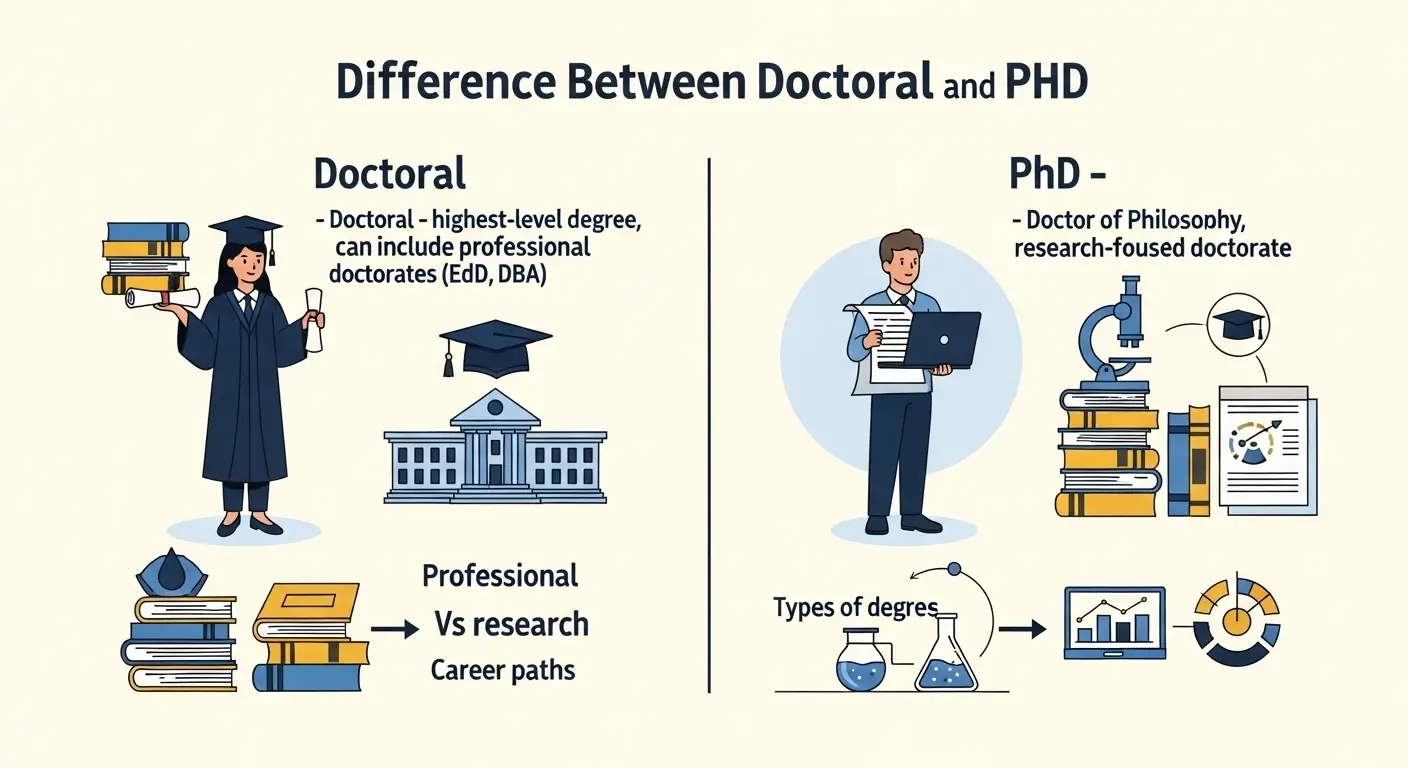
In essence, a Doctoral degree is an umbrella term for the highest academic qualification, whereas a PhD is a specific type of doctoral program. Knowing these distinctions helps learners make informed decisions about their education and career trajectory.
Pronunciation:
- Doctoral: UK /ˈdɒktərəl/, US /ˈdɑːktərəl/
- PhD: UK /ˌpiː.eɪtʃˈdiː/, US /ˌpiː.eɪtʃˈdiː/
Linking Hook:
Let’s dive deeper into the difference between Doctoral and PhD to understand their structure, usage, and relevance in academic and professional settings.
H2: Difference Between Doctoral and PhD
Here are 10 key differences between a Doctoral degree and a PhD:
- Definition
- Doctoral: The highest level of academic degree awarded in various fields.
Example 1: An EdD (Doctor of Education) is a doctoral degree in education.
Example 2: MD (Doctor of Medicine) is another type of doctoral degree. - PhD: A research-focused doctoral degree emphasizing original contributions.
Example 1: A PhD in Physics requires publishing new research.
Example 2: PhD in Literature involves analyzing texts critically.
- Doctoral: The highest level of academic degree awarded in various fields.
- Purpose
- Doctoral: Broadly aimed at professional expertise or academic excellence.
Example 1: JD (Doctor of Law) prepares students to practice law.
Example 2: DBA (Doctor of Business Administration) develops advanced managerial skills. - PhD: Specifically focuses on research and generating new knowledge.
Example 1: Conducting experiments in a Chemistry PhD program.
Example 2: Publishing a dissertation in Sociology.
- Doctoral: Broadly aimed at professional expertise or academic excellence.
- Duration
- Doctoral: 3–6 years depending on the field and nature of study.
- PhD: Typically 4–7 years with extensive research and thesis submission.
- Nature of Study
- Doctoral: Can be practical, professional, or research-based.
- PhD: Primarily research-based with original contributions to the field.
- Coursework
- Doctoral: May include significant coursework and practical training.
- PhD: Minimal coursework; focus is on independent research.
- Outcome
- Doctoral: Leads to titles such as Doctor or Prof. depending on field.
- PhD: Leads primarily to research recognition and the title “Doctor.”
- Recognition
- Doctoral: Recognized across professional and academic domains.
- PhD: Globally recognized in academia, particularly for research roles.
- Thesis Requirement
- Doctoral: Some professional doctorates may not require a thesis.
- PhD: Always requires a thesis based on original research.
- Career Path
- Doctoral: Suited for professional practice, leadership roles.
- PhD: Suited for academic careers, research, and teaching.
- Flexibility
- Doctoral: Offers flexible options for full-time or part-time studies.
- PhD: Usually full-time due to research demands.
Nature and Behaviour
- Doctoral: Professional, goal-oriented, applied in practice, and often interdisciplinary.
- PhD: Scholarly, analytical, deeply research-focused, and primarily theoretical.
Why People Are Confused
Many people assume that Doctoral and PhD degrees are identical because both lead to the title “Doctor.” However, the Doctoral degree covers a broader spectrum, including professional qualifications, while a PhD is a specialized research degree.
Table: Difference and Similarity
| Feature | Doctoral | PhD | Similarity |
| Focus | Professional or academic | Research-focused | Both are highest academic degrees |
| Thesis Requirement | Optional for some | Mandatory | Both can lead to ‘Doctor’ title |
| Duration | 3–6 years | 4–7 years | Both require years of study |
| Career Path | Professional practice | Academia/research | Both enhance career prospects |
| Nature | Practical & applied | Theoretical & research-oriented | Both require deep expertise |
Which is Better in What Situation?
- Doctoral: Ideal for professionals aiming for expertise in fields like education, law, or business leadership. For example, an EdD is perfect for educators leading school systems.
- PhD: Best for those pursuing research, teaching, or academic careers. For instance, a PhD in Biochemistry suits scientists contributing to research publications.
Metaphors and Similes
- Doctoral: “Like a captain navigating uncharted waters” – symbolizing professional mastery.
- PhD: “As sharp as a scalpel in the realm of knowledge” – highlighting analytical precision.
Connotative Meaning:
- Doctoral: Neutral to positive – denotes authority and professional achievement.
- PhD: Positive – signifies expertise, scholarship, and original contribution.
Idioms/Proverbs Related:
- “Knowledge is power” – applies to both doctoral and PhD scholars.
- “The proof of the pudding is in the eating” – reflects research outcomes in PhD programs.
Works in Literature
- Doctoral – often referenced in educational theory books.
- PhD – “The PhD Grind” by Philip Guo (2015, Non-fiction, Academic life)
Movies
- “The PhD Movie” (2011, US) – Comedy, academic life
- “Doctor Strange” (2016, US) – Fiction, metaphoric Doctoral theme
Frequently Asked Questions
- Is a PhD the same as a Doctoral degree?
No, PhD is a type of Doctoral degree focused on research. - Can all Doctoral degrees be called PhDs?
No, professional doctorates like EdD or MD are not PhDs. - Which is more recognized globally?
PhDs have global academic recognition, while some professional doctorates are region-specific. - Do both require a thesis?
PhD always requires a thesis; Doctoral degrees may vary. - Which degree is better for a career in research?
A PhD is better for research-focused careers.
How Both Are Useful for Society
- Doctoral degrees improve professional practices, leadership, and innovation.
- PhDs contribute to research, scientific discoveries, and academic knowledge advancement.
Final Words
While both Doctoral and PhD signify high-level academic achievements, their applications differ. Understanding the distinctions empowers learners, professionals, and society to appreciate their unique contributions.
Conclusion
In summary, the difference between Doctoral and PhD is vital for students, educators, and employers. Doctoral degrees offer professional mastery and applied knowledge, while PhDs focus on original research and academic scholarship. Knowing the nuances helps in selecting the right path for career growth, research contribution, and societal impact.
Both degrees, though sometimes confused, hold immense value in shaping expertise, innovation, and leadership across disciplines.

Hi, I’m DreamAnchor, the author behind GrammarCircle. I am passionate about language, writing, and helping people understand the small but important differences in English words and concepts. Through my work, I focus on explaining grammar rules, word comparisons, and language usage in a simple and practical way so that students, writers, and professionals can improve their communication skills.