Imagine visiting a doctor because of an unusual mark or lump on your skin. The doctor examines it and mentions two possible terms: lesion and tumor. For many people, these words immediately cause concern because they are often associated with serious illnesses. However, the difference between lesion and tumor is important to understand before jumping to conclusions.
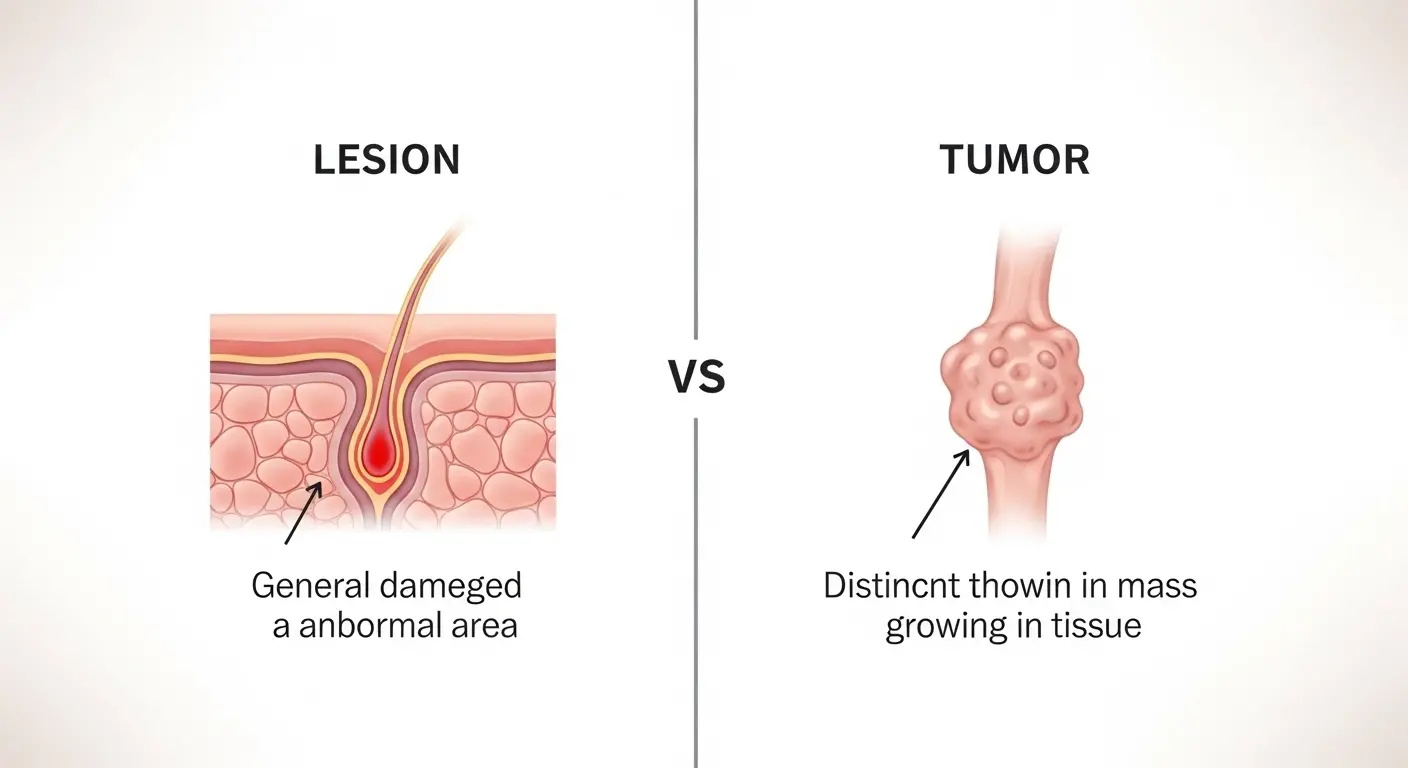
In simple terms, a lesion refers to any abnormal change in body tissue, while a tumor specifically refers to an abnormal growth or mass of cells. The difference between lesion and tumor often confuses patients, students, and even readers of medical reports because both terms describe abnormal conditions in the body.
Understanding the difference between lesion and tumor helps people interpret medical diagnoses correctly and reduces unnecessary fear. In fact, learning the difference between lesion and tumor allows both beginners and professionals to communicate clearly about health conditions.
Before we explore the details, let us break down the meaning, pronunciation, and practical usage of these two important medical terms.
Pronunciation of Both Terms
Lesion
- US pronunciation: /ˈliːʒən/
- UK pronunciation: /ˈliːʒən/
Tumor / Tumour
- US pronunciation: /ˈtuːmər/
- UK pronunciation: /ˈtjuːmə/
Both terms are widely used in medical science, but they describe different conditions. Now let’s move forward and explore the difference between lesion and tumor in detail.
Difference Between Lesion and Tumor
1. Definition
Lesion:
A lesion is any abnormal change or damage in tissue. It can appear as a wound, sore, discoloration, or damaged tissue.
Examples:
- A burn mark on the skin is considered a lesion.
- A brain lesion may appear after a stroke.
Tumor:
A tumor is a mass formed by abnormal cell growth. It can be benign (non-cancerous) or malignant (cancerous).
Examples:
- A benign fatty tumor called lipoma.
- A malignant tumor such as breast cancer.
2. Scope of the Term
Lesion:
The term lesion is very broad and includes many types of tissue damage.
Examples:
- Skin rash caused by infection.
- Liver lesion seen on a CT scan.
Tumor:
Tumor refers only to abnormal growth of cells forming a lump or mass.
Examples:
- Brain tumor.
- Lung tumor.
3. Cause
Lesion:
Lesions can occur due to injury, infection, inflammation, or disease.
Examples:
- Skin lesion from a bacterial infection.
- Brain lesion from trauma.
Tumor:
Tumors occur due to uncontrolled cell division.
Examples:
- Tumor caused by genetic mutation.
- Tumor due to prolonged exposure to radiation.
4. Appearance
Lesion:
Lesions may appear as spots, cuts, ulcers, or discolorations.
Examples:
- Red skin lesion from allergy.
- White lesion inside the mouth.
Tumor:
Tumors usually appear as lumps or masses.
Examples:
- Lump in the breast.
- Growth in the brain.
5. Size
Lesion:
Lesions can be very small or large depending on the damage.
Examples:
- Tiny skin lesion from acne.
- Large lesion from severe burn.
Tumor:
Tumors usually grow gradually in size.
Examples:
- Small benign tumor under the skin.
- Large tumor pressing on organs.
6. Severity
Lesion:
Lesions may be harmless or serious depending on the cause.
Examples:
- Minor skin lesion from insect bite.
- Brain lesions affecting movement.
Tumor:
Tumors can be benign or cancerous.
Examples:
- Benign ovarian tumor.
- Malignant lung tumor.
7. Medical Context
Lesion:
Used widely in dermatology, neurology, and pathology.
Examples:
- Skin lesion diagnosis by dermatologist.
- Brain lesion found in MRI scan.
Tumor:
Mostly used in oncology (cancer study).
Examples:
- Tumor detected in CT scan.
- Tumor removed through surgery.
8. Relationship Between Them
Lesion:
A lesion may or may not be a tumor.
Examples:
- Scar tissue lesion.
- Inflammatory lesion.
Tumor:
A tumor is technically a type of lesion.
Examples:
- Benign tumor as a lesion.
- Cancerous tumor as a lesion.
9. Treatment
Lesion:
Treatment depends on the cause.
Examples:
- Antibiotics for infected lesions.
- Cream for skin lesions.
Tumor:
Treatment often involves surgery, chemotherapy, or radiation.
Examples:
- Surgical removal of tumor.
- Chemotherapy for cancer tumours.
10. Medical Detection
Lesion:
Lesions are detected through visual exams or imaging.
Examples:
- Skin lesion detected during physical exam.
- Brain lesion detected in MRI.
Tumor:
Tumors often require imaging and biopsy.
Examples:
- Mammogram detecting breast tumor.
- Biopsy confirming tumor type.
Nature and Behaviour of Both
Lesion:
Lesions represent damage or abnormal tissue change. They may heal over time or remain stable depending on the cause.
Tumor:
Tumors involve abnormal cell growth. Benign tumors grow slowly, while malignant tumors can spread to other parts of the body.
Why People Are Confused About Their Use
People often confuse these terms because both describe abnormal body conditions. Doctors may use the word lesion in imaging reports when the exact nature of the abnormality is unknown. Later, further tests may reveal whether it is a tumor or another type of lesion. The overlap in medical terminology leads to misunderstanding among patients and readers.
Table Showing Difference and Similarity
| Feature | Lesion | Tumor |
| Meaning | Tissue damage or abnormal change | Abnormal mass of cells |
| Scope | Broad medical term | Specific type of growth |
| Cause | Injury, infection, disease | Uncontrolled cell growth |
| Appearance | Spots, wounds, ulcers | Lump or mass |
| Severity | Can be mild or serious | Benign or malignant |
| Relationship | May include tumors | A type of lesion |
Which Is Better in What Situation?
Lesion:
The term lesion is better used when doctors describe a general abnormality without confirming its exact nature. In early diagnosis, imaging reports often use this word to avoid making premature conclusions. It allows medical professionals to indicate that something unusual is present while further testing is required.
Tumor:
The word tumor is more appropriate when a mass caused by abnormal cell growth has been confirmed. It provides clearer information about the condition and helps guide treatment plans such as surgery, chemotherapy, or radiation therapy.
Use in Metaphors and Similes
Sometimes these words are used metaphorically.
Examples:
- “Corruption is a lesion on society.”
- “Hatred spread like a tumor in the community.”
These comparisons describe harmful problems that grow or damage systems.
Connotative Meaning
Lesion
- Usually neutral in medical context
Example: The scan revealed a small lesion on the liver.
Tumor
- Often negative due to association with cancer
Example: The discovery of the tumor worried the family.
Idioms or Proverbs Related to the Words
There are no common idioms using these exact terms, but they appear in descriptive expressions.
Examples:
- “A tumor of corruption growing in the system.”
- “A lesion in the fabric of society.”
Works in Literature Using the Keywords
Lesion
- The Cancer Journals – Memoir, Audre Lorde, 1980
- The Illness Narratives – Medical sociology, Arthur Kleinman, 1988
Tumor
- The Emperor of All Maladies – Biography/medical history, Siddhartha Mukherjee, 2010
- Cancer Ward – Novel, Aleksandr Solzhenitsyn, 1968
Movies Related to the Keywords
Tumor / Cancer Themes
- 50/50 – 2011, USA
- My Sister’s Keeper – 2009, USA
- The Fault in Our Stars – 2014, USA
Frequently Asked Questions
1. Is every tumor a lesion?
Yes, every tumor is considered a lesion because it is an abnormal tissue change.
2. Are all lesions cancerous?
No, most lesions are not cancerous and may result from infections or injuries.
3. Can a lesion turn into a tumor?
Some lesions may develop into tumors if abnormal cell growth begins.
4. How do doctors confirm a tumor?
Doctors usually use imaging tests and biopsy to confirm a tumor.
5. Are tumors always dangerous?
No, many tumors are benign and do not spread.
How Both Are Useful for Understanding Our Surroundings
Understanding these terms helps people interpret medical reports, health news, and scientific discussions accurately. It also improves communication between doctors, patients, and researchers. In public health education, knowing the difference between lesions and tumours allows communities to respond calmly and seek proper medical advice instead of fearing every abnormal finding.
Final Words for Both
Lesion is a broad medical term describing tissue damage or abnormal change. Tumor is a more specific term referring to abnormal cell growth forming a mass. Both terms are essential in medical diagnosis and research.
Conclusion
Understanding the difference between lesion and tumor is important for both medical learners and the general public. While a lesion refers to any abnormal change or damage in body tissue, a tumor specifically describes an abnormal mass formed by uncontrolled cell growth. Not all lesions are tumors, but every tumor can be considered a type of lesion.
Recognizing this distinction reduces confusion when reading medical reports or discussing health conditions. Clear knowledge of these terms promotes better health awareness, encourages accurate communication, and helps individuals make informed decisions about medical care.

Hi, I’m LunarCrest, the author behind GrammarCircle. I’m passionate about language, writing, and helping people understand the finer details of English. Through my work, I focus on explaining grammar rules, word differences, and language concepts in a simple and practical way.