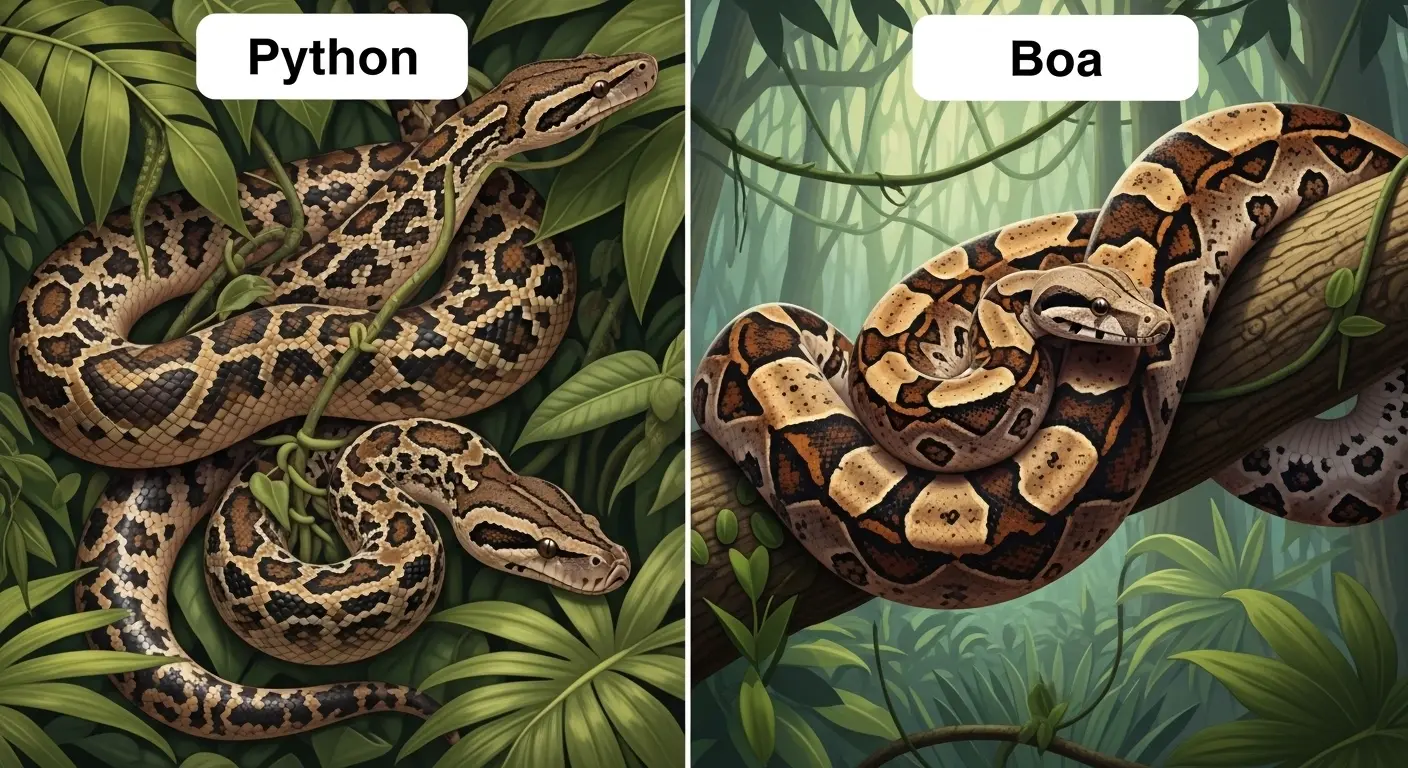
Imagine a wildlife photographer trekking through a dense rainforest in South America. Suddenly, he spots a huge snake resting on a tree branch. At first glance, he wonders whether it is a python or a boa.
Many people experience the same confusion when seeing large constrictor snakes in documentaries or zoos. Understanding the difference between python and boa becomes important when identifying these fascinating reptiles.
The difference between python and boa is often discussed by wildlife experts, biology students, and nature enthusiasts because both snakes look similar and belong to the same group of non-venomous constrictors. However, the difference between python and boa lies in their reproduction, habitat, anatomy, and evolutionary history.
Learning the difference between python and boa not only helps in wildlife education but also deepens our understanding of biodiversity and reptile behavior in nature.
Key Difference Between the Both
The main difference is that pythons lay eggs, while boas give birth to live young. This reproductive difference is one of the most important scientific distinctions between them.
Why Their Difference Is Necessary to Know for Learners and Experts
Understanding the differences between these snakes helps wildlife researchers, conservationists, and students correctly identify species. It also helps in ecological studies, zoo management, and wildlife protection programs. Knowing whether a snake is a python or a boa helps determine its habitat, breeding patterns, and behavior, which is essential for conservation efforts and public safety.
Pronunciation
- Python
- US: /ˈpaɪθɑːn/
- UK: /ˈpaɪθən/
- Boa
- US: /ˈboʊə/
- UK: /ˈbəʊə/
Both snakes share similarities, yet their biological characteristics reveal clear distinctions. Let’s explore the difference between python and boa in detail.
Difference Between Python and Boa
1. Reproduction Method
Pythons reproduce by laying eggs, while boas give birth to live young.
Examples:
- The Burmese Python lays eggs and protects them until they hatch.
- The Boa Constrictor gives birth to live baby snakes.
2. Geographic Distribution
Pythons mainly live in Africa, Asia, and Australia, whereas boas are mostly found in North and South America.
Examples:
- The Indian Python lives in South Asia.
- Boa species are commonly found in the Amazon rainforest.
3. Evolutionary History
Boas are considered evolutionarily older compared to pythons.
Examples:
- Fossil evidence suggests boas appeared earlier in reptile evolution.
- Pythons evolved later but adapted to many environments.
4. Skull Structure
Pythons have an extra bone in their skull called the premaxilla, which boas lack.
Examples:
- This bone helps pythons grasp prey more effectively.
- Boas rely mainly on strong jaw muscles instead.
5. Heat-Sensing Pits
Many pythons have well-developed heat-sensing pits, while boas have fewer.
Examples:
- Pythons detect warm-blooded prey easily at night.
- Boas rely more on smell and movement.
6. Egg Care
Female pythons actively incubate their eggs, while boas do not guard eggs because they give live birth.
Examples:
- A python coils around its eggs to keep them warm.
- A boa delivers young snakes that are independent immediately.
7. Habitat Preference
Pythons often prefer tropical forests and wetlands, while boas adapt to forests, deserts, and grasslands.
Examples:
- Pythons live near rivers and swamps.
- Boas can survive in dry environments.
8. Size Differences
Some python species grow larger than most boas.
Examples:
- The Reticulated Python is one of the longest snakes in the world.
- Most boa species remain shorter.
9. Behavior
Pythons are often more active hunters, while boas are more ambush predators.
Examples:
- Pythons may roam in search of prey.
- Boas usually wait quietly for animals to approach.
10. Species Variety
There are more python species than boa species worldwide.
Examples:
- Python family includes several large species.
- Boa family contains fewer but widely distributed species.
Nature and Behaviour
Python:
Pythons are powerful constrictors that kill prey by squeezing it tightly. They usually live near water and often climb trees. Many python species are known for their calm behavior when not threatened.
Boa:
Boas are also constrictors but tend to be slower and more patient hunters. They rely on camouflage and stealth. Boas often hide among trees or rocks while waiting for prey.
Why People Are Confused About Their Use
People confuse pythons and boas because both are large, non-venomous constrictor snakes with similar body shapes and hunting methods. Wildlife documentaries often show them performing similar behaviors such as wrapping around prey. Additionally, the general public frequently uses the word “boa” or “python” interchangeably when referring to large snakes, which increases the confusion.
Difference and Similarity Table
| Feature | Python | Boa | Similarity |
| Reproduction | Lays eggs | Gives live birth | Both reproduce sexually |
| Habitat | Africa, Asia, Australia | Americas | Both live in tropical areas |
| Hunting | Active hunter | Ambush predator | Both constrict prey |
| Size | Often larger | Usually smaller | Both can grow very large |
| Behavior | More active | More patient | Both are non-venomous |
Which Is Better in What Situation?
Python:
In scientific research about egg-laying reptiles, pythons are particularly useful for studying reptile incubation and parental care. Their egg-guarding behavior helps scientists understand reptile reproduction. Pythons are also commonly studied in wildlife documentaries and ecological research due to their large size and global distribution.
Boa:
Boas are useful in research focused on live-bearing reptiles. Because they give birth to live young, they provide valuable insights into reptile evolution and reproduction strategies. In zoos and educational programs, boas are often used for demonstrations because many species are relatively calm and easier to handle.
Use in Metaphors and Similes
Python
- “His grip was like a python around the rope.”
- “The crowd moved like a python tightening its coil.”
Boa
- “The scarf wrapped around her neck like a boa.”
- “Fear gripped him like a boa constrictor.”
Connotative Meaning
Python
- Neutral/Negative: Power, danger, or overwhelming strength.
- Example: “The corporation wrapped the market like a python.”
Boa
- Neutral: Smooth wrapping or elegance.
- Example: “The feather boa completed her glamorous outfit.”
Idioms or Proverbs
While direct idioms are rare, snake-related expressions include:
- “A snake in the grass.”
Example: “He seemed friendly but turned out to be a snake in the grass.” - “Like a snake squeezing its prey.”
Example: “Debt squeezed him like a snake squeezing its prey.”
Works in Literature
Python
- “Python” – Poem by D. H. Lawrence (Poetry, 1923)
Boa
- “The Little Prince” by Antoine de Saint-Exupéry (Children’s literature, 1943) – features a boa constrictor illustration.
Movies Related to Giant Snakes
- Anaconda – 1997, United States
- Anaconda: The Hunt for the Blood Orchid – 2004, United States
Frequently Asked Questions
1. Are pythons and boas venomous?
No, both are non-venomous snakes that kill prey through constriction.
2. Which snake is bigger, python or boa?
Many python species grow larger than most boas.
3. Do both snakes live in the same regions?
Generally no; pythons live in the Old World, while boas are mostly found in the Americas.
4. Can boas lay eggs?
No, boas give birth to live young.
5. Why do people confuse them?
Their similar body shape, hunting style, and large size cause confusion.
How Both Are Useful for Surroundings
Both snakes play important roles in ecosystems by controlling rodent populations. This helps maintain ecological balance and reduces crop damage in agricultural areas. They also contribute to biodiversity and scientific research.
Final Words for Both
Pythons and boas are remarkable reptiles that demonstrate the diversity of snake evolution. Despite their similarities, their reproductive methods, habitats, and anatomy set them apart in fascinating ways.
Conclusion
Understanding the difference between python and boa helps people appreciate the complexity of reptile biology and wildlife diversity.
Although both snakes are powerful constrictors and share many characteristics, their reproductive systems, geographic distribution, and anatomical features clearly distinguish them.
For students, researchers, and wildlife enthusiasts, learning these differences improves identification skills and scientific knowledge. Ultimately, both pythons and boas are important members of their ecosystems and deserve respect and conservation.

I’m BeaconRise, the author behind GrammarCircle, where I help readers understand English grammar, language differences, and writing concepts in a simple and practical way. I specialize in explaining confusing words, grammar rules, and “difference between” topics so learners can easily improve their writing and communication skills.