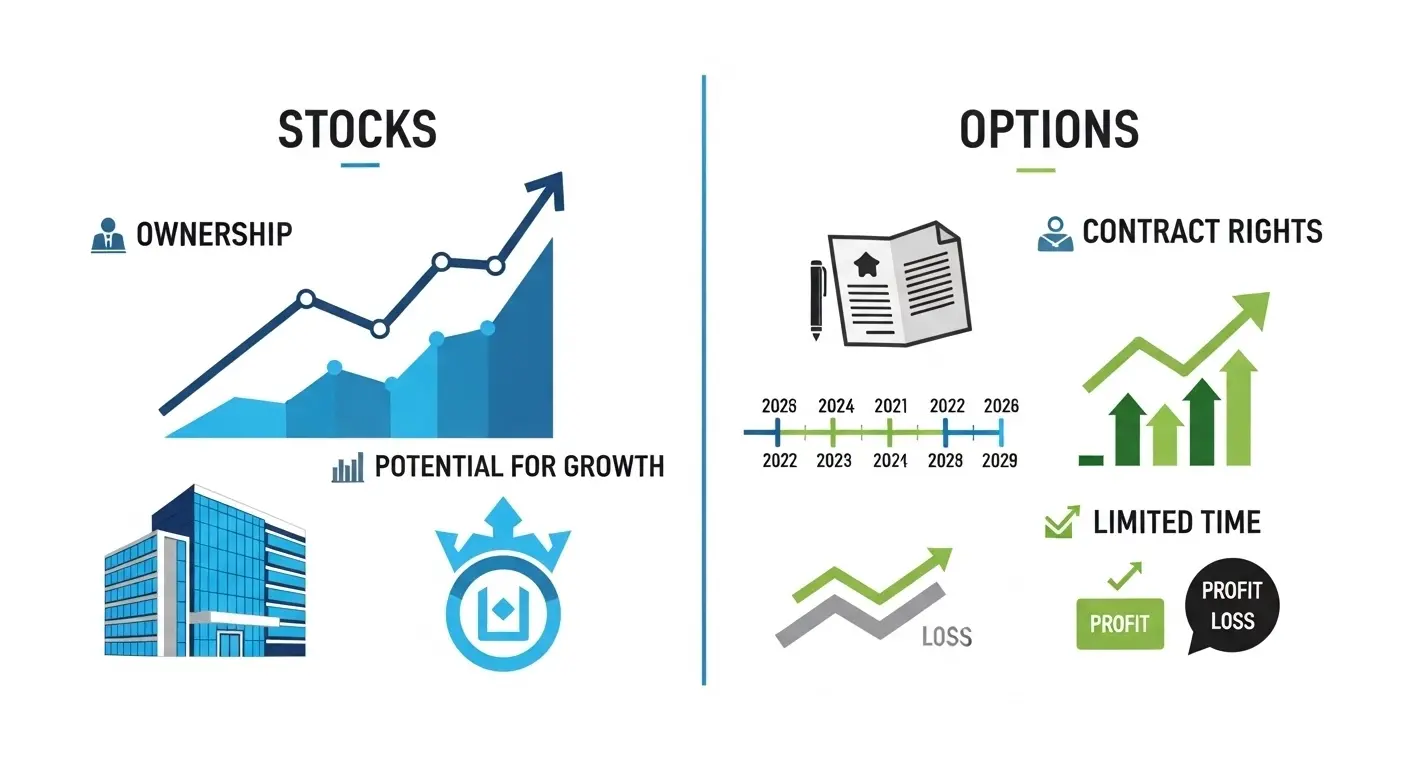
In today’s fast-paced financial world, terms like stocks and options are often used interchangeably, but they are far from identical. Imagine Sarah, a young investor, who walked into a brokerage firm wanting to “buy into the market.” She was offered stocks to own a piece of a company and options to secure the rightbut not the obligationto buy or sell stocks later.
She realized that understanding the difference between stocks and options could significantly impact her investment decisions. Knowing this difference helps investors like Sarah avoid costly mistakes and seize better opportunities. In both beginner and expert circles, clarifying the difference between stocks and options ensures informed, strategic financial choices.
Pronunciation:
- Stocks: /stɑːks/ (US), /stɒks/ (UK)
- Options: /ˈɑːp.ʃənz/ (US), /ˈɒp.ʃənz/ (UK)
This knowledge sets the stage to explore the finer points of how stocks and options differ in nature, behavior, and practical usage.
Difference Between Stocks and Options
Here are 10 key differences between stocks and options, explained clearly with examples:
- Ownership vs. Right to Trade
- Stocks represent ownership in a company.
Example: Buying Apple stock gives you part ownership. - Options are contracts giving the right to buy/sell stocks.
Example: A call option lets you buy Apple stock at $150 later.
- Stocks represent ownership in a company.
- Risk Level
- Stocks carry market risk but may yield dividends.
Example: Owning Tesla shares may earn dividends or fluctuate in value. - Options can be highly leveraged and risky.
Example: Buying a short-term call option could expire worthless.
- Stocks carry market risk but may yield dividends.
- Investment Horizon
- Stocks can be held indefinitely.
Example: Warren Buffett’s long-term investment in Coca-Cola. - Options have an expiration date.
Example: A call option expiring in 3 months requires timing accuracy.
- Stocks can be held indefinitely.
- Profit Potential
- Stocks profit from price appreciation and dividends.
Example: Gaining $10 per share increase. - Options can multiply profits with smaller capital.
Example: Investing $200 in options could yield $1,000 if stock rises.
- Stocks profit from price appreciation and dividends.
- Complexity
- Stocks are straightforward to buy/sell.
Example: Buying Amazon shares online is simple. - Options require understanding strike price, expiration, and type.
Example: Buying a put option involves predicting a price drop.
- Stocks are straightforward to buy/sell.
- Leverage
- Stocks do not inherently provide leverage.
Example: Buying 10 shares at $100 costs $1,000. - Options offer high leverage with limited upfront cost.
Example: Spending $100 on an option to control 10 shares of $100 stock.
- Stocks do not inherently provide leverage.
- Dividends and Voting Rights
- Stocks often provide dividends and voting rights.
Example: Shareholders vote in company decisions. - Options do not provide dividends or voting rights.
Example: Owning an option contract doesn’t let you vote.
- Stocks often provide dividends and voting rights.
- Liquidity
- Stocks are generally liquid, easy to sell on exchanges.
Example: Selling Microsoft shares anytime during market hours. - Options may have lower liquidity depending on strike price and expiry.
Example: Selling a rare options contract may be harder.
- Stocks are generally liquid, easy to sell on exchanges.
- Valuation Factors
- Stock value depends on company performance.
Example: Apple stock rises with strong earnings. - Options depend on stock price, time, and volatility.
Example: A volatile market can increase an option’s price.
- Stock value depends on company performance.
- Purpose
- Stocks are for long-term wealth building.
Example: Investors hold shares for retirement. - Options are often used for hedging or speculation.
Example: Using put options to protect against stock declines.
Nature and Behavior
Stocks:
- Represent tangible ownership.
- Tend to rise slowly over time with company growth.
- Behavior is influenced by earnings, dividends, and market sentiment.
Options:
- Represent contractual rights, not ownership.
- Highly volatile, with rapid value changes.
- Behavior is affected by stock price movement, time decay, and market volatility.
Why People Are Confused
Many confuse stocks and options because both involve financial markets and buying/selling securities. Options’ complexity and temporary nature, along with the similarity in underlying assets, make it easy for beginners to misunderstand their purpose.
Comparison Table: Stocks vs Options
| Feature | Stocks | Options | Similarities |
| Ownership | Yes | No | Both traded on markets |
| Risk | Moderate | High | Investment assets |
| Dividends | Often | No | Price affected by market |
| Voting Rights | Yes | No | Can be bought/sold |
| Leverage | Low | High | Tied to company performance |
| Expiration | None | Yes | Financial instruments |
| Complexity | Simple | Complex | Affected by supply/demand |
| Liquidity | High | Variable | Can generate profit/loss |
| Profit Potential | Moderate | High | Used by investors/traders |
| Purpose | Long-term | Hedging/Speculation | Market participation |
Which Is Better in What Situation?
Stocks are ideal for long-term investors seeking stability, dividends, and ownership in growing companies. They suit those building retirement funds or wealth over years.
Options are better for traders seeking short-term gains or hedging existing stock positions. They work well when predicting price movement or leveraging capital is essential.
Metaphors, Similes, and Connotation
- Stocks: “Stocks are the backbone of an investor’s portfolio” (positive).
- Options: “Options are like a double-edged sword” (neutral/negative, due to risk).
Idioms/Proverbs:
- “Don’t put all your eggs in one basket” – relates to diversifying stocks.
- “Strike while the iron is hot” – can refer to executing options.
Stocks and Options in Literature
- “The Intelligent Investor” – Benjamin Graham, 1949 (Stocks/Investment guide)
- “Options as a Strategic Investment” – Lawrence G. McMillan, 1980 (Options guide)
Movies Featuring Them
- Wall Street (1987, USA) – Stocks trading drama
- The Big Short (2015, USA) – Options and mortgage derivatives
FAQs
- Are stocks safer than options? – Yes, generally less risky due to ownership.
- Can you lose all money with stocks? – Rare, unless a company collapses.
- Do options pay dividends? – No, options holders don’t receive dividends.
- Which is better for beginners? – Stocks, because they are simpler.
- Can options be used for hedging? – Yes, options protect against stock declines.
How They Are Useful for Society
Stocks allow companies to raise capital for growth, creating jobs and products. Options help stabilize markets by providing hedging tools and investment strategies, contributing to financial system efficiency.
Final Words
Understanding the difference between stocks and options is crucial for anyone navigating financial markets. Stocks build wealth steadily, while options offer strategic opportunities for risk and reward. Knowledge empowers smarter investment decisions.
Conclusion
Both stocks and options play distinct roles in financial markets. While stocks provide tangible ownership, long-term growth, and stability, options offer flexibility, leverage, and hedging opportunities.
Confusing the two can lead to mismanaged investments, but clear knowledge enables informed strategies. Investors who understand the difference between stocks and options can tailor their approach to match risk tolerance, time horizon, and market goals.
By combining the right mix of both, one can achieve diversified portfolios, protect investments, and capitalize on market opportunities effectively. Ultimately, mastery of these tools enhances both personal wealth and broader economic activity.

Hi, I’m DreamAnchor, the author behind GrammarCircle. I am passionate about language, writing, and helping people understand the small but important differences in English words and concepts. Through my work, I focus on explaining grammar rules, word comparisons, and language usage in a simple and practical way so that students, writers, and professionals can improve their communication skills.