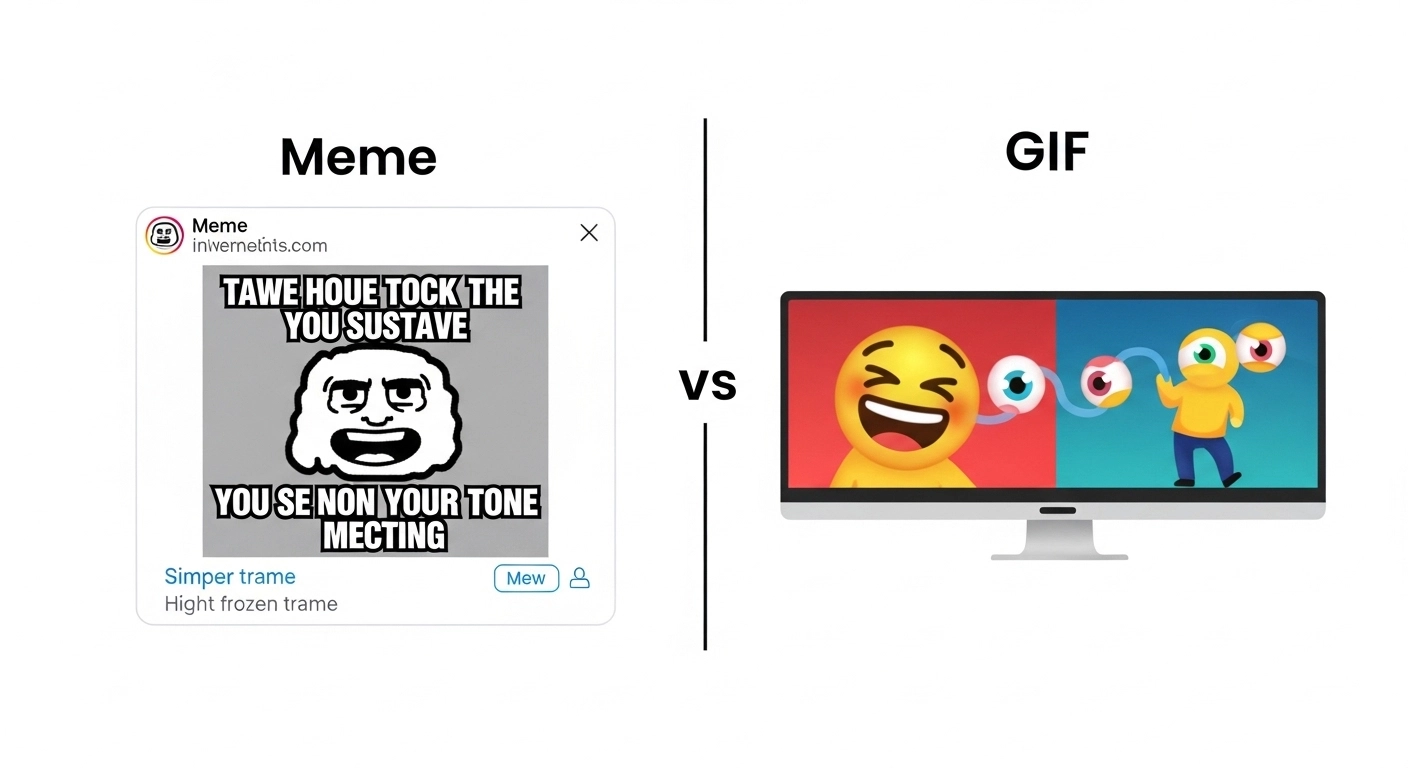
In today’s digital era, we constantly scroll through social media feeds filled with visuals that capture our attention instantly. Among these, two forms dominate: memes and GIFs. A meme is usually a static image or video with a humorous or relatable caption, while a GIF (Graphics Interchange Format) is a short, looping animation that communicates reactions or emotions effectively.
Imagine scrolling through a Facebook or Instagram feed: you see a picture of a cat looking judgmental with a witty captionthat’s a meme. Then, you notice a short looping clip of the same cat knocking over a vasethat’s a GIF.
Both memes and GIFs serve as quick, sharable cultural expressions. Understanding the difference between memes and GIF is essential not only for casual users but also for content creators, marketers, and educators. It helps in selecting the right medium for communication, enhancing engagement, and avoiding confusion.
Pronunciation:
- Meme: US /miːm/, UK /miːm/
- GIF: US /ɡɪf/ or /dʒɪf/, UK /ɡɪf/ or /dʒɪf/
The nuances between a meme and a GIF are subtle but significant. Let’s dive deeper to explore their differences, use cases, and societal impact.
H2 Difference Between the Keywords
1. Format
- Meme: Usually a static image or text-based visual.
Example 1: “Distracted Boyfriend” meme (image of man looking at another woman).
Example 2: “Success Kid” meme (child clenching fist with a victorious expression). - GIF: Animated looping clip, can be from videos or animations.
Example 1: Looping GIF of someone waving hello.
Example 2: GIF of a celebrity facepalm reaction.
2. Purpose
- Meme: Primarily to provoke humor, commentary, or social satire.
- GIF: Express emotions, reactions, or short storytelling visually.
3. Length
- Meme: Instantaneously understandable, usually one frame.
- GIF: Short animation (1–10 seconds) showing movement.
4. Origin
- Meme: Concept popularized by Richard Dawkins in 1976, cultural transmission.
- GIF: Developed in 1987 by CompuServe as a digital image format.
5. Interactivity
- Meme: Passive, static content; evokes thought or laughter.
- GIF: Dynamic, often used in chat, social media reactions.
6. Content
- Meme: Often includes text overlay.
- GIF: Focuses on action or movement without needing text.
7. Creation Tools
- Meme: Meme generators, Photoshop.
- GIF: Giphy, Photoshop, video-to-GIF converters.
8. Virality
- Meme: Can go viral through relatability.
- GIF: Viral due to emotional or comedic resonance in motion.
9. Cultural Impact
- Meme: Shapes online conversations and social commentary.
- GIF: Adds nuance to online chats and social media threads.
10. Sharing Platforms
- Meme: Instagram, Reddit, Twitter, Facebook.
- GIF: Messaging apps (WhatsApp, Telegram), Twitter, Giphy embeds.
Nature and Behaviour
- Meme: Static, thought-provoking, humorous; relies on context.
- GIF: Animated, expressive, often a direct emotional reaction; relies on motion.
Why People Are Confused
The confusion arises because both memes and GIFs are used to express humor or reactions online. Many GIFs are captioned like memes, and memes sometimes animate, blurring boundaries.
Meme vs GIF Table
| Feature | Meme | GIF | Similarity |
| Format | Static image/text | Animated loop | Both visual media |
| Purpose | Humor, commentary | Reaction, emotion | Communicate online |
| Length | Single frame | 1–10 sec loop | Quick to consume |
| Text Overlay | Often includes | Rarely | Can convey message |
| Interactivity | Passive | Dynamic | Shareable |
| Virality | Relatability | Emotional resonance | Can go viral |
Which is Better in What Situation?
- Meme: Best for making people laugh, sharing commentary, or creating viral cultural references. Memes excel when context and relatability matter.
- GIF: Ideal for conveying emotions in messaging or short animated storytelling. GIFs work better for dynamic reactions in online chats and presentations.
Use in Metaphors and Similes
- Meme: “As relatable as a Monday morning meme.”
- GIF: “His reaction was a GIF of pure shock.”
Connotative Meaning
- Meme: Positive or humorous; sometimes sarcastic.
- GIF: Neutral to positive; conveys emotion or reaction.
Idioms or Proverbs Related
- Meme: “A picture is worth a thousand words” – memes amplify this digitally.
- GIF: “Actions speak louder than words” – GIFs show motion instead of explanation.
Works in Literature
- Meme:
- The Selfish Gene by Richard Dawkins, 1976 (scientific concept inspiring meme culture)
- GIF: Not directly in traditional literature, but featured in digital media studies.
Movies on Meme/GIF Themes
- In Real Life Memes (2020, USA) – Documentary exploring meme culture
- GIF: The Motion Story (2021, UK) – Short film highlighting animated GIFs
Frequently Asked Questions
- What is the main difference between memes and GIFs?
- Memes are static, GIFs are animated.
- Can a meme be a GIF?
- Technically yes, if it’s an animated meme, but traditional memes are static.
- Which goes viral faster?
- Depends on context: memes rely on relatability, GIFs on emotions.
- Are GIFs always funny?
- No, GIFs can express any emotion.
- Which is better for marketing?
- Memes for viral campaigns, GIFs for interactive engagement.
How Both Are Useful for Surroundings
Memes and GIFs make digital communication lively, reduce text overload, and convey humor or reactions in education, social media, and workplace interactions.
Final Words
Memes and GIFs are complementary tools in digital communication. Memes provoke thought and laughter, while GIFs bring reactions to life. Mastering their differences helps enhance engagement online.
Conclusion
Understanding the difference between meme and GIF is essential in the digital era. While memes rely on static humor and relatability, GIFs use motion to convey emotions dynamically. Both serve unique purposes in online conversations, marketing, and creative expression.
By distinguishing between them, users, educators, and marketers can communicate more effectively and engage audiences meaningfully. Memes and GIFs are not just entertainment, they reflect culture, trends, and the way society interacts digitally, shaping modern communication.

Hi, I’m DreamAnchor, the author behind GrammarCircle. I am passionate about language, writing, and helping people understand the small but important differences in English words and concepts. Through my work, I focus on explaining grammar rules, word comparisons, and language usage in a simple and practical way so that students, writers, and professionals can improve their communication skills.