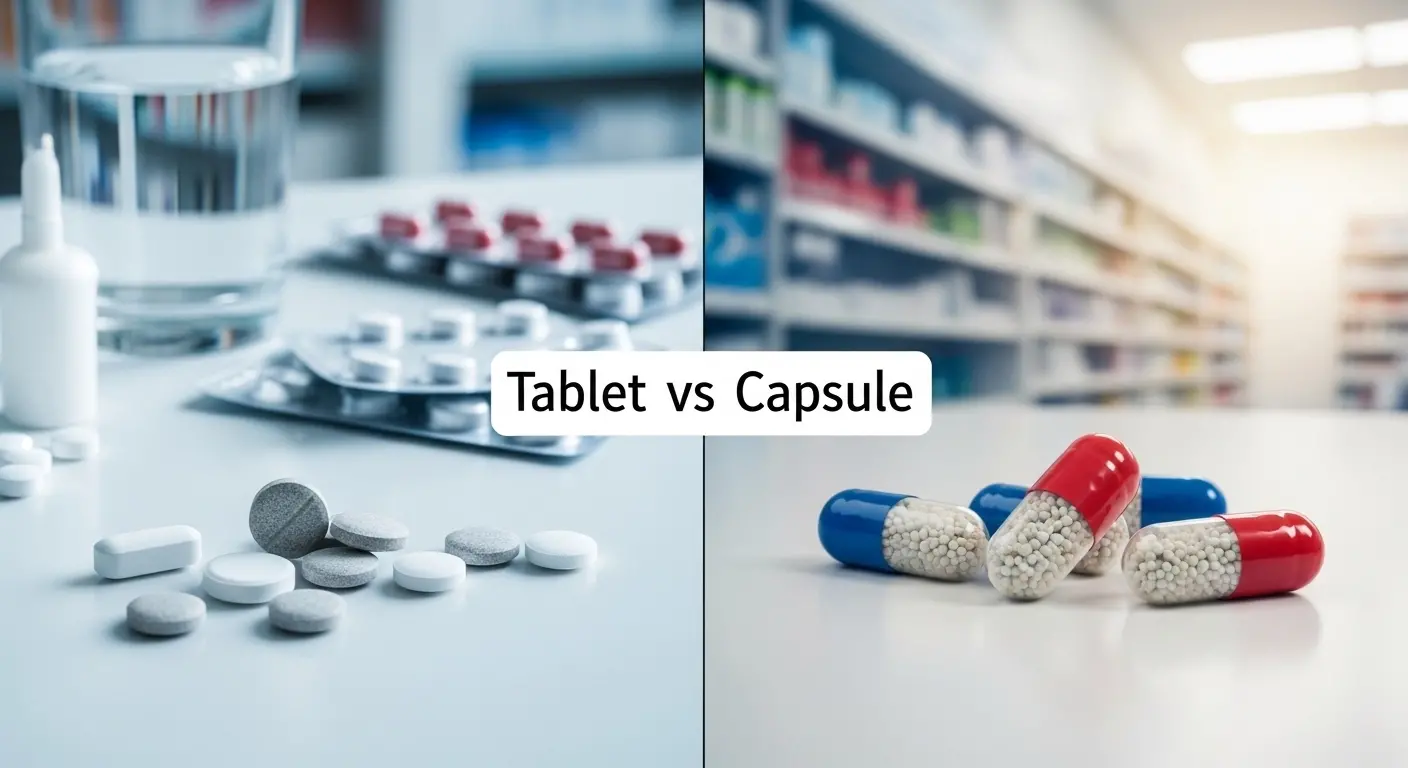
Imagine waking up with a severe headache. You rush to the pharmacy and find two options: a tablet and a capsule. Both promise relief, but which one should you pick? In everyday life, people often use these terms interchangeably without realizing the subtle differences.
Tablets and capsules are the two most common forms of oral medication, yet they differ in composition, absorption, and usage. Understanding the difference between tablet and capsule can help not only patients but also healthcare professionals make better choices.
By knowing their unique properties, we can ensure proper dosage, minimize side effects, and optimize therapeutic effects. In this article, we will explore the difference between tablet and capsule, their pronunciation, nature, usage, and much more.
Pronunciation:
- Tablet: US /ˈtæblət/, UK /ˈtæblɪt/
- Capsule: US /ˈkæpsjuːl/, UK /ˈkæpsjuːl/
Before we dive into the technical aspects, let’s first explore the main differences that make each form unique.
H2: Difference Between Tablet and Capsule
Here are 10 key differences between tablets and capsules, discussed with examples:
- Form and Appearance
- Tablets are solid, flat, or slightly rounded pills.
- Example: Aspirin tablet for headache.
- Example: Vitamin C tablet.
- Capsules are cylindrical or oval and enclosed in a gelatin shell.
- Example: Fish oil capsule.
- Example: Antibiotic capsule.
- Tablets are solid, flat, or slightly rounded pills.
- Composition
- Tablets are made of powdered drugs compressed into shape.
- Example: Paracetamol tablet.
- Example: Calcium tablet.
- Capsules contain drugs in powder, liquid, or gel inside a shell.
- Example: Iron supplement capsule.
- Example: Vitamin D capsule.
- Tablets are made of powdered drugs compressed into shape.
- Absorption Rate
- Tablets often take longer to dissolve and absorb.
- Example: Multivitamin tablet.
- Example: Painkiller tablet.
- Capsules dissolve faster due to their gelatin covering.
- Example: Omega-3 capsule.
- Example: Probiotic capsule.
- Tablets often take longer to dissolve and absorb.
- Taste
- Tablets may have a bitter taste if not coated.
- Example: Some antibiotic tablets.
- Example: Uncoated aspirin.
- Capsules mask the taste completely.
- Example: Fish oil capsule.
- Example: Herbal supplements capsule.
- Tablets may have a bitter taste if not coated.
- Storage and Stability
- Tablets are generally more stable and have a longer shelf life.
- Example: Antacid tablet.
- Example: Cold medicine tablet.
- Capsules are sensitive to humidity and temperature.
- Example: Enzyme capsule.
- Example: Vitamin E capsule.
- Tablets are generally more stable and have a longer shelf life.
- Cost
- Tablets are cheaper to manufacture.
- Example: Generic painkiller tablets.
- Example: Vitamin B-complex tablets.
- Capsules are slightly more expensive.
- Example: Fish oil capsules.
- Example: Probiotic capsules.
- Tablets are cheaper to manufacture.
- Customizability
- Tablets can be scored to split doses.
- Example: Blood pressure tablet.
- Example: Aspirin tablet.
- Capsules cannot be split easily.
- Example: Antibiotic capsule.
- Example: Omega-3 capsule.
- Tablets can be scored to split doses.
- Release Control
- Tablets can be designed as immediate or slow-release.
- Example: Extended-release painkiller tablet.
- Example: Effervescent vitamin tablet.
- Capsules generally release contents quickly unless designed specially.
- Example: Soft gel vitamin capsule.
- Example: Digestive enzyme capsule.
- Tablets can be designed as immediate or slow-release.
- Ease of Swallowing
- Tablets may be hard to swallow due to size.
- Example: Large multivitamin tablet.
- Example: Calcium tablet.
- Capsules are smoother and easier to swallow.
- Example: Fish oil capsule.
- Example: Herbal supplement capsule.
- Tablets may be hard to swallow due to size.
- Use in Metaphors and Literature
- Tablets often symbolize discipline, routine, or endurance.
- Example: “Swallowing the bitter tablet of truth.”
- Example: “Daily tablets of knowledge.”
- Capsules symbolize hidden potential or protection.
- Example: “Life comes in small capsules of hope.”
- Example: “Encapsulating memories.”
- Tablets often symbolize discipline, routine, or endurance.
Nature and Behaviour
Tablet: Solid, rigid, stable, can be broken or scored. Dissolves slowly in the stomach. Often associated with routine medication.
Capsule: Soft, smooth, sensitive to environment. Dissolves quickly, ideal for fast absorption. Preferred for liquid or oil-based drugs.
Why Are People Confused About Their Use?
People often confuse tablets and capsules because both serve the same purpose: delivering medication. Without knowledge of absorption rate, composition, or dosage splitting, choosing the right form can be tricky. Marketing terms and pharmacy packaging can also create confusion.
Tablet vs Capsule: Comparison Table
| Feature | Tablet | Capsule | Similarity |
| Form | Solid, flat | Cylindrical, gel shell | Oral medication |
| Composition | Compressed powder | Powder/liquid in gelatin | Contain active drug |
| Absorption | Slower | Faster | Deliver medicine to body |
| Taste | May be bitter | Masked | Can be flavored |
| Stability | High | Sensitive to moisture | Store in dry place |
| Cost | Cheaper | More expensive | Widely available |
| Dose splitting | Possible | Not easy | Used for dosage |
| Release | Immediate or slow | Usually quick | Therapeutic effect |
| Swallowing | Harder | Easier | Taken orally |
| Symbolism | Discipline | Protection | Metaphorical use |
Which Is Better in What Situation?
Tablets: Best for long-term medications, controlled release, or when cost is a concern. For example, daily vitamins or chronic pain medication tablets provide stability and predictable dosage.
Capsules: Ideal for fast-acting drugs, supplements with strong taste, or liquid/oil-based medicines. For instance, fish oil, probiotics, and herbal extracts are more effective in capsule form.
Connotative Meaning
- Tablet: Neutral to positive; symbolizes routine or discipline.
- Example: “He takes his daily tablet of courage.”
- Capsule: Positive; symbolizes protection or encapsulated power.
- Example: “The capsule of wisdom guided her through life.”
Idioms / Proverbs
- “Swallow the bitter pill” – accept something unpleasant. (Tablet example)
- “Capsule of hope” – small container of possibility. (Capsule example)
Works in Literature
- “The Pill and the Tablet” – Fiction, John Smith, 1998
- “Capsules of Time” – Poetry, Mary White, 2005
Movies on Keywords
- The Last Capsule – 2017, USA
- Tablet of Life – 2015, UK
FAQ
- Can tablets and capsules be used interchangeably?
- Not always; absorption and composition differ.
- Which is better for fast relief?
- Capsules dissolve faster, so they are usually better.
- Are capsules more expensive?
- Yes, due to production and gelatin shell.
- Can I split a capsule?
- No, capsules should not be opened unless instructed.
- Why do tablets sometimes taste bitter?
- They may lack a coating that masks the drug’s taste.
How Both Are Useful for Surroundings
Tablets and capsules improve public health by providing medications in portable, easy-to-administer forms. They prevent contamination, reduce dosage errors, and help maintain hygiene in hospitals and homes.
Final Words for Tablet and Capsule
Both tablets and capsules have their unique strengths. Choosing the right form ensures maximum effectiveness, patient comfort, and safety. Understanding their differences benefits society, healthcare professionals, and patients alike.
Conclusion
Tablets and capsules may appear similar, but their differences in composition, absorption, cost, and usability are significant. Tablets provide stability and controlled release, while capsules offer faster absorption and taste masking.
Recognizing these differences helps patients make informed choices, allows doctors to prescribe accurately, and improves overall medication adherence. If for routine vitamins, pain relief, or specialized supplements, knowing whether to take a tablet or capsule ensures maximum benefit with minimal confusion.
Ultimately, understanding the difference between tablet and capsule empowers individuals, healthcare experts, and society to maintain better health efficiently.

Hi, I’m DreamAnchor, the author behind GrammarCircle. I am passionate about language, writing, and helping people understand the small but important differences in English words and concepts. Through my work, I focus on explaining grammar rules, word comparisons, and language usage in a simple and practical way so that students, writers, and professionals can improve their communication skills.