One summer evening, a child spotted a tiny creature crawling on a leaf and excitedly shouted, “Look, a bug!” The parent smiled and gently replied, “Yes, but not every small creature is a bugsome are insects.” This everyday moment highlights how commonly people confuse these terms. The difference between insect and bug is often overlooked in daily language, even though both belong to the fascinating world of small creatures.
Understanding the difference between insect and bug helps us use correct terminology in science and communication. While people casually use these words interchangeably, the difference between insect and bug is quite specific. Learning the difference between insect and bug can improve both general knowledge and scientific awareness.
Key Difference Between the Both
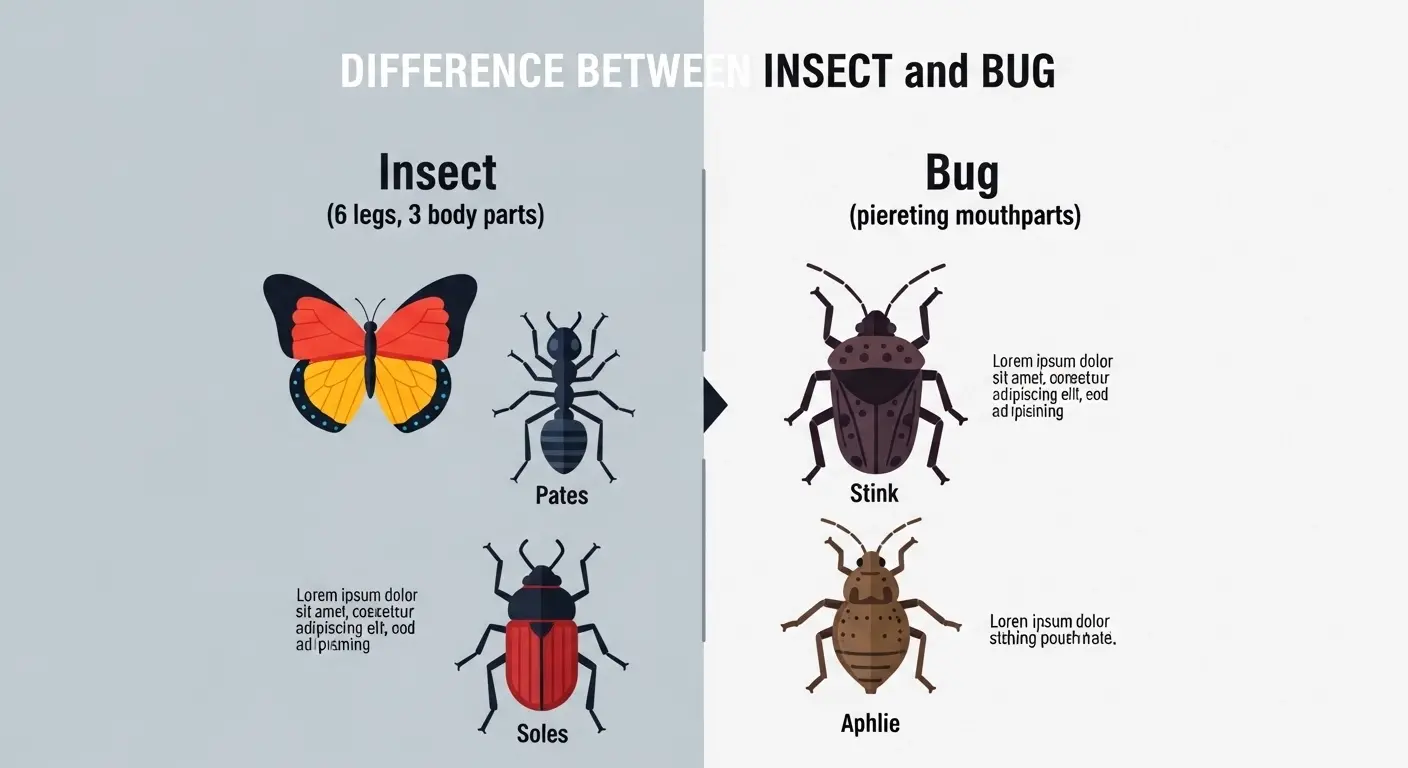
The main difference between insect and bug is that all bugs are insects, but not all insects are bugs. Bugs belong to a specific group (order Hemiptera), while insects include a much broader category of organisms.
Why Is Their Difference Necessary to Know for Learners and Experts?
Understanding the difference between insect and bug is important because it improves scientific accuracy and communication. For students, it builds a strong foundation in biology. For experts, it ensures precise identification, research accuracy, and better environmental understanding. In agriculture, medicine, and ecology, identifying whether a creature is a bug or an insect can impact pest control decisions and ecosystem balance. This knowledge also helps society appreciate biodiversity and avoid misconceptions.
Pronunciation (US & UK)
- Insect
- US: /ˈɪn.sekt/
- UK: /ˈɪn.sekt/
- Bug
- US: /bʌɡ/
- UK: /bʌɡ/
Linking Hook
Now that we have a basic understanding, let’s explore the detailed difference between insect and bug to clear up all confusion once and for all.
H2: Difference Between Insect and Bug
1. Definition
- Insect: A class of arthropods with three body parts and six legs.
Examples: Butterfly, Ant - Bug: A specific type of insect with piercing-sucking mouthparts.
Examples: Aphid, Bed bug
2. Scientific Classification
- Insect: Belongs to Class Insecta.
Examples: Beetle, Grasshopper - Bug: Belongs to Order Hemiptera.
Examples: Cicada, Shield bug
3. Mouthparts
- Insect: Can have chewing, sucking, or sponging mouthparts.
Examples: Bee (chewing), Mosquito (piercing) - Bug: Always have piercing-sucking mouthparts.
Examples: Stink bug, Water bug
4. Wings Structure
- Insect: Wings vary widely in structure.
Examples: Dragonfly, Fly - Bug: Forewings are half leathery and half membranous.
Examples: Assassin bug, Leaf-footed bug
5. Diet
- Insect: Herbivores, carnivores, or omnivores.
Examples: Caterpillar (herbivore), Praying mantis (carnivore) - Bug: Mostly feed on plant sap or animal fluids.
Examples: Aphid (plant sap), Bed bug (blood)
6. Diversity
- Insect: Extremely diverse group.
Examples: Ant, Butterfly - Bug: Less diverse compared to all insects.
Examples: Cicada, True bug
7. Habitat
- Insect: Found in nearly all environments.
Examples: Desert beetle, Aquatic insect - Bug: Mostly terrestrial or semi-aquatic.
Examples: Water strider, Bed bug
8. Metamorphosis
- Insect: Can have complete or incomplete metamorphosis.
Examples: Butterfly (complete), Grasshopper (incomplete) - Bug: Usually undergo incomplete metamorphosis.
Examples: Aphid, Cicada
9. Role in Ecosystem
- Insect: Pollinators, decomposers, predators.
Examples: Bee (pollinator), Ladybug (predator) - Bug: Mostly feeders on plants or pests.
Examples: Aphid, Stink bug
10. Common Usage
- Insect: Scientific term.
Examples: Entomology, Research papers - Bug: Informal/general term for small creatures.
Examples: “Computer bug,” “Bed bug”
Nature and Behaviour
- Insects: Highly diverse in behaviorsome fly, some crawl, some live socially like ants and bees. They adapt easily to environments.
- Bugs: Usually feed using their piercing mouthparts and may act as pests or parasites, often targeting plants or animals.
Why Are People Confused About Their Use?
People often use “bug” as a general term for any small crawling or flying creature. Media, daily conversation, and lack of scientific knowledge contribute to this confusion. The simplicity of the word “bug” makes it more popular than “insect.”
Table: Difference and Similarity
| Feature | Insect | Bug | Similarity |
| Definition | Broad category | Specific group | Both are arthropods |
| Classification | Insecta | Hemiptera | Belong to same class |
| Mouthparts | Various types | Piercing-sucking | Both feed for survival |
| Wings | Different forms | Half leathery | Many have wings |
| Usage | Scientific | Informal | Used for small creatures |
Which Is Better in What Situation?
Insect:
The term “insect” is better in scientific, academic, and professional contexts. It provides accuracy and clarity, especially in biology, agriculture, and environmental studies. Using “insect” ensures correct classification and avoids misunderstandings.
Bug:
The word “bug” is better suited for casual conversations. It is simple, easy to remember, and widely understood by people of all ages. In everyday speech, it helps communicate quickly without needing scientific precision.
Metaphors and Similes
- “Busy as an insect” – hardworking
- “Bugging someone” – annoying repeatedly
- “Like a bug in a rug” – comfortable
Connotative Meaning
- Insect: Neutral (scientific term)
Example: “The insect population is declining.” - Bug: Often negative
Example: “This issue is really bugging me.”
Idioms and Proverbs
- “Catch a bug” – become ill
Example: He caught a bug during winter. - “Bug in the system” – an error
Example: There’s a bug in the software.
Works in Literature
- The Insect Play – Karel Čapek (Drama, 1922)
- Empire of the Ants – H.G. Wells (Science Fiction, 1905)
Movies Based on Keywords
- A Bug’s Life – 1998, USA
- Them! – 1954, USA
FAQs
1. Are all bugs insects?
Yes, all bugs are insects, but not all insects are bugs.
2. What makes a bug different?
Bugs have piercing-sucking mouthparts.
3. Is a spider a bug?
No, it is an arachnid, not an insect.
4. Why do people call everything a bug?
Because it is easier and more common in daily speech.
5. Are bugs harmful?
Some are harmful, but many are harmless or beneficial.
How Both Are Useful for Surroundings
Insects play a vital role in pollination, decomposition, and maintaining ecological balance. Bugs, although sometimes pests, help control plant populations and serve as food for other animals. Both contribute to biodiversity and ecosystem stability.
Final Words for Both
Insects represent a vast and essential category of life, while bugs are a specialized group within it. Both are important for nature and human understanding.
Conclusion
The difference between insect and bug is more than just a matter of words it reflects scientific accuracy and understanding of nature. While insects form a large and diverse group, bugs are a specific type within that group. Knowing this distinction helps in education, communication, and environmental awareness.
Although everyday language may blur the lines, learning the correct usage enriches knowledge and appreciation of biodiversity. By understanding the difference between insect and bug, we can better observe, describe, and respect the tiny creatures that play a huge role in our world.

Hi, I’m DreamAnchor, the author behind GrammarCircle. I am passionate about language, writing, and helping people understand the small but important differences in English words and concepts. Through my work, I focus on explaining grammar rules, word comparisons, and language usage in a simple and practical way so that students, writers, and professionals can improve their communication skills.