Choosing between a townhouse and house is one of the most common dilemmas for modern homebuyers. Many people search for the difference between townhouse and house because both options look similar at first glance, yet they offer very different lifestyles, costs, and ownership responsibilities. A townhouse and house may appear like just architectural variations, but in reality, they reflect different living experiences.
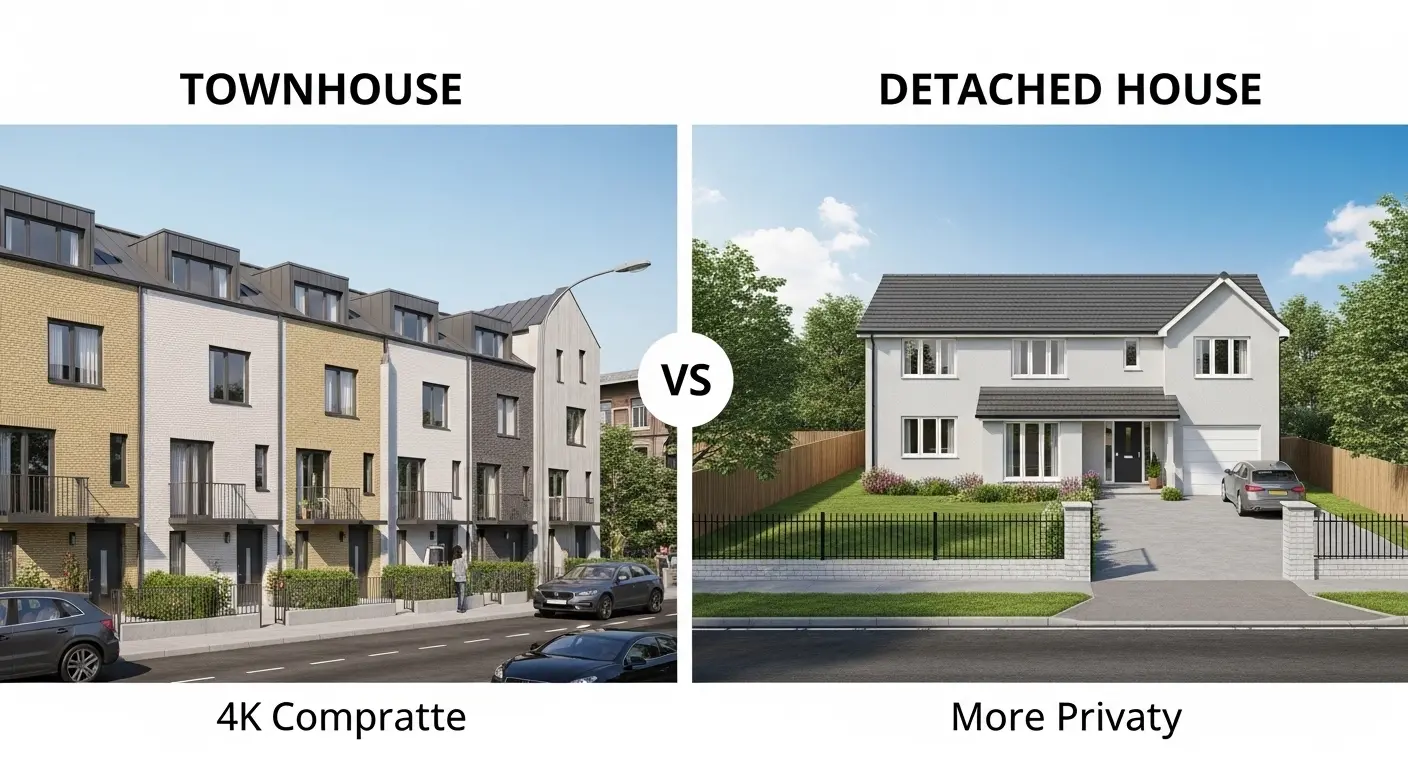
Imagine a young couple moving to a growing city. They first tour a townhouse and house in the same neighborhood. The townhouse is compact, connected to neighboring units, and easier to maintain. The house is spacious, standalone, and offers more privacy. This simple comparison creates confusion especially for first-time buyers trying to understand the difference between townhouse and house and what fits their needs best.
The phrase townhouse and house often appears in real estate listings, making it even more important to understand their true meaning. In this article, we will break down the difference between townhouse and house, explore pronunciation, usage, lifestyle impact, and even cultural meaning.
The confusion is natural because both offer shelter, ownership, and comfortbut in very different ways.
Pronunciation
- Townhouse
- US: /ˈtaʊnˌhaʊs/
- UK: /ˈtaʊnhaʊs/
- House
- US: /haʊs/
- UK: /haʊs/
Now let’s move deeper into the real comparison and understand the clear difference between townhouse and house.
Key Difference Between Townhouse and House
Understanding the difference between townhouse and house helps buyers, renters, and even investors make smarter decisions. While both serve as residential properties, their structure, ownership, and lifestyle impact vary significantly.
Why is This Difference Important?
Knowing the difference between townhouse and house is essential for learners, real estate professionals, and homeowners because housing affects lifestyle, privacy, finances, and community interaction. In society, housing choices shape urban planning, population density, and economic balance. A wrong decision may lead to financial burden or lifestyle dissatisfaction. For experts, this knowledge helps in advising clients, designing cities, and evaluating property markets effectively.
Difference Between Townhouse and House (10 Key Points)
1. Structure
- Townhouse: Attached to other units in a row.
- House: Standalone building.
Examples:
- A townhouse shares walls with neighbors in a city complex.
- A house stands alone with open space around it.
2. Ownership
- Townhouse: You own interior + land within limits.
- House: You own the entire building and land.
Examples:
- Townhouse owners may share driveway rights.
- House owners control full property boundaries.
3. Privacy
- Townhouse: Moderate privacy.
- House: High privacy.
Examples:
- You may hear neighbors in a townhouse.
- A house allows quiet backyard relaxation.
4. Maintenance
- Townhouse: Shared maintenance (HOA).
- House: Full personal responsibility.
Examples:
- HOA may fix townhouse roofing.
- The homeowner repairs everything in a house.
5. Cost
- Townhouse: Usually cheaper.
- House: Usually more expensive.
Examples:
- The townhouse suits budget buyers.
- A house requires higher investment.
6. Space
- Townhouse: Limited indoor and outdoor space.
- House: Larger living and yard space.
Examples:
- The townhouse has a small backyard.
- The house has a garden and garage.
7. Lifestyle
- Townhouse: Community-oriented living.
- House: Independent lifestyle.
Examples:
- Townhouse residents share amenities.
- House residents enjoy full control.
8. Security
- Townhouse: Higher due to close neighbors.
- House: Depends on individual setup.
Examples:
- Townhouse complexes may have guards.
- Houses rely on private security systems.
9. Resale Value
- Townhouse: Stable but moderate growth.
- House: Higher appreciation potential.
Examples:
- Townhouse resale depends on HOA rules.
- House value increases with land demand.
10. Location
- Townhouse: Mostly urban or suburban.
- House: Found in all areas including rural.
Examples:
- Townhouses are common in cities.
- Houses are common in countryside areas.
Nature and Behaviour of Both
A townhouse behaves like a shared ecosystemcompact, efficient, and community-driven. It reflects urban living where space is optimized and neighbors are close. It encourages social interaction but limits personal expansion.
A house, on the other hand, behaves like an independent ecosystem. It represents freedom, individuality, and space. It allows homeowners to expand, renovate, and personalize without restrictions.
Why People Are Confused
People confuse townhouse and house because:
- Both are residential properties.
- Modern townhouses look like small houses.
- Real estate listings often use similar terms.
- Urban development blends architectural styles.
This confusion is common among first-time buyers who assume all standalone-looking buildings are houses.
Difference and Similarity Table
| Feature | Townhouse | House | Similarity |
| Structure | Attached | Detached | Both are residential |
| Ownership | Limited land | Full land | Both can be owned |
| Privacy | Moderate | High | Both provide privacy |
| Cost | Lower | Higher | Both are investments |
| Maintenance | Shared | Individual | Both need upkeep |
Which is Better in What Situation?
A townhouse is better for people who want affordability, low maintenance, and community living. It suits young professionals, small families, and urban lifestyles. It also works well for those who prefer security and shared facilities without managing large spaces.
A house is better for families who value privacy, space, and long-term investment. It is ideal for people planning to expand their family, build gardens, or customize their living environment. It also suits those who prefer independence and long-term property appreciation. Choosing between them depends entirely on lifestyle goals and financial capacity.
Metaphors and Similes
- A townhouse is like a book in a shared library shelf connected but distinct.
- A house is like a standalone novel, complete and independent.
- Living in a townhouse is like sharing a playlist with neighbors.
- Living in a house is like composing your own music.
Connotative Meaning
- Townhouse
- Positive: Affordable, community-based, efficient.
- Negative: Less privacy, limited space.
- Example: “She prefers townhouse living for its convenience.”
- House
- Positive: Freedom, privacy, luxury.
- Negative: Expensive, maintenance-heavy.
- Example: “They bought a house for long-term stability.”
Idioms and Proverbs
- “A house is not a home” – Meaning emotional comfort matters more than property.
- Example: Even a big house feels empty without family.
- “Home sweet home”
- Example: After renting a townhouse, she finally said home sweet home.
Works in Literature
- The House of the Seven Gables – Nathaniel Hawthorne (Gothic fiction, 1851)
- A House for Mr. Biswas – V.S. Naipaul (Novel, 1961)
- Townhouse Blues (fictional modern urban short stories genre, 2010s contemporary literature)
Movies Related to Houses/Townhouses
- The House with a Clock in Its Walls (2018, USA)
- Monster House (2006, USA)
- Single Family Townhouse (independent urban drama, 2015, USA – inspired theme-based depiction)
Frequently Asked Questions
1. Is a townhouse cheaper than a house?
Yes, generally townhouses cost less than standalone houses.
2. Do townhouses have yards?
Yes, but they are usually smaller than house yards.
3. Which is better for families?
Houses are usually better for larger families needing space.
4. Are townhouses noisy?
They can be slightly noisy due to shared walls.
5. Which gives better investment return?
Houses usually offer higher long-term appreciation.
How Both Are Useful for Surroundings
Both townhouses and houses play a major role in urban development. Townhouses help manage population density and provide affordable housing in cities. Houses contribute to suburban expansion and offer balanced land use. Together, they create structured communities and support economic growth in the real estate sector.
Final Words
Both townhouse and house represent essential living options in modern society. A townhouse reflects shared living, efficiency, and affordability, while a house represents freedom, space, and individuality. Understanding the difference between townhouse and house helps people make informed decisions that match their financial goals and lifestyle needs. Neither is universally better; each serves a unique purpose in shaping comfortable and sustainable living environments.
Conclusion
The difference between townhouse and house goes beyond architecture, it reflects lifestyle choices, financial priorities, and personal values. A townhouse offers community-driven living with lower costs and less maintenance, making it ideal for urban dwellers.
A house, however, provides privacy, space, and independence, appealing to families seeking long-term stability. Understanding the difference between townhouse and house allows buyers to align their decisions with future goals. In today’s evolving real estate market, both options play a crucial role in shaping how people live, grow, and interact within society. Choosing wisely ensures comfort, financial balance, and satisfaction for years to come.

Hi, I’m DreamAnchor, the author behind GrammarCircle. I am passionate about language, writing, and helping people understand the small but important differences in English words and concepts. Through my work, I focus on explaining grammar rules, word comparisons, and language usage in a simple and practical way so that students, writers, and professionals can improve their communication skills.