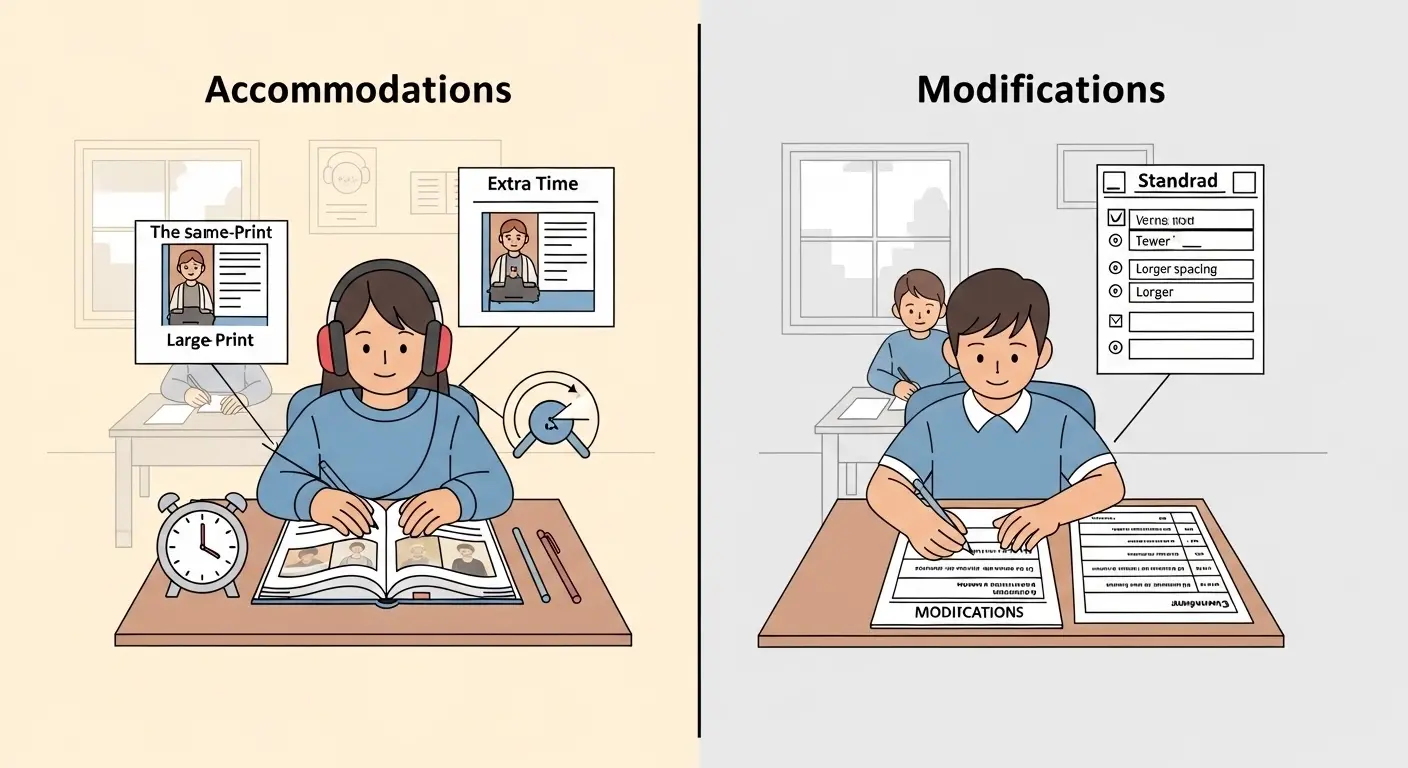
The difference between accommodations and modifications is often misunderstood in education, workplaces, and inclusive learning environments. Imagine a classroom where two students are studying the same subject, but one needs extra time while the other is given a simplified assignment.
This is where the difference between accommodations and modifications becomes important. In special education, teachers frequently apply the difference between accommodations and modifications to ensure fairness and accessibility. Understanding the difference between accommodations and modifications helps educators, parents, and learners create equal opportunities for success.
In real life, consider a student with dyslexia. One teacher allows extra time for reading (accommodation), while another reduces the reading load entirely (modification). Both strategies support learning, but in different ways. This story shows how the difference between accommodations and modifications shapes learning experiences.
- Accommodations: changes in how a student learns
- Modifications: changes in what a student learns
Why knowing the difference matters
Knowing the difference between accommodations and modifications is essential because it ensures fairness in education and workplaces. It helps teachers design inclusive classrooms, supports students with disabilities, and guides employers in creating accessible environments. Without this understanding, learners may not receive the right support, leading to inequality in performance and opportunity.
Difference Between Agile and Waterfall
Pronunciation
- Accommodations
- US: /ə-ˌkɑː-mə-ˈdeɪ-ʃənz/
- UK: /ə-ˌkɒ-mə-ˈdeɪ-ʃənz/
- Modifications
- US: /ˌmɑː-də-fə-ˈkeɪ-ʃənz/
- UK: /ˌmɒ-dɪ-fɪ-ˈkeɪ-ʃənz/
Both terms sound similar but carry very different educational meanings. Let’s explore the details further.
Difference Between Accommodations and Modifications
1. Definition
- Accommodations adjust how learning happens.
- Example 1: A student gets extra time on exams.
- Example 2: A learner uses audio books instead of printed text.
- Modifications adjust what is learned.
- Example 1: A student receives a shorter math test.
- Example 2: A learner studies simplified reading material.
- Difference Between Moles and Freckles: in current circumstances
2. Learning Goals
- Accommodations keep the same learning goals.
- Example 1: Same exam syllabus, extra time given.
- Example 2: Same project, but oral presentation allowed.
- Modifications change learning goals.
- Example 1: Reduced syllabus in science.
- Example 2: Easier version of assignments.
3. Difficulty Level
- Accommodations do not reduce difficulty.
- Example 1: Same difficulty, larger font test paper.
- Example 2: Same questions, but read aloud support.
- Modifications reduce difficulty.
- Example 1: Simplified math problems.
- Example 2: Fewer essay questions.
4. Assessment Type
- Accommodations use the same assessment standards.
- Example 1: Same grading system with extra time.
- Example 2: Same rubric, but oral response allowed.
- Modifications use different assessments.
- Example 1: Alternative grading system.
- Example 2: Different test content.
5. Purpose
- Accommodations aim for equal access.
- Example 1: Wheelchair-accessible classroom.
- Example 2: Text-to-speech software.
- Modifications aim for adjusted expectations.
- Example 1: Reduced homework load.
- Example 2: Simplified curriculum.
6. Target Learners
- Accommodations support equal participation.
- Example 1: Students with hearing impairment using captions.
- Example 2: ESL learners using dictionaries.
- Modifications support different ability levels.
- Example 1: Special needs students with reduced tasks.
- Example 2: Beginner-level coursework.
7. Legal/Educational Status
- Accommodations are often required by law.
- Example 1: Exam time extensions for disabled students.
- Example 2: Workplace accessibility tools.
- Modifications depend on educational planning.
- Example 1: Individual learning plans (IEP).
- Example 2: Adjusted curriculum goals.
8. Impact on Certification
- Accommodations do not affect certification.
- Example 1: Same diploma earned.
- Example 2: Same exam certificate.
- Modifications may affect certification.
- Example 1: Different academic certificates.
- Example 2: Alternative completion track.
9. Flexibility
- Accommodations are flexible supports.
- Example 1: Breaks during exams.
- Example 2: Preferential seating.
- Modifications are structural changes.
- Example 1: Reduced syllabus.
- Example 2: Altered grading criteria.
10. Focus
- Accommodations focus on accessibility.
- Example 1: Screen readers for blind users.
- Example 2: Sign language interpreter.
- Modifications focus on capability adjustment.
- Example 1: Lower reading level content.
- Example 2: Simplified problem-solving tasks.
Nature and Behaviour
Accommodations are supportive in nature. They act like bridges that help learners reach the same destination without changing the path. They maintain equality while adjusting the method.
Modifications, on the other hand, are adaptive changes. They reshape the path itself, making it easier or different depending on the learner’s needs. They focus on capability rather than uniformity.
Why People Get Confused
People confuse these terms because both are used in education support systems and both aim to help learners. Additionally, they are sometimes used interchangeably in casual speech. However, the key difference lies in whether the learning goal remains the same (accommodation) or changes (modification).
Table: Difference and Similarity
| Feature | Accommodations | Modifications |
| Learning Goal | Same | Changed |
| Difficulty | Same | Reduced |
| Assessment | Same | Altered |
| Purpose | Access | Adjustment |
| Legal Requirement | Often required | Depends on plan |
Similarity: Both support learners and improve accessibility.
Which is Better in What Situation?
Accommodations are better when a student can understand the material but needs support in accessing it. For example, a student with ADHD may need extra time but can complete the same exam. Accommodations ensure fairness without lowering expectations.
Modifications are better when the learner cannot meet standard academic goals due to cognitive or developmental challenges. For example, a student with severe learning difficulties may need simplified content. This ensures learning is still meaningful and achievable.
Metaphors and Similes
- Accommodations are like “a ramp for a wheelchair”—same destination, easier access.
- Modifications are like “a different road altogether”—a new path to learning.
Connotative Meanings
- Accommodations: Positive (supportive, inclusive, fair)
- Example: “The school provided accommodations for equal learning.”
- Modifications: Neutral (adaptive, flexible, situational)
- Example: “Modifications were made for beginner students.”
Idioms or Proverbs
- “Level the playing field” → often used for accommodations
- Example: Extra time in exams levels the playing field.
- “Different strokes for different folks” → relates to modifications
- Example: Modified lessons follow different strokes for different folks.
Works in Literature
There are no major literary works directly titled “accommodations” or “modifications.” However, the concepts appear in educational and disability literature:
- “The Inclusion of Special Needs Students” (Educational Genre, UNESCO reports, 2015+)
- “Disability and Education in the Classroom” (Academic research, multiple authors, 2000s–present)
Movies Related to Concepts
There are no mainstream movies directly titled “accommodations” or “modifications.” However, related themes appear in films:
- The Miracle Worker (1962, USA) – disability learning support
- Taare Zameen Par (2007, India) – learning differences in children
- Front of the Class (2008, USA) – educational accommodations for disability
Frequently Asked Questions
1. What is the main difference between accommodations and modifications?
Accommodations change how learning happens, while modifications change what is learned.
2. Do accommodations change test results?
No, they support performance without changing outcomes.
3. Are modifications common in schools?
Yes, especially in special education programs.
4. Can a student have both?
Yes, depending on individual needs.
5. Which is more inclusive?
Accommodations are generally more inclusive because they maintain the same learning goals.
How Both Are Useful for Surroundings
Both accommodations and modifications improve educational accessibility. They help build inclusive classrooms, support diversity, and ensure equal opportunity for all learners. In workplaces, they promote fairness and productivity by adjusting environments and expectations according to individual needs.
Final Words
Understanding the difference between accommodations and modifications is crucial in modern education and inclusive systems. While accommodations ensure equal access to the same learning goals, modifications adjust those goals to match learner abilities. Both approaches play a vital role in building supportive environments where every individual can succeed in their own way.
Conclusion
The difference between accommodations and modifications lies in their purpose and application. Accommodations provide support without changing expectations, while modifications adjust the expectations themselves. Both are essential tools in education and workplace inclusion.
When used correctly, they create balanced systems that respect individual differences and promote fairness. Recognizing this distinction helps teachers, parents, and professionals make better decisions that positively impact learning outcomes and personal development.

I’m BeaconRise, the author behind GrammarCircle, where I help readers understand English grammar, language differences, and writing concepts in a simple and practical way. I specialize in explaining confusing words, grammar rules, and “difference between” topics so learners can easily improve their writing and communication skills.