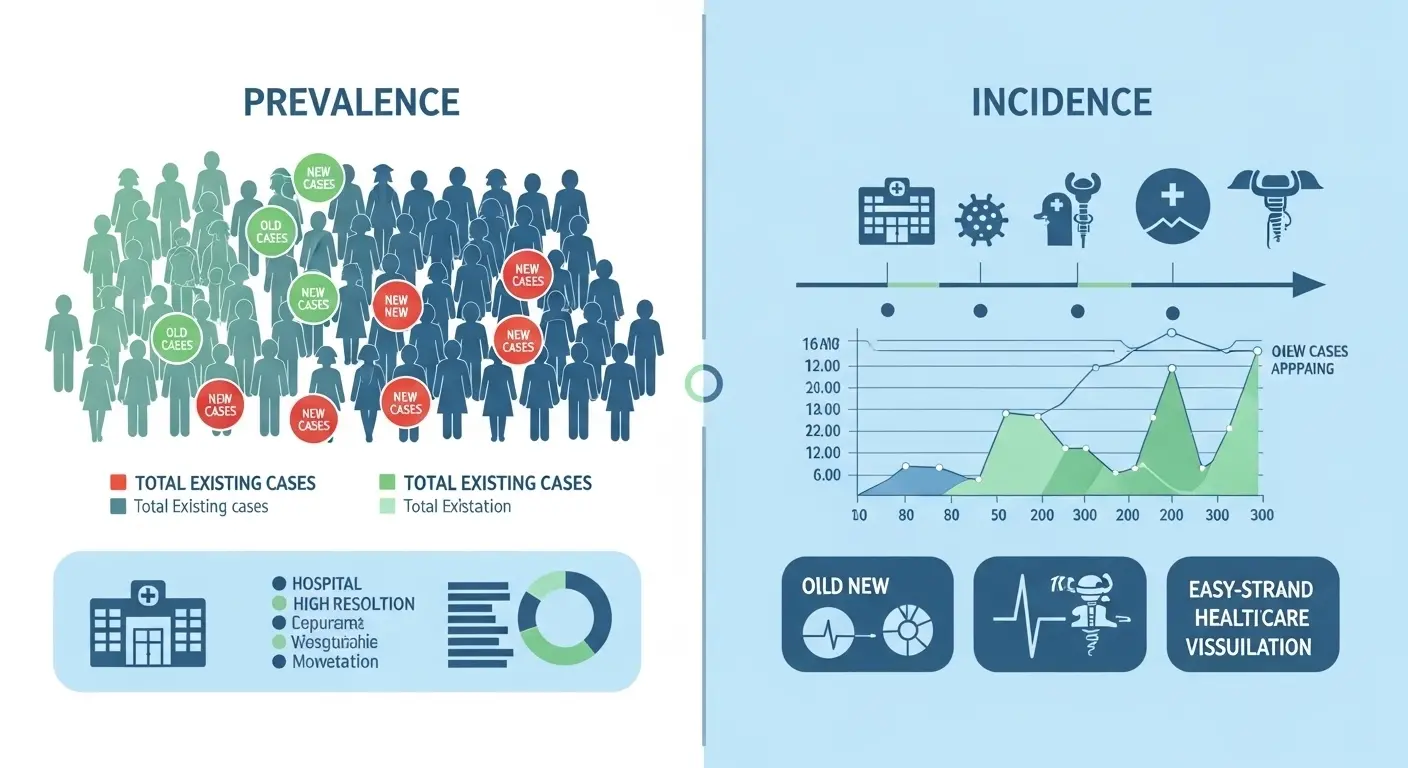
Imagine a small town where a flu outbreak begins during winter. At first, only a few people fall sick, but as days pass, more cases appear. Some people recover, while others continue to suffer. Now, if you were asked how widespread the disease is, you would be discussing prevalence. But if you were asked how many new people got sick today, you would be talking about incidence.
Understanding the difference between prevalence and incidence is essential, especially in health, research, and everyday awareness. The difference between prevalence and incidence helps us measure how diseases spread and persist over time. Whether you are a student or a professional, grasping the difference between prevalence and incidence allows you to interpret data more accurately. In simple terms, the difference between prevalence and incidence lies in “existing cases” versus “new cases,” but the concept goes much deeper.
Pronunciation (US & UK)
- Prevalence
- US: /ˈprɛv.ə.ləns/
- UK: /ˈprev.ə.ləns/
- Incidence
- US: /ˈɪn.sɪ.dəns/
- UK: /ˈɪn.sɪ.dəns/
Understanding these terms at a deeper level will help you analyze real-world situations more clearly so let’s explore them in detail.
Key Difference Between the Both
The primary difference between prevalence and incidence is simple:
- Prevalence measures all existing cases (old + new).
- Incidence measures only new cases within a specific time period.
Migrants vs Immigrants: in (2026)
Why Is Their Difference Necessary to Know for Learners and Experts?
Knowing the difference between prevalence and incidence is crucial for society. For learners, it builds a foundation in statistics, public health, and research. For experts, it helps design better healthcare policies, track disease trends, and allocate resources efficiently. Without understanding this distinction, data can be misinterpreted, leading to poor decisions in medical treatment and prevention strategies. In society, this knowledge supports disease control, awareness campaigns, and overall public safety.
H2: Difference Between Prevalence and Incidence
1. Definition
- Prevalence: Total number of existing cases in a population.
- Example 1: 200 people currently have diabetes in a city.
- Example 2: 50 students in a school have allergies.
- Incidence: Number of new cases over a time period.
- Example 1: 10 new diabetes cases this month.
- Example 2: 5 new allergy cases this week.
- Difference Between W9 and 1099: in (2026)
2. Time Factor
- Prevalence: Not time-specific (snapshot).
- Example 1: Current number of COVID-19 patients today.
- Example 2: Total cancer patients this year.
- Incidence: Always time-bound.
- Example 1: New COVID-19 cases this week.
- Example 2: New cancer diagnoses this month.
3. Nature of Measurement
- Prevalence: Measures burden of disease.
- Example 1: High prevalence of obesity shows lifestyle issues.
- Example 2: High asthma prevalence indicates environmental problems.
- Incidence: Measures risk of disease.
- Example 1: Rising incidence of flu shows spreading infection.
- Example 2: Increased incidence of dengue signals outbreak.
4. Includes Old Cases
- Prevalence: Includes both old and new cases.
- Example 1: Chronic patients included.
- Example 2: Long-term illness counted.
- Incidence: Includes only new cases.
- Example 1: Only newly diagnosed patients counted.
- Example 2: Past cases ignored.
5. Use in Research
- Prevalence: Used in surveys and health status reports.
- Example 1: National health surveys.
- Example 2: Disease burden studies.
- Incidence: Used in clinical trials and outbreak tracking.
- Example 1: Vaccine effectiveness studies.
- Example 2: Infection spread tracking.
6. Duration Impact
- Prevalence: Affected by duration of disease.
- Example 1: Chronic diseases increase prevalence.
- Example 2: Long recovery time raises numbers.
- Incidence: Not affected by duration.
- Example 1: Only new cases matter.
- Example 2: Recovery time irrelevant.
7. Indicator Type
- Prevalence: Indicator of overall health condition.
- Example 1: High hypertension prevalence.
- Example 2: Mental health statistics.
- Incidence: Indicator of disease spread.
- Example 1: Sudden spike in infections.
- Example 2: Epidemic detection.
8. Calculation
- Prevalence: Total cases ÷ population.
- Example 1: 100/1000 people = 10%.
- Example 2: 50/500 = 10%.
- Incidence: New cases ÷ population over time.
- Example 1: 10 new cases per 1000 per year.
- Example 2: 5 new cases per 500 per month.
9. Usefulness
- Prevalence: Helps in planning healthcare services.
- Example 1: Hospital beds needed.
- Example 2: Long-term care planning.
- Incidence: Helps in prevention strategies.
- Example 1: Vaccination campaigns.
- Example 2: Awareness programs.
10. Focus
- Prevalence: Focus on “how widespread.”
- Example 1: Total flu patients.
- Example 2: Total diabetic population.
- Incidence: Focus on “how fast spreading.”
- Example 1: New flu cases daily.
- Example 2: New infections weekly.
Nature and Behaviour of Both
- Prevalence: Stable, accumulative, and influenced by recovery or death rates. It reflects long-term conditions and overall disease load.
- Incidence: Dynamic, time-sensitive, and fluctuates quickly. It reflects sudden outbreaks and changes in disease spread.
Why Are People Confused About Their Use?
People often confuse these terms because both deal with counting disease cases. The difference is subtle but important: one counts total cases, while the other counts only new ones. Additionally, both are used in similar contexts like health reports, which adds to the confusion.
Table: Difference and Similarity
| Aspect | Prevalence | Incidence | Similarity |
| Definition | Total cases | New cases | Both measure disease |
| Time | Not specific | Time-bound | Used in health studies |
| Focus | Spread level | Spread rate | Population-based |
| Usage | Planning | Prevention | Epidemiology tools |
| Nature | Stable | Dynamic | Statistical measures |
Which Is Better in What Situation?
Prevalence is better when you want to understand the overall burden of a disease in a population. It helps policymakers decide how many hospitals, doctors, and medicines are needed. For chronic diseases like diabetes or hypertension, prevalence provides a clearer picture of long-term healthcare demands.
Incidence, on the other hand, is more useful when tracking new cases and controlling outbreaks. It is essential during epidemics or pandemics, where understanding how fast a disease spreads can help implement timely interventions such as quarantines, vaccinations, and awareness campaigns.
Metaphors and Similes
- Prevalence: “Like water filling a lake” it shows how much is already there.
- Incidence: “Like rain falling” it shows what is newly added.
Connotative Meaning
- Prevalence: Neutral (sometimes negative in disease context)
- Example: High prevalence of smoking.
- Incidence: Neutral
- Example: Incidence of accidents increased.
Idioms or Proverbs
(Not directly linked, but adapted usage)
- “Numbers don’t lie”
- Example: The incidence data proved the outbreak was real.
- “A growing concern”
- Example: The prevalence of obesity is a growing concern.
Works in Literature
- The Ghost Map – Steven Johnson (2006, Non-fiction)
- Spillover – David Quammen (2012, Science writing)
- The Hot Zone – Richard Preston (1994, Thriller/Non-fiction)
Movies Related to the Concepts
- Contagion (2011, USA)
- Outbreak (1995, USA)
- Pandemic (2016, USA)
Frequently Asked Questions
1. What is the main difference between prevalence and incidence?
Prevalence counts total cases, while incidence counts only new cases.
2. Which is more important?
Both are important depending on the situation, prevalence for burden, incidence for spread.
3. Can prevalence decrease while incidence increases?
Yes, if recovery is fast but new cases keep appearing.
4. Which is used in epidemics?
Incidence is mainly used to track epidemics.
5. Is prevalence always higher than incidence?
Usually yes, because it includes all cases.
How Both Are Useful for Surroundings
Prevalence helps communities understand long-term health challenges, while incidence helps detect and control sudden outbreaks. Together, they guide healthcare systems, improve awareness, and ensure better living conditions.
Final Words for Both
Prevalence shows the “big picture,” while incidence reveals the “current action.” Both are essential tools for understanding and improving public health.
Conclusion
The difference between prevalence and incidence may seem small at first, but it plays a vital role in understanding health data and real-world situations. Prevalence provides a snapshot of how widespread a condition is, while incidence highlights how quickly it is spreading.
Together, they form a complete picture of disease patterns. Whether you are a student, researcher, or policymaker, understanding this distinction helps you make informed decisions and interpret data correctly. In a world where health challenges are constantly evolving, mastering these concepts is not just academic, it is practical and essential.

Hi, I’m LunarCrest, the author behind GrammarCircle. I’m passionate about language, writing, and helping people understand the finer details of English. Through my work, I focus on explaining grammar rules, word differences, and language concepts in a simple and practical way.