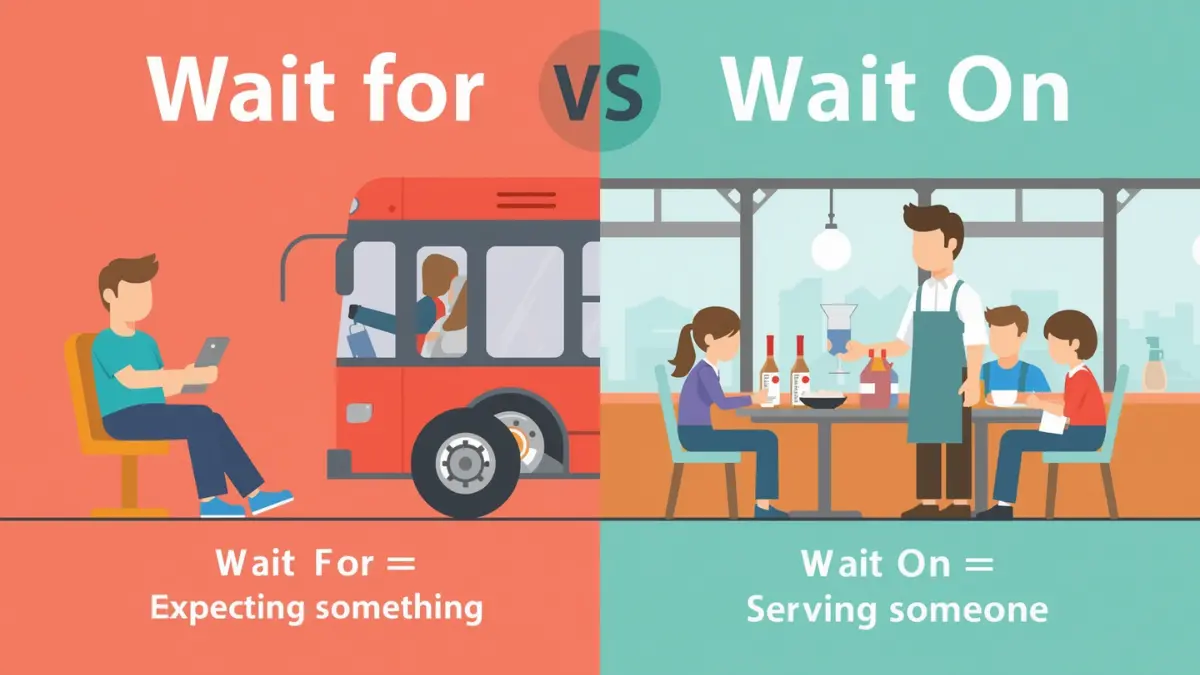
Many English learners and native speakers get confused about “wait for” or “wait on.” Both phrases sound similar, but they are not always used the same way. In some places, people say “wait for someone,” while in restaurants or customer service, you may hear “wait on someone.” This difference creates confusion in writing, speaking, and professional communication.
The good news is simple: both phrases are correct, but they have different meanings and uses depending on the context and country. Understanding the difference helps you sound natural and avoid grammar mistakes.
In this guide, you will learn the meaning of wait for and wait on, where each phrase came from, and how British and American English use them differently. You will also see comparison tables, common mistakes, real-life examples, and Google Trends insights. By the end, you will know exactly which phrase to use in emails, conversations, business writing, and daily speech.
Wait For or Wait On – Quick Answer
“Wait for” means to stay until someone or something arrives.
Example:
- I will wait for the bus.
- She waited for her friend.
“Wait on” usually means to serve someone, especially in American English.
Example:
- The waiter waited on the customers.
- A nurse waited on the patient.
In some parts of the United States, “wait on” can also mean “wait for,” but this use is regional and less common in formal English.
| Phrase | Main Meaning | Example |
| Wait for | Stay until someone/something arrives | I waited for the train. |
| Wait on | Serve or assist someone | The server waited on us. |
The Origin of Wait For or Wait On
The word “wait” comes from old Germanic and French roots meaning “to watch” or “to stay ready.” Over time, English speakers added prepositions like for and on to create different meanings.
Origin of “Wait For”
“Wait for” became common in standard English many centuries ago. It described remaining in one place until something happened.
Example:
- People waited for letters in the past.
- Travelers waited for ships to arrive.
Origin of “Wait On”
“Wait on” originally meant to attend or serve a person. Servants and workers “waited on” kings, guests, or customers.
Example:
- Servants waited on noble families.
- Restaurant staff waited on diners.
Later, some American dialects began using “wait on” to also mean “wait for.” This regional use still exists today.
Agree With or Agree To: What’s the Difference ?
British English vs American English Spelling
The difference between wait for and wait on is more about usage than spelling. Still, British and American English prefer different styles.
British English
- Mostly uses wait for
- “Wait on” usually means serving someone
Example:
- British: “I am waiting for the train.”
American English
- Uses wait for in standard writing
- Sometimes uses wait on informally to mean “wait for”
Example:
- American informal speech: “Wait on me before you leave.”
Comparison Table
| English Type | Preferred Phrase | Meaning |
| British English | Wait for | Stay until arrival |
| British English | Wait on | Serve someone |
| American English | Wait for | Standard use |
| American English | Wait on | Serve someone or regional “wait for” |
Which Spelling Should You Use?
Your choice depends on your audience and situation.
Use “Wait For” When:
- Writing formal English
- Speaking internationally
- Writing emails or business documents
- Talking about time or arrival
Example:
- Please wait for my reply.
Use “Wait On” When:
- Talking about customer service
- Referring to serving people
- Using informal American regional speech
Example:
- The staff waited on customers quickly.
On Time or In Time: What’s the Difference ?
Best Choice by Audience
| Audience | Recommended Phrase |
| United States | Wait for (formal), wait on (service context) |
| United Kingdom | Wait for |
| Canada | Wait for |
| Australia | Wait for |
| Global audience | Wait for |
Common Mistakes with Wait For or Wait On
Many learners mix these phrases because both contain the word “wait.”
| Incorrect | Correct | Reason |
| I waited on the bus. | I waited for the bus. | You are not serving the bus. |
| Please wait for me outside. | Please wait for me outside. | Standard English prefers “for.” |
| The waiter waited for us. | The waiter waited on us. | The waiter served customers. |
Easy Rule
- Wait for = delay until arrival
- Wait on = serve someone
Wait For or Wait On in Everyday Examples
In Emails
- Please wait for confirmation before payment.
- Our support team will wait on customers during office hours.
In News Writing
- Fans waited for the singer outside the stadium.
- Restaurant workers waited on guests during the event.
On Social Media
- “Can’t wait for the weekend!”
- “The staff waited on us so well tonight.”
In Formal Writing
- Applicants must wait for approval.
- Hotel staff are trained to wait on guests professionally.
Wait For or Wait On – Google Trends & Usage Data
Google search data shows that “wait for” is far more popular worldwide. It is the standard phrase used in schools, books, business writing, and international English.
Popularity by Region
| Country | Common Phrase |
| United States | Wait for |
| United Kingdom | Wait for |
| Canada | Wait for |
| Australia | Wait for |
| Southern US regions | Sometimes “wait on” |
Context Usage
| Phrase | Common Context |
| Wait for | Travel, communication, daily speech |
| Wait on | Restaurants, hotels, customer service |
Overall, “wait for” is safer and more widely understood.
Wait For vs Wait On Comparison Table
| Feature | Wait For | Wait On |
| Main meaning | Stay until arrival | Serve someone |
| Formal English | Yes | Limited |
| Common worldwide | Yes | Less common |
| Used in restaurants | Rarely | Yes |
| Used in business writing | Yes | Sometimes |
| Common in British English | Very common | Less common |
FAQs About Wait For or Wait On
Is “wait on” grammatically correct?
Yes. It is correct when talking about serving or assisting someone.
Can “wait on” mean “wait for”?
Yes, in some American dialects, but it is informal.
Which is more common: wait for or wait on?
“Wait for” is much more common worldwide.
Should I use “wait for” in formal writing?
Yes. It is the safest and most professional choice.
Do British people say “wait on”?
Usually only when talking about service or hospitality.
Is “wait on me” rude?
Not always, but it can sound informal depending on the region.
What do restaurants use?
Restaurants often use “wait on” because it means serving customers.
Conclusion
Understanding the difference between “wait for” and “wait on” makes English clearer and more natural. The phrase “wait for” is the standard choice when talking about staying until someone or something arrives. It is widely used in British English, American English, and international communication. Because of this, it is the safest option for formal writing, business emails, academic work, and everyday speech.
On the other hand, “wait on” usually means serving or assisting someone. You will often hear it in restaurants, hotels, and customer service settings. In some parts of the United States, people also use “wait on” instead of “wait for,” but this use is informal and regional.
If you are unsure which phrase to use, choose “wait for.” It sounds natural to most English speakers around the world and avoids confusion. Learning these small differences improves both your grammar and confidence in English communication.

Hi, I’m LunarCrest, the author behind GrammarCircle. I’m passionate about language, writing, and helping people understand the finer details of English. Through my work, I focus on explaining grammar rules, word differences, and language concepts in a simple and practical way.