Many English learners get confused between “addicted to” and “addicted on.” Both look similar, but only one is correct in standard English. This small grammar doubt often appears in school writing, emails, social media posts, and even professional communication. People search for this keyword because they want a quick and clear answer: Which preposition should come after “addicted”?
The confusion happens because English prepositions are tricky. Different verbs use different prepositions, and sometimes informal speech creates wrong patterns like “addicted on.” Learners also hear mixed usage online, which increases uncertainty.
This article will clearly explain the correct usage of “addicted to or addicted on.” You will learn the correct form, its origin, common mistakes, and real-life examples. You will also see comparisons between British and American usage, plus a simple table for quick understanding.
By the end, you will never confuse these two again.
Addicted to or Addicted on – Quick Answer
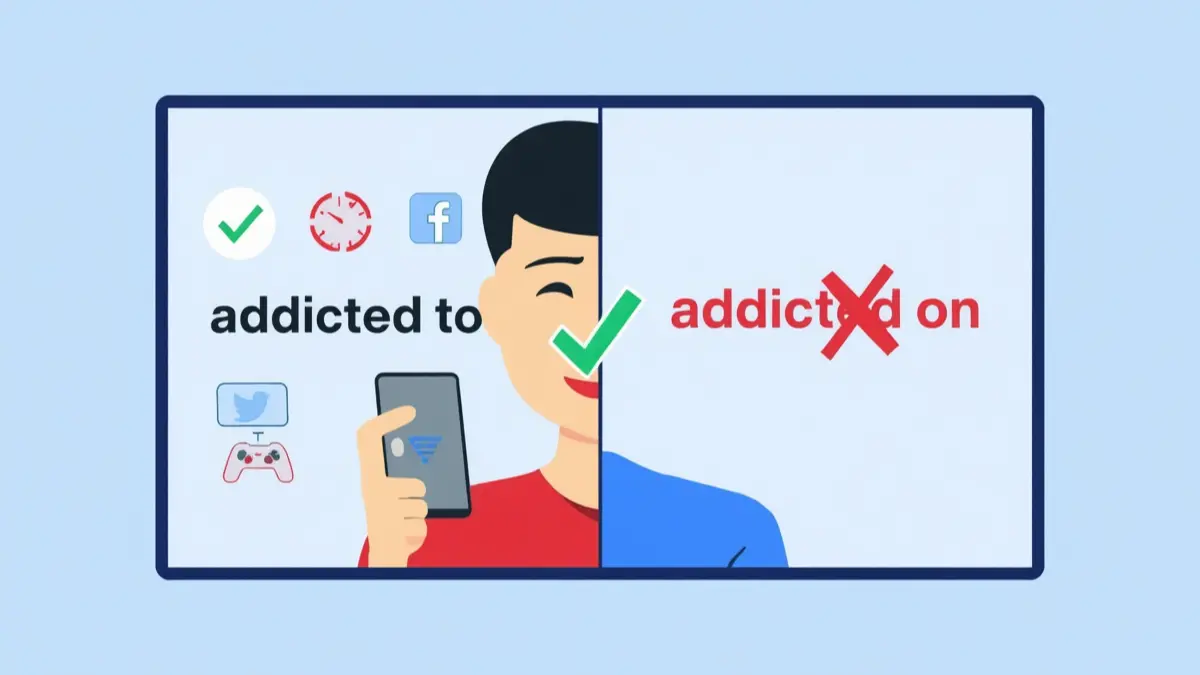
The correct phrase is “addicted to.”
✔ Correct:
- He is addicted to social media.
- She is addicted to coffee.
❌ Incorrect:
- He is addicted to social media.
- She is addicted to coffee.
Simple rule:
Use “addicted to + noun/verb-ing”
Preferable to or Preferable than: Which One Is Correct?
The Origin of “Addicted to”
The word addicted comes from the Latin addicere, meaning “to give over” or “to devote.” In early English, “addicted” meant being strongly devoted to something.
Over time, the meaning shifted toward dependence, especially harmful habits like drugs, gaming, or social media use.
The preposition “to” became standard because it shows direction or attachment. In grammar, “to” connects a person to what they depend on.
Example:
- Addicted to = attached or dependent on something
The phrase “addicted on” is not historically correct in English grammar. It likely appeared from informal speech patterns.
British English vs American English Spelling
Good news: Both British and American English use the same phrase.
✔ Both use: addicted to
There is no spelling difference between UK and US English for this phrase.
Comparison Table
| Usage Type | Correct Form | Example |
| British English | addicted to | He is addicted to tea. |
| American English | addicted to | He is addicted to coffee. |
| Incorrect Form | addicted on | ❌ Not standard English |
Which Spelling Should You Use?
Use “addicted to” in all situations:
- US English: Always “addicted to”
- UK English: Always “addicted to”
- Academic Writing: “addicted to” only
- Business Emails: “addicted to” only
- Social Media: Avoid “addicted on” for correct grammar
👉 There is no accepted situation where “addicted on” is correct.
Agree With or Agree To: What’s the Difference ?
Common Mistakes with “Addicted to”
Here are frequent errors learners make:
Why this mistake happens:
- Influence of other prepositions like “based on”
- Informal spoken English
- Direct translation from native languages
“Addicted to” in Everyday Examples
Email Example:
- “He has become addicted to online meetings, so we should manage his screen time.”
News Example:
- “Teenagers are increasingly addicted to short-form video apps.”
Social Media Example:
- “I’m totally addicted to coffee ☕”
Formal Writing Example:
- “Many individuals are addicted to technology in modern society.”
“Addicted to” – Google Trends & Usage Data
Search behavior shows that:
- High searches come from India, Pakistan, Bangladesh, and non-native English countries
- Most users search because they hear “addicted on” in speech
- “Addicted to” is the only grammatically accepted form worldwide
- “Addicted on” has almost no formal usage in writing or academic content
👉 Conclusion: “Addicted to” dominates global English usage.
Comparison Table: Addicted to vs Addicted on
| Phrase | Correct? | Usage Level | Example |
| addicted to | ✔ Yes | Standard English | addicted to gaming |
| addicted on | ❌ No | Incorrect usage | addicted on gaming |
FAQs
1. Is it “addicted to” or “addicted on”?
The correct form is addicted to.
2. Why do people say “addicted on”?
It comes from informal speech and confusion with other prepositions.
3. Is “addicted on” ever correct?
No, it is not correct in standard English.
4. Can we say “addicted to drugs”?
Yes, this is correct and commonly used.
5. Is “addicted to” used in British English?
Yes, British English also uses “addicted to.”
6. What grammar rule is used with “addicted”?
Always use addicted + to + noun/gerund.
7. Can I use “addicted to” in formal writing?
Yes, it is correct in academic and professional writing.
Conclusion
Understanding the difference between “addicted to” and “addicted on” is simple once you know the rule. The correct and only standard form is “addicted to.” This applies to all types of English, including British, American, academic, and professional writing.
The confusion happens mainly because learners hear incorrect informal usage. But in proper English grammar, “to” is the fixed preposition that connects a person with what they depend on or cannot stop doing.
By using “addicted to” correctly, your writing becomes more natural, clear, and professional. Whether you are writing emails, essays, or social media posts, this small correction improves your English accuracy instantly.
Keep practicing with real examples, and soon this mistake will disappear completely from your writing.

Hi, I’m DreamAnchor, the author behind GrammarCircle. I am passionate about language, writing, and helping people understand the small but important differences in English words and concepts. Through my work, I focus on explaining grammar rules, word comparisons, and language usage in a simple and practical way so that students, writers, and professionals can improve their communication skills.