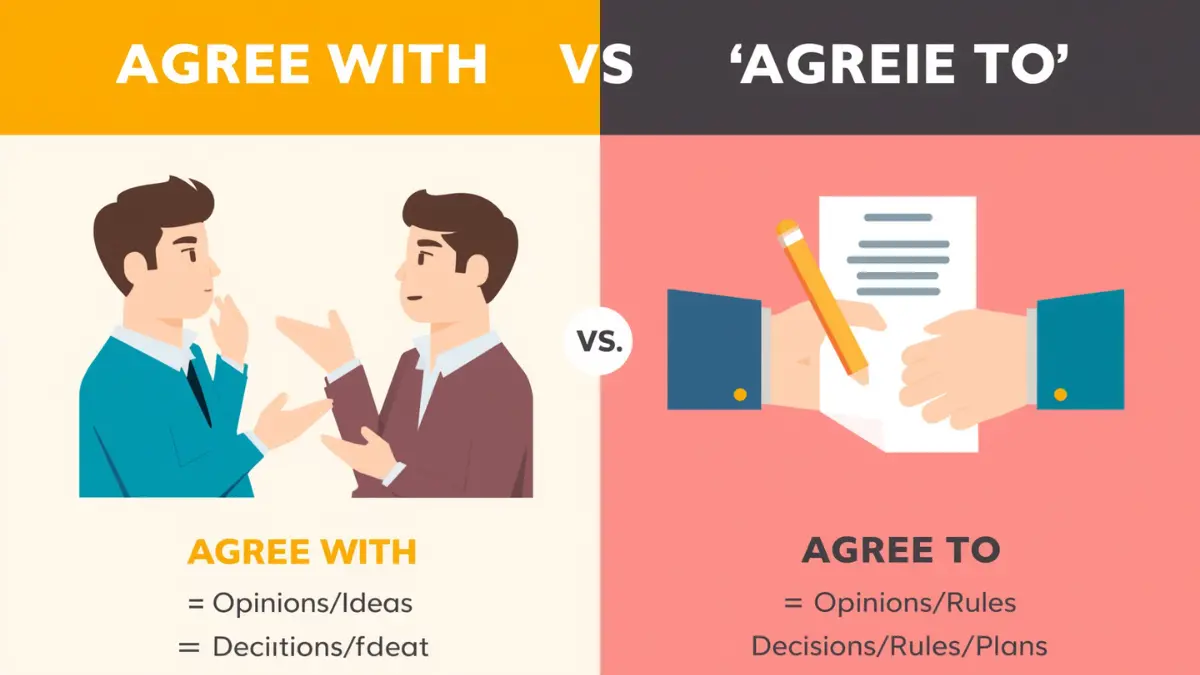
Many English learners ask about “agree with or agree to” because both phrases look similar. Yet, they are used in different ways. This can make writing and speaking confusing.
For example, should you say:
- “I agree with you.”
- Or “I agree with you.”
Only one is correct in that sentence.
People often search for this keyword because they want to sound natural in emails, school work, business writing, and daily conversations. Native speakers use both phrases often, but each one follows a different grammar rule.
The good news is that the difference is simple once you understand it.
In this guide, you will learn:
- The quick answer
- The meaning of each phrase
- Common mistakes
- Real-life examples
- British vs American English usage
- Google Trends and popularity
- FAQs and expert advice
By the end, you will know exactly when to use agree with and when to use agree to.
Agree With or Agree To – Quick Answer
Use agree with for:
- A person
- An opinion
- An idea
- A statement
Use agree to for:
- A plan
- A proposal
- A request
- Terms or conditions
Good At or Good In : Which One Should You Use?
Examples
| Correct Phrase | Example |
| Agree with | I agree with your opinion. |
| Agree with | She agrees with the teacher. |
| Agree to | We agreed to the new rules. |
| Agree to | He agreed to help us. |
Easy Rule
- Agree with = same opinion
- Agree to = accept something
The Origin of Agree With or Agree To
The word agree comes from the Old French word agreer, which means “to please” or “to accept willingly.” Later, English speakers began using different prepositions after the word.
Over time:
- Agree with becoming linked to opinions and people.
- Agree to become linked to decisions, offers, and actions.
These phrases are not spelling differences. They are grammar patterns called verb-preposition combinations.
That is why both phrases are correct, but they fit different situations.
Historical Examples
| Phrase | Traditional Meaning |
| Agree with | Share the same view |
| Agree to | Accept a proposal |
English kept both forms because they help show different meanings clearly.
At the End or In the End: What’s the Difference?
British English vs American English Spelling
There is no major spelling difference between British English and American English for agree with or agree to.
Both forms are used the same way in:
- The United States
- The United Kingdom
- Canada
- Australia
- New Zealand
The grammar rules stay almost identical.
Comparison Table
| Usage | British English | American English |
| Agree with someone | Correct | Correct |
| Agree to a plan | Correct | Correct |
| Agree with an idea | Correct | Correct |
| Agree to terms | Correct | Correct |
Example Sentences
| British English | American English |
| I agree with the report. | I agree with the report. |
| They agreed to the contract. | They agreed to the contract. |
So, unlike many English keywords, this one is about grammar, not spelling.
Which Spelling Should You Use?
You should use:
- Agree with when talking about opinions or people
- Agree to when accepting plans or requests
Audience-Based Advice
| Audience | Best Choice |
| US readers | Standard grammar rules |
| UK readers | Standard grammar rules |
| Global audience | Use the same rules everywhere |
Since both phrases are accepted worldwide, your focus should be on meaning, not location.
Common Mistakes with Agree With or Agree To
Many learners mix these phrases because they translate directly from other languages.
Here are common errors.
| Incorrect | Correct |
| I agree with you. | I agree with you. |
| She agreed with the proposal. | She agreed to the proposal. |
| We agree with his opinion. | We agree with his opinion. |
| He agreed to join us. | He agreed to join us. |
Why These Mistakes Happen
People confuse:
- opinions
- people
- decisions
- actions
Remember:
- with = opinion/person
- to = acceptance/action
Agree With or Agree To in Everyday Examples
In Emails
- I agree with your suggestion.
- We agree to the new schedule.
In News Writing
- The minister agreed to the peace deal.
- Experts agree with the findings.
On Social Media
- I totally agree with you!
- They agreed to the challenge online.
In Formal Writing
- Both parties agreed to the contract.
- Researchers agree with earlier studies.
In Conversations
| Situation | Correct Usage |
| Same opinion | I agree with you. |
| Accepting an offer | I agree to the deal. |
| Supporting an idea | We agree with the plan. |
| Accepting conditions | She agreed to the rules. |
Agree With or Agree To – Google Trends & Usage Data
Search interest to agree with or agree to stay high because English learners often struggle with prepositions.
Popular Countries
This keyword is searched often in:
- India
- Pakistan
- Philippines
- United States
- United Kingdom
Why People Search It
Users usually want:
- Grammar help
- Writing correction
- Email accuracy
- Better spoken English
Usage Context
| Phrase | Common Context |
| Agree with | Opinions, debates, discussions |
| Agree to | Contracts, offers, requests |
General Trend
- Agree with appears more in conversations.
- Agree to appear more in legal and formal writing.
Comparison Table: Agree With vs Agree To
| Feature | Agree With | Agree To |
| Used for opinions | Yes | No |
| Used for people | Yes | No |
| Used for requests | No | Yes |
| Used for contracts | No | Yes |
| Used in debates | Yes | Sometimes |
| Used in formal agreements | Rarely | Often |
FAQs About Agree With or Agree To
Is “agree to you” correct?
No. The correct phrase agrees with you.
When should I use “agree to”?
Use it when accepting something, such as:
- a request
- an offer
- a proposal
Can I say “agree with a plan”?
Yes. It means you think the plan is good.
Can I say “agree to a plan”?
Yes. It means you accept the plan officially.
Which phrase is more formal?
Agree sounds more formal because it is common in business and legal writing.
Do native speakers use both phrases?
Yes. Native speakers use both every day.
Is this a British or American English issue?
No. Both British and American English use the same grammar rules.
Conclusion
Understanding agree with or agree to is easier than many learners think. The main difference is meaning.
Use agree with when talking about:
- people
- opinions
- ideas
- beliefs
Use agree to when accepting:
- requests
- plans
- contracts
- actions
This simple rule can improve your speaking and writing quickly. It also helps you sound more natural in emails, meetings, school work, and conversations.
Many learners make mistakes because both phrases seem similar. However, once you remember the core meanings, choosing the right one becomes simple.
A good memory trick is:
- with = same opinion
- to = accept something
These rules work in British English, American English, and global English. So you can use them confidently anywhere.
Practice with real sentences every day, and soon the difference between agree with and agree to will feel natural.

Hi, I’m DreamAnchor, the author behind GrammarCircle. I am passionate about language, writing, and helping people understand the small but important differences in English words and concepts. Through my work, I focus on explaining grammar rules, word comparisons, and language usage in a simple and practical way so that students, writers, and professionals can improve their communication skills.