Many English learners and even native speakers get confused by “at the end” and “in the end.” They look similar, but they do not mean the same thing. This small difference can change the meaning of a sentence.
People often search for this keyword because they want to write correct emails, school papers, blog posts, or social media captions. They may ask questions like:
- Is it “at the end” or “in the end”?
- Are they interchangeable?
- Which phrase sounds more natural?
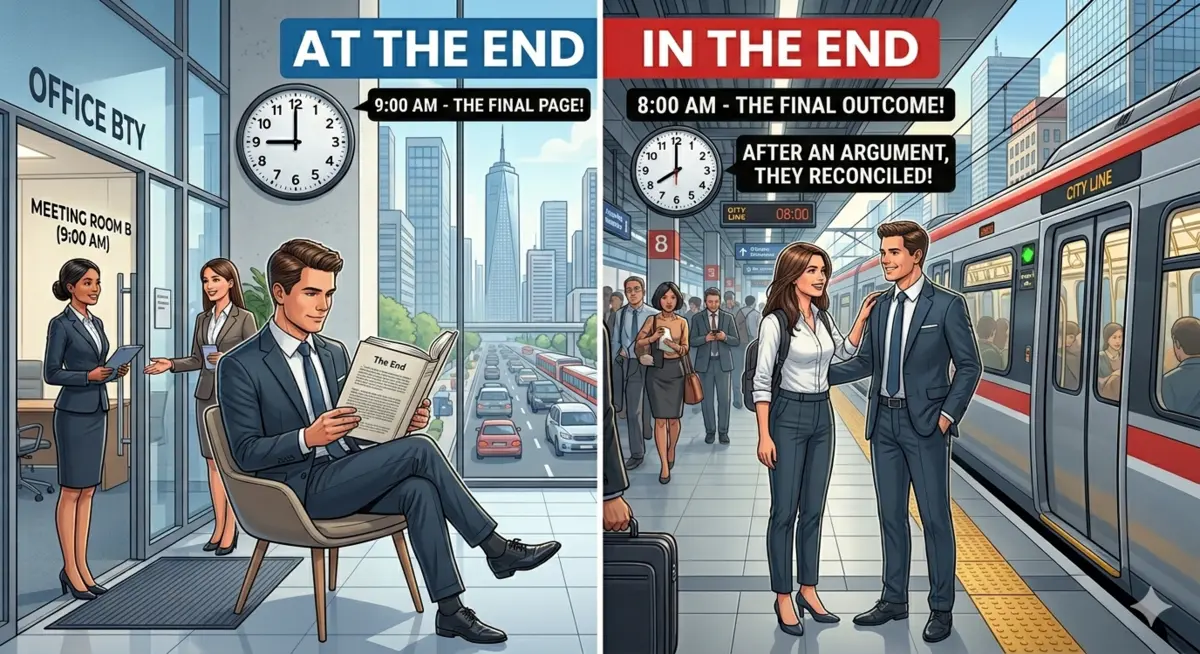
The good news is that the difference is simple once you understand the context. “At the end” usually talks about a place or time position, while “in the end” means “finally” or “after everything happened.”
This guide explains the meaning, history, grammar, examples, common mistakes, and usage trends of both phrases. By the end, you will know exactly when to use each one in daily English.
At the End or In the End – Quick Answer
“At the end”
Use “at the end” when talking about the final part of something.
Examples:
- Please sign your name at the end of the page.
- We met at the end of the movie.
- There is a shop at the end of the street.
“In the end”
Use “in the end” when meaning finally, eventually, or after all events.
Examples:
- In the end, they got married.
- She was nervous, but in the end she did well.
- We argued a lot, but in the end we agreed.
Simple Rule
- At the end = final position or point
- In the end = final result or outcome
On Time or In Time: What’s the Difference ?
The Origin of At the End or In the End
The word “end” comes from the Old English word ende, meaning “limit,” “boundary,” or “final part.”
Over time, English speakers created different expressions using the word “end.”
Origin of “At the End”
The phrase “at the end” developed to describe a physical or time-related position.
Examples from history:
- At the end of the road
- At the end of the story
- At the end of the year
It became common in everyday speech because people needed a way to describe the last part of something.
Origin of “In the End”
The phrase “in the end” became popular later as an idiom meaning “eventually” or “after everything.”
It focuses on the result instead of the position.
Example:
- In the end, truth wins.
Why the Confusion Exists
Both phrases contain the same word: end. Because of this, many learners think they mean the same thing. However, their grammar and purpose are different.
British English vs American English Spelling
There is no spelling difference between “at the end” and “in the end” in British and American English. Both regions use the same spelling and meaning.
The difference is mainly about usage and style.
British English Examples
- At the end of the programme
- In the end, they accepted the offer
American English Examples
- At the end of the program
- In the end, they accepted the offer
The only small change is words like:
- programme → program
- colour → color
The phrases themselves stay the same.
Comparison Table
| Feature | British English | American English |
| At the end | Same usage | Same usage |
| In the end | Same usage | Same usage |
| Meaning difference | Yes | Yes |
| Common in speech | Very common | Very common |
| Formal writing | Accepted | Accepted |
Which Spelling Should You Use?
Since both phrases are correct, the choice depends on your meaning.
Use “At the End” When:
- Talking about location
- Talking about the final section
- Mentioning a specific time point
Examples:
- At the end of the class
- At the end of the book
- At the end of the month
Use “In the End” When:
- Talking about results
- Talking about outcomes
- Saying “finally”
Examples:
- In the end, we succeeded.
- In the end, he apologized.
Audience-Based Advice
| Audience | Recommended Phrase |
| US readers | Both are correct |
| UK readers | Both are correct |
| Global audience | Use based on meaning |
| Academic writing | Use carefully by context |
| Business emails | Choose the phrase that matches intent |
Common Mistakes with At the End or In the End
Many people mix these phrases because they both include “end.”
Mistake 1: Using “In the End” for Position
❌ The park is in the end of the street.
✅ The park is at the end of the street.
Mistake 2: Using “At the End” for Final Result
❌ At the end, they decided to move.
✅ In the end, they decided to move.
Mistake 3: Forgetting Context
❌ At the end, love won.
✅ In the end, love won.
Mistake 4: Confusing Time and Result
❌ In the end of the movie, everyone clapped.
✅ At the end of the movie, everyone clapped.
At the End or In the End in Everyday Examples
In Emails
- Please review the notes at the end of the document.
- In the end, we approved the project.
In News Writing
- The president spoke at the end of the event.
- In the end, the team won the match.
On Social Media
- I cried at the end of the film.
- In the end, everything worked out.
In Formal Writing
- The summary appears at the end of the report.
- In the end, the research supported the theory.
In Conversations
- Meet me at the end of the hallway.
- In the end, we stayed home.
At the End or In the End – Google Trends & Usage Data
Search data shows that both phrases are very popular worldwide because learners often confuse them.
“At the End”
Most commonly searched for:
- Grammar help
- Essay writing
- School assignments
- Location descriptions
Popular in:
- United States
- United Kingdom
- India
- Pakistan
“In the End”
Most commonly searched for:
- Speaking English naturally
- Storytelling
- Formal writing
- IELTS and TOEFL preparation
Popular in:
- Canada
- Australia
- Philippines
- Nigeria
Usage Context Comparison
| Phrase | Main Meaning | Common Context |
| At the end | Final point or position | Time, location |
| In the end | Final result | Outcomes, conclusions |
| At the end of | Specific object or event | Books, roads, movies |
| In the end | General conclusion | Stories, decisions |
Comparison Table: At the End vs In the End
| Phrase | Meaning | Example | Type |
| At the end | Final position | At the end of the road | Location |
| At the end | Final moment | At the end of the class | Time |
| In the end | Eventually | In the end, she agreed | Result |
| In the end | After all events | In the end, peace returned | Conclusion |
FAQs
Is “at the end” correct?
Yes. It is correct when talking about the last part or position of something.
Is “in the end” correct?
Yes. It means finally or eventually.
Can I use them interchangeably?
No. They have different meanings.
Which phrase is more formal?
Both are formal and accepted in professional writing.
Do Americans and British people use both phrases?
Yes. Both phrases are common in American and British English.
Is “in the end of” correct?
Usually no. Native speakers normally say:
- At the end of the movie
- In the end, we left
How can I remember the difference?
Think of this:
- At = place or point
- In = result or conclusion
Conclusion
The difference between “at the end” and “in the end” is small but important. Understanding this grammar point can improve your writing and speaking immediately.
Use “at the end” when you talk about the last part of something. It often refers to location or time. For example, you can say “at the end of the road” or “at the end of the meeting.”
Use “in the end” when talking about a final result or conclusion. It means “eventually” or “after everything happened.” For example, “In the end, we solved the problem.”
Both phrases are correct in British and American English, so the key is choosing the right meaning. If you remember that “at” points to position and “in” points to outcome, you will avoid most mistakes.
With practice, these phrases will start to feel natural in emails, conversations, academic writing, and everyday English.

Hi, I’m DreamAnchor, the author behind GrammarCircle. I am passionate about language, writing, and helping people understand the small but important differences in English words and concepts. Through my work, I focus on explaining grammar rules, word comparisons, and language usage in a simple and practical way so that students, writers, and professionals can improve their communication skills.