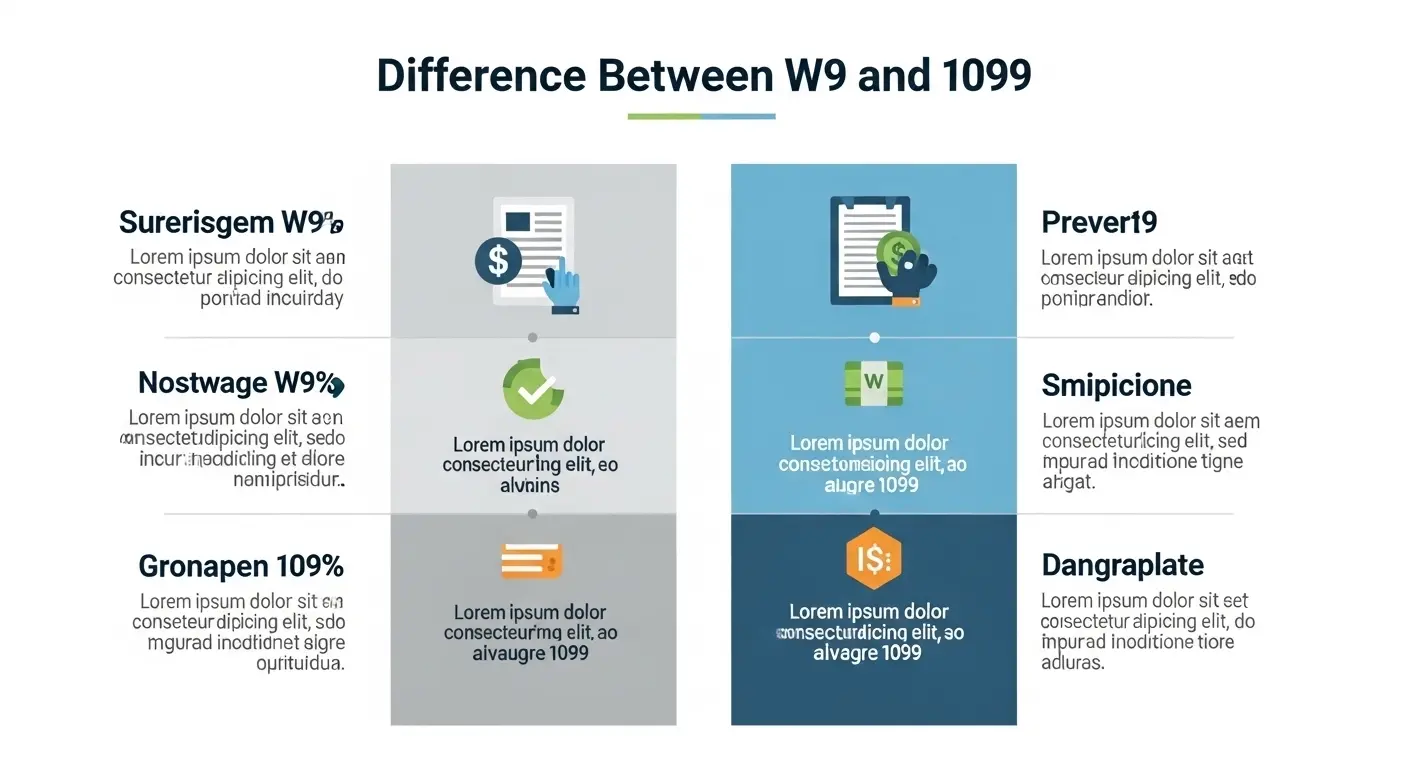
The difference between W9 and 1099 is one of the most commonly searched topics in the world of U.S. taxation, especially for freelancers, contractors, and small business owners. Many people get confused when dealing with payments and tax reporting, often asking about the difference between W9 and 1099 while setting up work agreements or filing taxes.
To put it simply, these forms are connected but serve very different purposes. Understanding the difference between W9 and 1099 can save you from tax errors, compliance issues, and financial misunderstandings.
Imagine a freelance graphic designer named Alex who just started working with multiple U.S. companies. Each client asks for a W9 form before payment, but at year-end, Alex receives several 1099 forms. This situation creates confusion until Alex learns that one form is for providing information and the other is for reporting income. That’s where understanding the difference between W9 and 1099 becomes essential in real-world financial transactions.
Pronunciation
- W9
- US: “Double-U Nine”
- UK: “Double-U Nine”
- 1099
- US: “Ten Ninety-Nine”
- UK: “Ten Ninety-Nine”
Now that we understand the basics, let’s explore how these two forms actually work and why they matter in the financial system.
Key Difference Between W9 and 1099
The main difference is simple:
- W9 is a request form for taxpayer information.
- 1099 is an income reporting form issued to contractors.
In other words, W9 collects data, while 1099 reports earnings to the IRS.
Difference Between Jackie and Shadow
Why Knowing the Difference is Important
Understanding the difference between W9 and 1099 is essential for freelancers, businesses, accountants, and even students entering the financial world. It ensures tax compliance, avoids penalties, and supports transparent financial reporting. In society, it helps maintain a structured economy where income is properly recorded and taxed. For professionals, it builds trust between clients and workers, ensuring smooth financial operations.
Difference Between W9 and 1099
1. Purpose
- W9: Collects taxpayer details
- Example: A company asks a freelancer for a W9 before hiring.
- Example: A bank requests a W9 for account verification.
- 1099: Reports income earned
- Example: A freelancer receives a 1099 for $5,000 earned.
- Example: A consultant gets a 1099 from multiple clients.
- Difference Between Expat and Immigrant: in (2026)
2. Who Issues It
- W9: Filled by the contractor or freelancer
- Example: A photographer fills it for a client.
- Example: A writer submits it to an agency.
- 1099: Issued by the payer/business
- Example: A company sends it to a contractor.
- Example: A platform like Uber issues it to drivers.
3. Timing
- W9: Submitted before work starts
- Example: Before a project begins.
- Example: At onboarding stage.
- 1099: Issued after year-end
- Example: Sent in January.
- Example: Used for annual tax filing.
4. Information Contained
- W9: Name, address, TIN/SSN
- Example: Freelancer provides SSN.
- Example: Business gives EIN.
- 1099: Income details
- Example: Total earnings of $10,000.
- Example: Payment breakdown per client.
5. Purpose in Tax System
- W9: Helps prepare reporting
- Example: Client collects data for IRS forms.
- Example: Prevents tax withholding errors.
- 1099: Reports taxable income
- Example: Sent to IRS for record.
- Example: Used during tax filing.
6. Recipient
- W9: Given to payer (not IRS)
- Example: Freelancer sends it to clients.
- Example: Vendor submits it to company.
- 1099: Sent to freelancer and IRS
- Example: Contractor receives copy.
- Example: IRS gets official record.
7. Legal Role
- W9: Identity verification document
- Example: Confirms tax status.
- Example: Avoids backup withholding.
- 1099: Income declaration document
- Example: Required for tax reporting.
- Example: Helps IRS track earnings.
8. Frequency
- W9: One-time or updated when needed
- Example: Updated if address changes.
- Example: Provided once per client.
- 1099: Annual reporting form
- Example: Issued every tax year.
- Example: Multiple forms per freelancer.
9. IRS Involvement
- W9: Not sent directly to IRS
- Example: Kept by company.
- Example: Stored for records.
- 1099: Submitted to IRS
- Example: Reported income details.
- Example: Used for audits.
10. Risk Factor
- W9: Low risk, informational
- Example: No tax liability.
- Example: Just identity data.
- 1099: High importance for taxes
- Example: Missing income leads to penalties.
- Example: Incorrect reporting causes issues.
Nature and Behaviour
- W9: Passive, informational, and preparatory in nature. It simply gathers data and does not involve tax calculation.
- 1099: Active, reporting-based, and financial in nature. It directly affects tax obligations and income reporting.
Why People Get Confused
People often confuse W9 and 1099 because both are used in freelance and contract work. They are closely linked in process—one is requested before payment and the other is issued after payment. The similar names and tax context add to the confusion.
Table: Difference and Similarity Between W9 and 1099
| Feature | W9 | 1099 |
| Purpose | Collect taxpayer info | Report income |
| Issued By | Contractor | Employer/client |
| Sent To IRS | No | Yes |
| Timing | Before work | After year-end |
| Nature | Informational | Reporting |
| Use | Identity verification | Tax filing |
Which is Better in What Situation?
The W9 form is better when a business needs to hire a freelancer or contractor and must collect tax identification details. It ensures compliance before payments begin. On the other hand, the 1099 form is better for tax reporting purposes at the end of the year, helping both the IRS and individuals track income accurately. Neither is “better” overall; they serve different stages of financial transactions. W9 supports the hiring process, while 1099 supports tax reporting and legal accountability.
Metaphors and Similes
- W9 as a key collection box: It gathers information like a mailbox collecting letters.
- 1099 as a tax mirror: It reflects what you earned throughout the year.
Connotative Meaning
- W9: Neutral – administrative and informational
- 1099: Slightly serious/official – linked to taxes and obligations
Examples:
- Submitting a W9 feels routine and neutral.
- Receiving a 1099 often signals tax preparation responsibility.
Idioms or Proverbs
There are no direct idioms for W9 or 1099, but related expressions include:
- “Pay your dues” – related to 1099 tax obligations
- Example: Freelancers must pay their dues after receiving 1099 forms.
Works in Literature
There are no known literary works specifically focused on W9 or 1099 forms, as they are administrative tax documents rather than literary subjects.
Movies Related to the Concept
No films are directly based on W9 or 1099 forms. However, tax and finance themes appear in movies like:
- The Big Short (2015, USA) – financial systems
- Margin Call (2011, USA) – corporate finance
Frequently Asked Questions
1. What is a W9 form used for?
It is used to collect taxpayer information from freelancers or contractors.
2. What is a 1099 form used for?
It reports income earned by independent workers.
3. Who fills out a W9?
The contractor or freelancer fills it out.
4. Who issues a 1099?
The employer or client issues it.
5. Do I need both W9 and 1099?
Yes, if you work as a freelancer in the U.S.
Use in Surroundings
Both forms help maintain financial transparency in workplaces. Businesses use W9 for hiring compliance, while individuals use 1099 for tax reporting. Together, they support a structured economic system.
Final Words
Understanding both forms is crucial for anyone working in the U.S. freelance or contract economy. The W9 and 1099 difference is not just technical—it impacts how income is recorded, reported, and taxed. Knowing their roles helps avoid confusion and ensures smooth financial operations for individuals and businesses alike.
Conclusion
In summary, the difference between W9 and 1099 lies in their purpose and timing. W9 collects essential taxpayer information before work begins, while 1099 reports income after payments are made.
Both forms are interconnected parts of the U.S. tax system, ensuring transparency and compliance. Whether you are a freelancer, employer, or accountant, understanding these forms helps you manage finances effectively and avoid tax-related issues. Mastering the difference between W9 and 1099 is essential for smooth professional and financial operations.

I’m BeaconRise, the author behind GrammarCircle, where I help readers understand English grammar, language differences, and writing concepts in a simple and practical way. I specialize in explaining confusing words, grammar rules, and “difference between” topics so learners can easily improve their writing and communication skills.