Many English learners and even native speakers get confused between “compare to” and “compare with.” Both phrases look similar, but they are not always used in the same way. This small difference often changes meaning in writing, exams, business communication, and even SEO content.
People usually search for this keyword because they want a quick rule they can remember. Some are writing essays, emails, or reports and are unsure which one sounds correct. Others see both forms in books, news, and online articles and think one might be wrong.
The confusion happens because English does not always follow strict rules in everyday use. In British and American English, both phrases can sometimes overlap, but traditional grammar books still suggest different uses.
In this article, you will learn the simple difference between compare to and compare with, their origin, correct usage, common mistakes, and real-life examples. By the end, you will know exactly which one to use without hesitation.
Compare to or Compare with – Quick Answer
Simple rule:
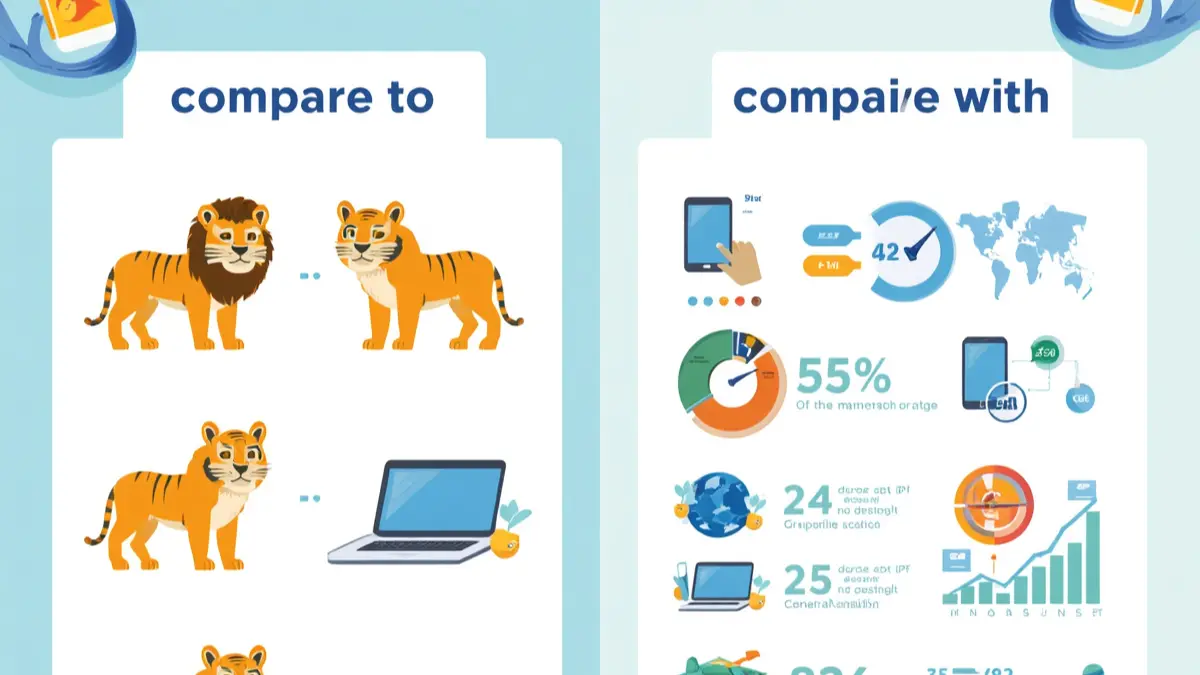
- Compare to → Used when showing similarity between two things
- Compare with → Used when showing differences between two things
Examples:
- She compared his smile to the sun. (similarity)
- Compare this phone with that one. (differences)
In short:
- “to” = similarity
- “with” = analysis or comparison
Read more: Up to date or Up-to-Date: Meaning and Differences explained?
The Origin of Compare to or Compare with
The word “compare” comes from Latin comparare, meaning “to match” or “to liken.”
In Old English usage:
- “Compare to” developed first to show likeness
- “Compare with” later became common for detailed examination
Over time, English speakers started using both forms in flexible ways. Modern English now allows overlap, but traditional grammar still keeps the distinction.
British English vs American English Spelling
There is no spelling change here, but usage preference differs slightly.
| Feature | British English | American English |
| Compare to | Common for similarity | Very common |
| Compare with | Formal comparison | Less strict usage |
| Rule strictness | More traditional | More flexible |
Key point:
- British English keeps the distinction clearer
- American English often uses both interchangeably
Read more: Benefitting or Benefiting: Understanding the Correct Spelling ?
Which Spelling Should You Use?
Your choice depends on your audience:
- USA audience: Either is acceptable
- UK/Commonwealth audience: Prefer traditional usage
- Academic writing:
- Use compare to for similarity
- Use compare with for analysis
- Business writing: Use “compare with” for reports and data
Common Mistakes with Compare to or Compare with
Mistake 1:
❌ He compared the car to the bike (when showing differences)
✔ He compared the car with the bike
Mistake 2:
❌ She compared his voice with an angel (wrong context)
✔ She compared his voice to an angel
Mistake 3:
Mixing both without meaning clarity
❌ Compare this with that to find similarity
✔ Compare this with that to find differences
Compare to or Compare with in Everyday Examples
Emails:
- “I have compared the report with last month’s data.”
Social Media:
- “This new phone is like comparing Tesla to old cars.”
News Writing:
- “Experts compared the economy with previous years.”
Formal Reports:
- “The results were compared with industry standards.”
Compare to or Compare with – Google Trends & Usage Data
Search behavior shows:
- “compare to” → higher usage in casual writing and social media
- “compare with” → more common in academic and business contexts
- USA → balanced use of both
- UK → stronger preference for “compare with” in formal writing
- India, Pakistan, and other ESL regions → mixed usage, often confused
Overall trend:
People search this keyword mainly for grammar clarity and writing accuracy, especially students and content writers.
Comparison Table: Compare to vs Compare with
| Feature | Compare to | Compare with |
| Main meaning | Similarity | Differences |
| Tone | Figurative | Analytical |
| Example | She compared him to a hero | Compare data with last year |
| Usage style | Creative writing | Reports, analysis |
| Formality | Medium | High |
FAQs
1. Is “compare to” correct?
Yes, it is correct when showing similarity between two things.
2. Is “compare with” correct?
Yes, it is correct when analyzing differences or details.
3. Can I use both interchangeably?
In modern English, sometimes yes, but it is better to follow the traditional rule.
4. Which is more formal?
“Compare with” is generally more formal.
5. What is the main difference?
“Compare to” = similarity, “compare with” = detailed comparison.
6. Do British and American English differ?
Yes, British English is stricter; American English is more flexible.
7. Which should I use in exams?
Use “compare with” for analysis and “compare to” for similarity.
Conclusion
Understanding compare to or compare with is simple once you know the basic rule. “Compare to” is used when you want to show similarity between two things, often in creative or descriptive writing. On the other hand, “compare with” is used when you are analyzing differences, especially in academic, technical, or formal contexts.
Although modern English sometimes mixes both, using them correctly improves clarity and professionalism. Writers, students, and professionals benefit from following the traditional distinction because it reduces confusion and makes writing more precise.
In everyday communication, both forms appear frequently, but your choice should depend on context and audience. If you are writing formally, stick with “compare with.” If you are making a metaphor or expressive statement, “compare to” is more natural.
Mastering this small grammar rule can significantly improve your English accuracy and confidence in writing.

I’m BeaconRise, the author behind GrammarCircle, where I help readers understand English grammar, language differences, and writing concepts in a simple and practical way. I specialize in explaining confusing words, grammar rules, and “difference between” topics so learners can easily improve their writing and communication skills.