A teacher once received a message from a student that said, “Whose coming to the school event today?” The sentence looked simple, but there was one small mistake. The student should have written “Who’s coming to the school event today?” This is a common error because who’s or whose sound exactly the same when spoken.
Many people search for who’s or whose because they want to write correctly in emails, social media posts, school assignments, and professional documents. The confusion comes from the fact that both words have the same pronunciation but different meanings and grammar rules.
Understanding who’s or whose helps writers avoid mistakes and communicate more clearly. Whether you are a learner, teacher, editor, or professional writer, mastering who’s or whose can improve your confidence and writing accuracy.
Key Difference Between Who’s and Whose
The difference is simple:
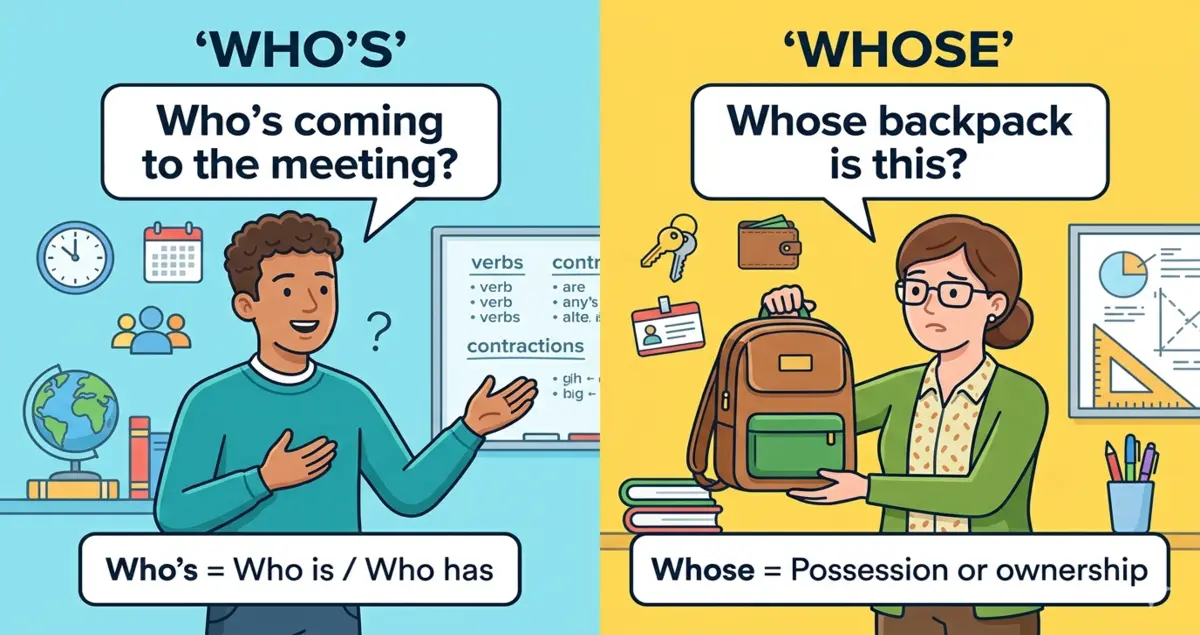
- Who’s is a contraction of who is or who has.
- Whose is a possessive pronoun that shows ownership.
Examples
Who’s
- Who’s at the door?
- Who’s finished the project?
Whose
- Whose book is this?
- Whose car is parked outside?
Read more: True or False: Meaning, Usage and Examples
Why Is Their Difference Necessary to Know for Learners and Experts?
Knowing the difference between who’s and whose is important because grammar mistakes can change the meaning of a sentence. In education, correct grammar improves writing quality and exam performance. In business, accurate writing creates a professional image.
For journalists, teachers, editors, and researchers, precise language builds trust and credibility. Society relies on clear communication in schools, workplaces, media, and legal documents. Understanding who’s or whose helps people share information accurately and avoid misunderstandings.
Pronunciation of Who’s and Whose
| Word | US Pronunciation | UK Pronunciation |
| Who’s | /huːz/ | /huːz/ |
| Whose | /huːz/ | /huːz/ |
Both words are pronounced exactly the same.
Linking Hook
Now that we understand the basic meanings of who’s and whose, let’s explore their differences in detail so you can use them confidently in every situation.
Read more: Benefited or Benefitted: Which Spelling Is Correct?
Difference Between Who’s and Whose
1. Meaning
Who’s
Means who is or who has.
Examples:
- Who’s ready for dinner?
- Who’s completed the assignment?
Whose
Shows ownership or possession.
Examples:
- Whose jacket is this?
- Whose phone is ringing?
2. Grammar Type
Who’s
A contraction.
Examples:
- Who’s coming today?
- Who’s been here before?
Whose
A possessive pronoun.
Examples:
- Whose keys are these?
- Whose house are we visiting?
3. Apostrophe Usage
Who’s
Contains an apostrophe.
Examples:
- Who’s calling?
- Who’s waiting outside?
Whose
Contains no apostrophe.
Examples:
- Whose bag is this?
- Whose turn is next?
4. Function in a Sentence
Who’s
Replaces who is or who has.
Examples:
- Who’s your teacher?
- Who’s gone already?
Whose
Indicates ownership.
Examples:
- Whose bicycle is missing?
- Whose laptop is on the desk?
5. Common Usage
Who’s
Used in questions and statements.
Examples:
- Who’s responsible?
- Who’s attending the meeting?
Whose
Used when asking about ownership.
Examples:
- Whose shoes are these?
- Whose idea was it?
6. Formal Writing
Who’s
Acceptable but less common in highly formal writing.
Examples:
- Who’s available for discussion?
- Who’s signed the agreement?
Whose
Frequently used in formal documents.
Examples:
- Identify whose signature appears below.
- Determine whose property was affected.
7. Ease of Recognition
Who’s
Can be tested by replacing it with “who is.”
Examples:
- Who’s there? → Who is there?
- Who’s speaking? → Who is speaking?
Whose
Cannot be replaced with “who is.”
Examples:
- Whose pen is this?
- Whose dog barked?
8. Educational Importance
Who’s
Teaches contractions.
Examples:
- Who’s next?
- Who’s ready?
Whose
Teaches possession.
Examples:
- Whose notebook is missing?
- Whose desk is empty?
9. Frequency in Conversation
Who’s
Very common.
Examples:
- Who’s at the gate?
- Who’s online?
Whose
Also common but more specific.
Examples:
- Whose coat is hanging there?
- Whose child is playing outside?
10. Error Rate
Who’s
Often misused instead of whose.
Examples:
- Who’s book is this? ❌
- Whose book is this? ✅
Whose
Often replaced by who’s incorrectly.
Examples:
- Whose coming tomorrow? ❌
- Who’s coming tomorrow? ✅
Nature and Behaviour of Both
Who’s
Who’s is a shortened grammatical form. It combines two words into one. Its behavior depends on the verbs “is” and “has.”
Whose
Whose acts as a possessive word. It identifies ownership and relationships between people and objects.
Why People Are Confused About Their Use?
People confuse who’s and whose because:
- They sound exactly the same.
- Both begin with the word “who.”
- One contains an apostrophe while the other does not.
- Many writers assume possessive words need apostrophes.
- English contractions can be difficult to learn.
Difference and Similarity Table
| Feature | Who’s | Whose |
| Pronunciation | Same | Same |
| Meaning | Who is / Who has | Ownership |
| Apostrophe | Yes | No |
| Part of Speech | Contraction | Possessive Pronoun |
| Shows Possession | No | Yes |
| Used in Questions | Yes | Yes |
| Formal Writing | Less Common | More Common |
| English Word | Yes | Yes |
| Commonly Confused | Yes | Yes |
| Correct Grammar Usage | Yes | Yes |
Which Is Better in What Situation?
When Who’s Is Better
Who’s is better when you mean who is or who has. It works well in conversations, emails, social media posts, and everyday writing. For example, “Who’s joining the meeting?” or “Who’s completed the report?” A simple test is to replace who’s with “who is.” If the sentence still makes sense, then who’s is the correct choice. This word helps make writing shorter and more natural while maintaining clarity.
When Whose Is Better
Whose is better when talking about ownership or possession. It is useful when asking who something belongs to or identifying a relationship between a person and an object. Examples include “Whose laptop is this?” and “Whose responsibility is this task?” Whose is especially important in academic, legal, and professional writing because it clearly shows ownership and avoids confusion.
How the Keywords Are Used in Metaphors and Similes
Who’s
Metaphorical Example:
- Who’s steering the ship of our future?
Simile Example:
- Who’s leading the team like a captain guiding a vessel?
Whose
Metaphorical Example:
- Whose hands hold the key to success?
Simile Example:
- Whose influence spreads like sunlight across a field?
Connotative Meaning of Both Keywords
| Word | Connotation |
| Who’s | Neutral |
| Whose | Neutral |
Examples
Neutral:
- Who’s arriving today?
- Whose bag is on the chair?
Unlike many nouns or adjectives, these words generally carry grammatical rather than emotional meaning.
Idioms or Proverbs Related to the Words
Although there are no major idioms built directly on who’s or whose, related expressions exist.
Who’s Who
Meaning: A guide to important people.
Example:
- She appeared in a who’s who of business leaders.
Know Who’s Who
Meaning: To know important people.
Example:
- He knows who’s who in the technology industry.
Judge a Man by His Company
Related to identifying whose influence surrounds someone.
Example:
- You can often judge a man by his company.
Works in Literature Containing the Keywords
Who’s
- Who’s Afraid of Virginia Woolf? – Play, Edward Albee, 1962
- Who’s That Knocking at My Door? (adapted title influence in literature discussions)
Whose
- For Whose Benefit? – Nonfiction, various academic editions
- Whose Body? – Detective Novel, Dorothy L. Sayers, 1923
Movie Names Based on the Keywords
Who’s
- Who’s Afraid of Virginia Woolf? – 1966, United States
- Who’s That Girl – 1987, United States
Whose
Direct movie titles using “whose” are relatively uncommon.
- Whose Life Is It Anyway? – 1981, United States
- Whose Child Am I? – 2013, Canada
Frequently Asked Questions
1. What is the difference between who’s and whose?
Who’s means who is or who has, while whose shows ownership.
2. Is whose possessive?
Yes. Whose is a possessive pronoun.
3. Does who’s always contain an apostrophe?
Yes. It is a contraction and requires an apostrophe.
4. How can I test whether who’s is correct?
Replace it with “who is.” If the sentence makes sense, use who’s.
5. Which word is used for ownership?
Whose is used for ownership.
How Both Are Useful for Surroundings
Who’s
Who’s helps people ask questions, identify individuals, and communicate efficiently in daily life.
Whose
Whose helps identify ownership, responsibility, and relationships. It improves clarity in homes, schools, workplaces, and legal settings.
Final Words for Both
Who’s is a useful contraction that simplifies communication by replacing who is or who has.
Whose is an essential possessive pronoun that clearly shows ownership and relationships.
Both words play important roles in English grammar and should be used carefully.
Conclusion
The confusion between who’s or whose is common because both words sound identical. However, their meanings are very different. Who’s is a contraction of who is or who has, while whose is a possessive pronoun used to show ownership.
Learning this distinction can improve writing accuracy in school, business, and everyday communication. A simple rule can help: if you can replace the word with who is, use who’s. If the sentence refers to ownership, use whose.
By understanding these grammar rules and practicing them regularly, writers can avoid common mistakes and communicate more clearly. Mastering who’s and whose is a small step that creates a big improvement in English language skills.

I’m BeaconRise, the author behind GrammarCircle, where I help readers understand English grammar, language differences, and writing concepts in a simple and practical way. I specialize in explaining confusing words, grammar rules, and “difference between” topics so learners can easily improve their writing and communication skills.