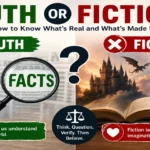
Have you ever read a shocking story online and wondered If it was truth or fiction? With social media, blogs, news websites, and AI-generated content becoming more common, it can be difficult to tell what is real and what is made up. That is why many people search for truth or fiction. They want to know how to separate facts from false stories.
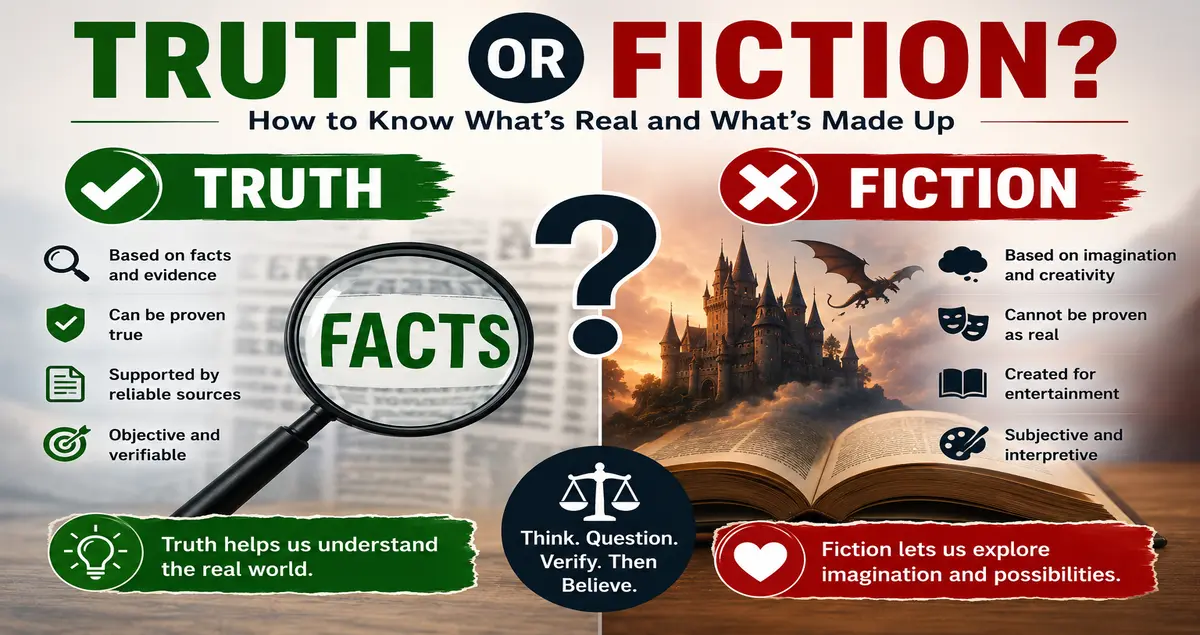
Although the phrase is simple, understanding it is important. Truth refers to something that is real, accurate, and supported by evidence. Fiction refers to stories, characters, or events that are imagined or invented. Both have value, but they serve different purposes. Truth informs us, while fiction entertains, inspires, and encourages creativity.
In this guide, you’ll learn the meaning of truth or fiction, where the phrase comes from, how it is used in British and American English, common mistakes people make, and practical examples from everyday life. Whether you’re writing an article, reading the news, or enjoying a novel, this guide will help you understand the difference with confidence.
Truth or Fiction – Quick Answer
The quick answer is:
- Truth means something that is real, factual, and can be verified.
- Fiction means something that is imagined or invented.
Examples
Truth
- Water freezes at 0°C.
- The Earth orbits the Sun.
Fiction
- Harry Potter attends Hogwarts School.
- Dragons breathe fire.
Remember this simple rule:
Truth is based on facts. Fiction is based on imagination.
Read more: Me Neither or Me Either: Which Expression Is Correct
The Origin of Truth or Fiction
The words truth and fiction have different historical roots.
Origin of Truth
The word truth comes from the Old English word trēowth, meaning:
- Faithfulness
- Honesty
- Accuracy
Over time, it came to mean something that matches reality.
Origin of Fiction
The word fiction comes from the Latin word fictio, meaning:
- To shape
- To invent
- To create
Originally, it referred to things created by imagination rather than real events.
Why Are They Compared?
The phrase truth or fiction became popular because people often compare real events with made-up stories. It is commonly used in:
- Books
- Television shows
- News articles
- Podcasts
- Fact-checking websites
Read more: Who’s or Whose: The Complete Guide
British English vs American English Spelling
Unlike many English words, there is no spelling difference between British and American English.
Both use:
- Truth
- Fiction
Comparison Table
| Feature | British English | American English |
| Truth | Truth | Truth |
| Fiction | Fiction | Fiction |
| Pronunciation | Nearly the same | Nearly the same |
| Meaning | Same | Same |
The words are identical in both spelling and meaning.
Which Spelling Should You Use?
There is no regional spelling choice to make.
Use truth and fiction exactly as written, whether your audience is:
- United States
- United Kingdom
- Canada
- Australia
- New Zealand
- International readers
The only important decision is choosing the correct word based on its meaning.
Use “Truth” When:
- Talking about facts
- Referring to real events
- Discussing evidence
Use “Fiction” When:
- Talking about novels
- Discussing movies or stories
- Referring to imaginary characters
Common Mistakes with Truth or Fiction
Here are some common mistakes.
Mistake 1: Calling Fiction True
❌ This fantasy novel is the truth.
✅ This fantasy novel is fiction.
Mistake 2: Assuming Fiction Means False Information
Not all fiction is meant to deceive.
Fiction is created for entertainment, storytelling, or artistic expression.
Mistake 3: Believing Everything Online Is Truth
Always verify information before sharing it.
Common Corrections Table
| Incorrect | Correct |
| Fiction means lying | Fiction means imaginary storytelling |
| Truth is just opinion | Truth is supported by evidence |
| Fiction is always harmful | Fiction can educate and entertain |
| Truth and fiction are interchangeable | They have different meanings |
Truth or Fiction in Everyday Examples
Emails
- Please verify whether this information is truth or fiction before forwarding it.
News
- Journalists work to separate truth from fiction.
Social Media
- Don’t believe every viral post without checking the facts.
Books
- The novel is fiction but inspired by true events.
Business
- Companies rely on truthful information when making decisions.
Education
- Students learn to distinguish truth from fiction when researching.
Truth or Fiction – Google Trends & Usage Data
Search interest in truth or fiction has grown because people want reliable information online.
Common Search Topics
People search for:
- Truth or fiction stories
- Urban legends
- Viral news
- Historical facts
- AI-generated content
- Myth versus reality
Usage by Context
| Phrase | Common Use |
| Truth | News, science, education |
| Fiction | Books, films, entertainment |
| Truth or Fiction | Fact-checking and comparisons |
The phrase remains popular because readers increasingly want trustworthy information.
Truth vs Fiction Comparison Table
| Feature | Truth | Fiction |
| Based on Facts | Yes | No |
| Based on Imagination | No | Yes |
| Found in News | Yes | Sometimes |
| Found in Novels | Rarely | Yes |
| Requires Evidence | Yes | No |
| Purpose | Inform | Entertain |
FAQs
1. What does truth or fiction mean?
It compares real, factual information (truth) with imaginary or invented stories (fiction).
2. Is fiction the same as lying?
No. Fiction is creative storytelling and is not necessarily intended to deceive.
3. Can fiction contain real events?
Yes. Many novels mix fictional characters with historical events.
4. How can I tell if something is true or fiction?
Look for reliable sources, evidence, expert opinions, and fact-checking before accepting information as true.
5. Is the phrase truth or fiction used worldwide?
Yes. It is commonly used in British English, American English, and other English-speaking countries.
6. Why is truth important?
Truth helps people make informed decisions, build trust, and understand reality.
7. Why do people enjoy fiction?
Fiction entertains, inspires creativity, teaches lessons, and allows readers to explore imaginary worlds.
Conclusion
Understanding the difference between truth or fiction is more important today than ever before. In a world filled with news reports, social media posts, advertisements, and AI-generated content, knowing how to separate facts from imagination helps you make better decisions and avoid misinformation.
Truth refers to information that is accurate, verifiable, and supported by evidence. Fiction, on the other hand, is created through imagination and is commonly found in novels, movies, television shows, and creative writing. Neither is inherently better than the other—they simply serve different purposes. Truth informs us, while fiction entertains and inspires us.
If you are reading an article, watching a documentary, or enjoying a bestselling novel, understanding the difference allows you to appreciate both forms of communication. Whenever you are unsure, remember the simple rule: truth is based on facts, while fiction is based on imagination.

Hi, I’m DreamAnchor, the author behind GrammarCircle. I am passionate about language, writing, and helping people understand the small but important differences in English words and concepts. Through my work, I focus on explaining grammar rules, word comparisons, and language usage in a simple and practical way so that students, writers, and professionals can improve their communication skills.