Have you ever heard someone say “me neither” and another person say “me either” in the same situation? If so, you may have wondered which expression is correct. This is a common question among English learners, writers, and even native speakers.
The confusion happens because both phrases are often used to agree with a negative statement. For example, if someone says, “I don’t like coffee,” another person might respond with either “Me neither” or “Me either.” Since both expressions appear in everyday conversation, many people struggle to know which one is grammatically correct and which one sounds more natural.
The good news is that both phrases are widely understood. However, they are not always used in the same way. Their acceptance can vary based on grammar rules, region, and speaking style.
In this guide, you’ll learn the difference between me neither or me either, where the expressions come from, which one is preferred in formal and informal English, and how to use them correctly in real-life situations.
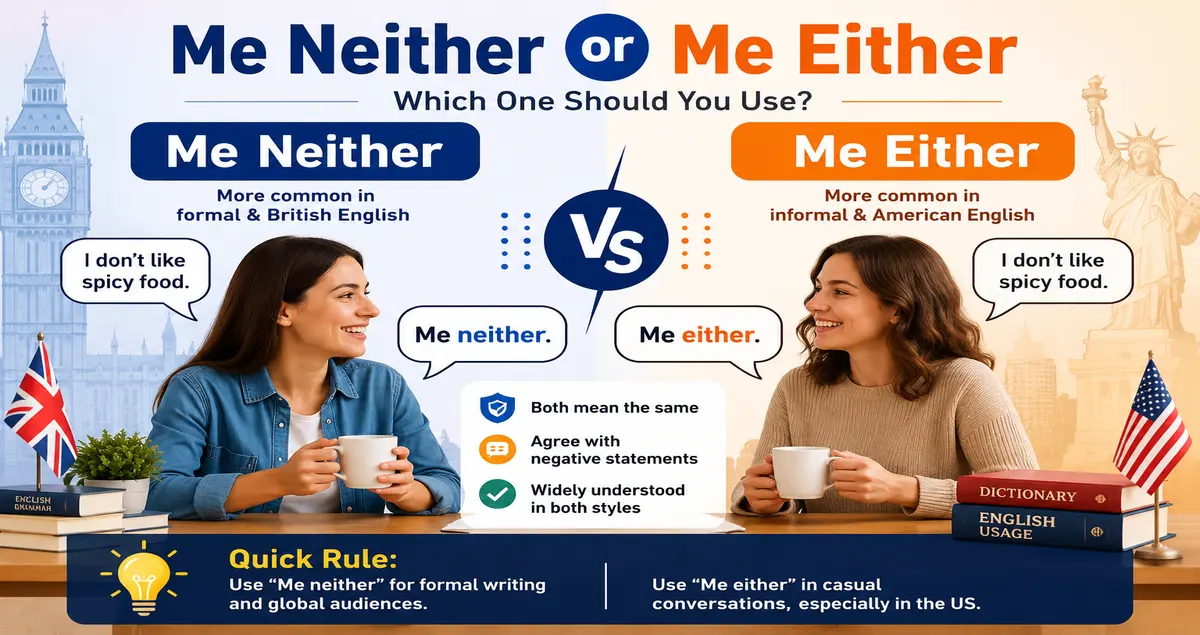
Me Neither or Me Either – Quick Answer
The quick answer is:
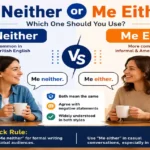
- Me neither is traditionally considered the grammatically correct response to a negative statement.
- Me either is common in informal American English and is widely accepted in conversation.
Examples
Person A: I don’t enjoy horror movies.
Traditional Response
- Me neither.
Informal American Response
- Me either.
Both responses mean:
I don’t enjoy horror movies either.
Read more: En Route or In Route: Which Phrase Is Correct?
The Origin of Me Neither or Me Either
To understand the difference, it helps to know where these expressions come from.
The Word “Neither”
The word neither comes from Old English and means:
Not one and not the other.
It has long been associated with negative statements.
Example:
- I don’t like tea.
- Neither do I.
Over time, people shortened this response to:
- Me neither.
The Word “Either”
The word either traditionally appears in negative sentences.
Examples:
- I don’t like tea either.
- She doesn’t like tea either.
Because of this structure, many English speakers began saying:
- Me either.
This informal usage became especially popular in North America.
Today, both phrases are commonly heard, although grammar experts often favor me neither.
Read more: Healthcare or Health Care: Which Spelling Is Correct?
British English vs American English Spelling
Unlike many grammar topics, the difference here is not really about spelling. Instead, it is about usage and preference.
British English
British English generally prefers:
- Me neither
American English
American English uses:
- Me neither
- Me either
Both are commonly understood.
Comparison Table
| Feature | Me Neither | Me Either |
| Traditional Grammar | Yes | No |
| Informal Speech | Yes | Yes |
| British English | Common | Less Common |
| American English | Common | Very Common |
| Formal Writing | Preferred | Usually Avoided |
Examples
British Style:
- I don’t watch that show.
- Me neither.
American Style:
- I don’t watch that show.
- Me either.
Which Spelling Should You Use?
Since this is a usage question rather than a spelling question, your choice depends on the situation.
Use “Me Neither” If:
- You want the safest grammatical choice.
- You are writing formally.
- You are taking an English exam.
- You are writing professional content.
Example:
- I don’t agree with that decision.
- Me neither.
Use “Me Either” If:
- You are having casual conversations.
- You are speaking with American English speakers.
- You want natural everyday speech.
Example:
- I don’t like cold weather.
- Me either.
For Global Audiences
Use me neither because it is accepted worldwide and aligns with traditional grammar rules.
Common Mistakes with Me Neither or Me Either
Many learners make mistakes when responding to negative statements.
Mistake 1: Using Me Too After a Negative Statement
❌ I don’t like spiders.
- Me too.
✅ I don’t like spiders.
- Me neither.
Mistake 2: Using Either in Formal Writing
❌ The employee stated he disagreed with the proposal. Me either.
✅ The employee stated he disagreed with the proposal. Neither did I.
Mistake 3: Mixing Positive and Negative Responses
❌ I love pizza.
- Me neither.
✅ I love pizza.
- Me too.
Common Corrections Table
| Incorrect | Correct |
| I don’t like it. Me too. | I don’t like it. Me neither. |
| I love it. Me neither. | I love it. Me too. |
| Formal report: Me either. | Neither did I. |
| Positive statement + neither | Use me too |
Me Neither or Me Either in Everyday Examples
Emails
Informal Email:
- I couldn’t attend the meeting.
- Me neither.
News Conversation
Reporter:
- Many residents do not support the proposal.
Resident:
- Me neither.
Social Media
- I don’t understand this trend.
- Me either!
Workplace Chat
Employee A:
- I didn’t get enough sleep.
Employee B:
- Me neither.
Formal Writing
Formal English usually uses:
- Neither do I.
- Neither did she.
- Neither have they.
Instead of:
- Me either.
Me Neither or Me Either – Google Trends & Usage Data
Search data and language studies show that both phrases remain popular.
Me Neither
Most common in:
- Schools
- Grammar books
- Formal communication
- British English
Me Either
Most common in:
- American conversations
- Social media
- Informal speech
- Casual messaging
Usage by Context
| Expression | Common Context |
| Me Neither | Formal and informal |
| Me Either | Mostly informal |
| Neither Do I | Formal writing |
| Neither Did I | Formal writing |
Language usage continues to evolve, but me neither remains the most universally accepted option.
Me Neither vs Me Either Comparison Table
| Feature | Me Neither | Me Either |
| Meaning | I don’t either | I don’t either |
| Grammar Status | Traditional | Informal |
| Formal Writing | Yes | Rarely |
| Casual Conversation | Yes | Yes |
| British English | Common | Less Common |
| American English | Common | Very Common |
| Recommended for Learners | Yes | Only Informally |
FAQs
1. Is me neither or me either correct?
Both are used, but me neither is traditionally considered more grammatically correct.
2. Why do Americans say me either?
It developed as a common informal response in spoken American English.
3. Is me either wrong?
Not usually. It is widely accepted in casual conversation, especially in the United States.
4. Which is better for formal writing?
Use neither do I, neither did I, or me neither.
5. Can I use me neither in everyday conversation?
Yes. It is natural, common, and understood everywhere.
6. What should English learners use?
English learners should generally use me neither because it is accepted in both formal and informal settings.
7. Do me neither and me either mean the same thing?
Yes. Both express agreement with a negative statement.
Conclusion
The debate between me neither or me either comes down to grammar, context, and regional preference. Traditionally, me neither is the grammatically preferred response to a negative statement. It is accepted in formal writing, education, and everyday conversation.
Me either, however, has become extremely common in informal American English. While some grammar experts still prefer me neither, most native speakers understand and use both expressions naturally.
If you want the safest and most widely accepted choice, use me neither. It works in almost every situation and follows traditional grammar rules. If you are speaking casually with American English speakers, me either will sound natural and familiar.
Understanding the difference helps you communicate more confidently and choose the expression that best fits your audience and situation.

Hi, I’m DreamAnchor, the author behind GrammarCircle. I am passionate about language, writing, and helping people understand the small but important differences in English words and concepts. Through my work, I focus on explaining grammar rules, word comparisons, and language usage in a simple and practical way so that students, writers, and professionals can improve their communication skills.