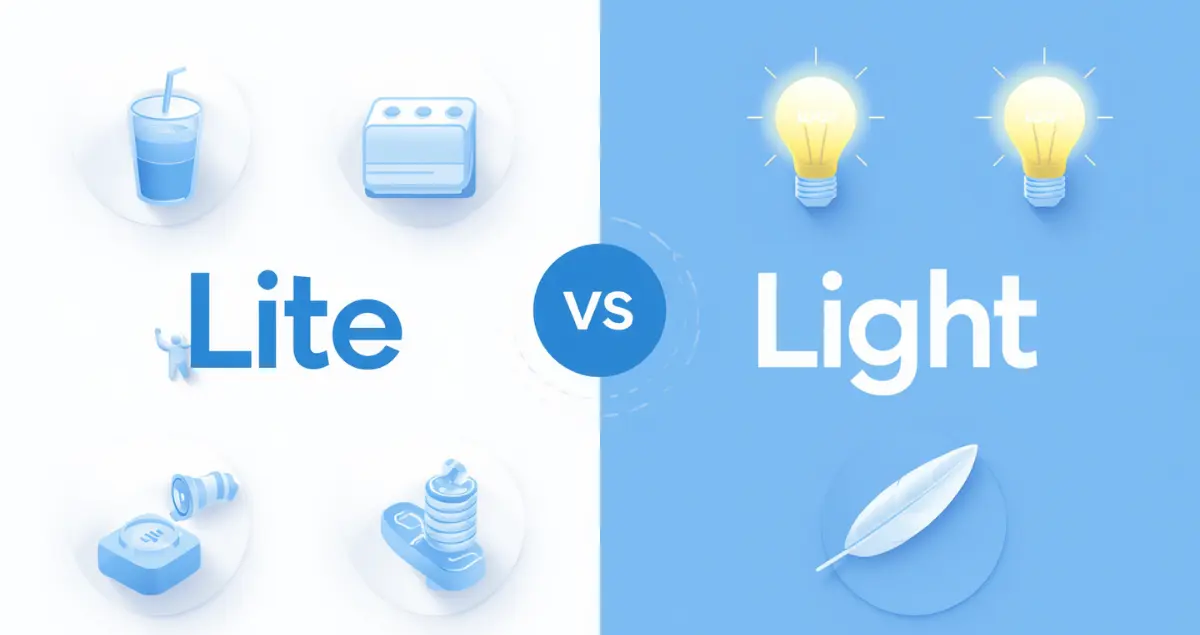
Have you ever seen the words lite and light and wondered which one is correct? You are not alone. Many people search for “lite or light” because both words appear in advertisements, product labels, menus, and everyday writing. At first glance, they seem to mean the same thing, but they are not always interchangeable.
The confusion often comes from marketing language. You may see products labeled as “lite beer,” “lite mayonnaise,” or “lite software,” while standard English dictionaries define light as the correct spelling. This leaves many writers unsure about which word to use in emails, articles, business documents, and social media posts.
Understanding the difference between lite and light helps you communicate clearly and professionally. It also prevents common writing mistakes and ensures your content matches your audience’s expectations. In this guide, you’ll learn the meaning, history, usage rules, examples, and best practices for choosing between lite and light.
Lite or Light – Quick Answer
Light is the standard English word and is correct in most situations.
Lite is an informal spelling often used in marketing to suggest that a product has fewer calories, less fat, fewer features, or a simplified version of something.
Examples
✅ The room is full of light.
✅ This bag is very light and easy to carry.
✅ The company released a lite version of its software.
✅ He ordered a lite beer.
Quick Rule
- Use light in regular writing.
- Use lite mainly when it is part of a product name or marketing term.
Read more: True or False: Meaning, Usage and Examples
The Origin of Lite or Light
The word light comes from Old English and has been part of the language for more than a thousand years. It has several meanings, including illumination, low weight, and low intensity.
The spelling lite appeared much later. It became popular during the 20th century, especially in advertising. Food and beverage companies used “lite” to suggest reduced calories, reduced fat, or a lighter product without changing the pronunciation.
Over time, the word expanded beyond food products. Technology companies began using lite to describe simplified versions of apps, software, and services.
Why the Difference Exists
- Light is the traditional English spelling.
- Lite is a commercial and informal variation.
- Marketers use lite because it looks modern and distinctive.
British English vs American English Spelling
Unlike many English spelling differences, lite and light are not mainly a British-versus-American issue.
Both British and American English recognize light as the standard spelling. However, lite is commonly accepted in advertising and product branding.
Read more: Benefited or Benefitted: Which Spelling Is Correct?
Comparison Table
| Usage | British English | American English |
| Standard writing | Light | Light |
| Formal documents | Light | Light |
| Product marketing | Lite or Light | Lite or Light |
| Food labels | Sometimes Lite | Commonly Lite |
| Software versions | Lite | Lite |
Examples
British English
- The suitcase is very light.
- The room needs more light.
American English
- This laptop is surprisingly light.
- I bought a lite yogurt.
Which Spelling Should You Use?
The best choice depends on your audience and purpose.
For US Audiences
Use light for normal writing.
Use lite only when referring to branded products or simplified versions.
For UK Audiences
Use light almost all the time.
Use lite only when it appears in product names.
For Global Audiences
Choose light because it is universally understood and accepted.
Professional Advice
If you are writing:
- Articles
- Emails
- Reports
- Academic papers
- Business documents
Use light.
If you are discussing:
- Lite beer
- Lite software
- Lite products
Use lite only when it matches the official name.
Common Mistakes with Lite or Light
Many writers misuse these words because they sound identical.
Mistake 1: Using Lite in Formal Writing
❌ The package is very lite.
✅ The package is very light.
Mistake 2: Replacing Light Everywhere
❌ Turn on the lite.
✅ Turn on the light.
Mistake 3: Ignoring Brand Names
❌ Lite version of the app should be written as light version.
✅ Keep the official brand spelling if it is marketed as “Lite.”
Mistake 4: Assuming Lite Is Standard English
❌ Lite is always correct.
✅ Light is the standard dictionary spelling.
Lite or Light in Everyday Examples
In Emails
✅ Please travel light and bring only essential items.
✅ We have attached the lite version of the presentation.
In News Articles
✅ The city installed new street lights.
✅ The company launched a lite subscription plan.
On Social Media
✅ Packing light for my weekend trip.
✅ Just downloaded the lite version of the app.
In Formal Writing
✅ The equipment is lightweight and easy to transport.
✅ The room receives natural light throughout the day.
Lite or Light – Google Trends & Usage Data
Search behavior shows that people often look up lite or light because they encounter both spellings online.
General Trends
- Light is far more common worldwide.
- Lite appears frequently in marketing and branding.
- Technology companies often use lite for simplified applications.
- Food and beverage brands commonly use lite to indicate reduced calories or ingredients.
Popular Usage by Context
| Context | Preferred Word |
| General English | Light |
| Education | Light |
| Business Writing | Light |
| Food Marketing | Lite |
| Software Products | Lite |
| Product Branding | Lite |
| Journalism | Light |
Popular Usage by Country
| Country | Common Choice |
| United States | Light (Lite in branding) |
| United Kingdom | Light |
| Canada | Light |
| Australia | Light |
| New Zealand | Light |
Lite vs Light Comparison Table
| Feature | Lite | Light |
| Standard English | No | Yes |
| Formal Writing | Rarely | Yes |
| Marketing Usage | Common | Common |
| Food Products | Very Common | Sometimes |
| Software Versions | Common | Less Common |
| Dictionary Preference | Limited | Standard |
| Academic Writing | No | Yes |
FAQs About Lite or Light
1. Is lite a real word?
Yes. It is a recognized informal spelling used mainly in marketing and branding.
2. Which is grammatically correct, lite or light?
Light is the standard grammatical spelling in English.
3. Why do companies use lite instead of light?
Companies use lite to suggest a reduced, simplified, or lower-calorie version of a product.
4. Can I use lite in professional writing?
It is generally better to use light unless you are referring to a specific product named “Lite.”
5. Is lite American English?
Not exactly. It is primarily a marketing spelling used in many English-speaking countries.
6. Is light always the safer choice?
Yes. In most writing situations, light is the correct and preferred option.
7. What does a lite version mean?
A lite version usually offers fewer features, reduced size, or a simplified experience compared to the full version.
Conclusion
The difference between lite and light is simple once you understand their roles. Light is the traditional and standard English spelling used in everyday communication, professional writing, education, journalism, and formal documents. It is the safest and most widely accepted choice for nearly every situation.
Lite, on the other hand, developed as a marketing term. Companies often use it to describe products with fewer calories, less fat, reduced features, or simplified functionality. You will commonly see it in food labels, beverages, software applications, and branded services. While it is a recognized word, it is not usually the preferred spelling in standard English writing.
When deciding between the two, think about your audience and purpose. If you are writing for school, business, or general readers, choose light. If you are referring to an official product name or a marketed reduced version, use lite. Following this rule will help your writing stay clear, professional, and easy to understand.

Hi, I’m LunarCrest, the author behind GrammarCircle. I’m passionate about language, writing, and helping people understand the finer details of English. Through my work, I focus on explaining grammar rules, word differences, and language concepts in a simple and practical way.