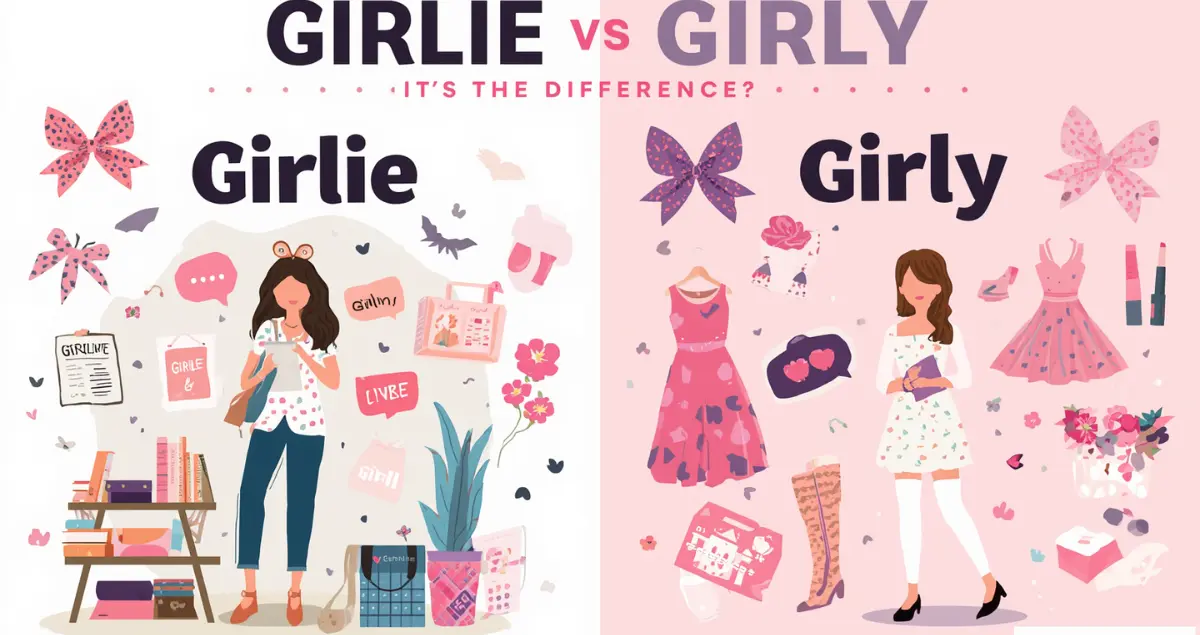
Have you ever seen the words girlie and girly and wondered which one is correct? You are not alone. Many people search for “girlie or girly” because both words look similar and often appear in social media posts, fashion blogs, and everyday conversations.
The confusion comes from the fact that both words are related to feminine styles, interests, or behaviors. However, they are not always used in the same way. One spelling is far more common and accepted in standard English, while the other is often used as a variation, nickname, or stylistic choice.
Understanding the difference can help you write more clearly and choose the right word for your audience. Whether you are writing an article, posting on social media, sending an email, or creating marketing content, knowing when to use girly or girlie matters.
This guide explains the meaning, history, spelling differences, usage examples, common mistakes, and popularity trends of both words.
Girlie or Girly – Quick Answer
Girly is the standard and most widely accepted spelling in English.
Girlie is an informal variation that is sometimes used as a nickname, term of affection, or stylistic spelling.
Examples
✅ She loves wearing pink dresses and has a very girly style.
✅ Hey, girlie, how have you been?
❌ She has a very girlie style. (Less common in formal writing)
In most situations, girly is the better choice.
Read more: Check in or Check-in: Meaning and Spelling Rules
The Origin of Girlie or Girly
The word girl comes from Middle English and has been part of English for centuries.
The adjective girly developed by adding the suffix -y, which often means “having the qualities of” something. Therefore, girly means having characteristics traditionally associated with girls or femininity.
The spelling girlie appeared later as an affectionate or playful variation. The suffix -ie is commonly used in English to create friendly or informal words, such as:
- dog → doggie
- aunt → auntie
- girl → girlie
Because of this development, girlie is often used as a friendly form of address rather than a standard adjective.
British English vs American English Spelling
Unlike many spelling differences such as colour/color or travelling/traveling, the distinction between girlie and girly is not primarily a British-versus-American issue.
Both British and American English generally prefer girly as the standard adjective.
Read more: Check in or Check-in: Meaning and Spelling Rules
Comparison Table
| Feature | Girly | Girlie |
| Standard English | Yes | Usually No |
| Common in Formal Writing | Yes | Rare |
| Common in Casual Speech | Yes | Yes |
| Used as Nickname | Sometimes | Often |
| Preferred in US English | Yes | Less Common |
| Preferred in UK English | Yes | Less Common |
Examples
American English
- She likes a girly fashion style.
British English
- The room has a girly design.
Informal Use
- Thanks, girlie!
Which Spelling Should You Use?
Choosing the correct spelling depends on your audience and purpose.
For US Audiences
Use girly in articles, blogs, business writing, and educational content.
For UK Audiences
Use girly because it is the standard spelling.
For Commonwealth Countries
Countries such as Australia, Canada, New Zealand, and South Africa generally prefer girly.
For Global Audiences
Use girly because it is widely understood and accepted worldwide.
When to Use Girlie
Use girlie only when:
- Writing informal messages
- Using affectionate language
- Creating playful social media content
- Referring to someone with a nickname
Common Mistakes with Girlie or Girly
Many writers confuse the two spellings.
Mistake 1
❌ She has a girlie personality.
✅ She has a girly personality.
Mistake 2
❌ The article discussed girlie fashion trends.
✅ The article discussed girly fashion trends.
Mistake 3
❌ Girlie is always wrong.
✅ Girlie is acceptable in informal contexts.
Mistake 4
❌ Use girlie in professional reports.
✅ Use girly in professional reports.
Girlie or Girly in Everyday Examples
In Emails
Professional
- Our new collection features a modern girly design.
Friendly
- Hi girlie, hope you’re having a great day!
In News Articles
- The brand is known for its girly aesthetic.
On Social Media
- Feeling extra girly today! 💕
- Thanks for the gift, girlie!
In Formal Writing
- Researchers examined the influence of girly marketing on consumer behavior.
Girlie or Girly – Google Trends & Usage Data
Search behavior shows that girly is much more popular than girlie.
Usage Patterns
| Term | Popularity |
| Girly | Very High |
| Girlie | Moderate |
| Formal Writing | Girly |
| Social Media Nicknames | Girlie |
| Fashion Content | Girly |
| Academic Content | Girly |
Popular Countries
Girly is commonly used in:
- United States
- United Kingdom
- Canada
- Australia
- New Zealand
Girlie appears more often in:
- Informal online conversations
- Social media captions
- Friendly text messages
Comparison Table: Girlie vs Girly
| Aspect | Girly | Girlie |
| Correct Standard Form | Yes | Informal Variant |
| Dictionary Acceptance | Common | Limited |
| Professional Writing | Recommended | Not Recommended |
| Casual Writing | Yes | Yes |
| Fashion Discussions | Common | Less Common |
| Friendly Nickname | Sometimes | Frequently |
| Global Recognition | High | Moderate |
FAQs
1. Is girly or girlie correct?
Both are correct, but girly is the standard and preferred spelling.
2. Is girlie a real word?
Yes. It is an informal word often used as a nickname or affectionate term.
3. Which spelling is more common?
Girly is significantly more common in everyday and professional writing.
4. Is girlie used in British English?
Yes, but mainly in casual conversation rather than formal writing.
5. Can I use girlie in an article?
It is better to use girly unless you are quoting someone or using a playful tone.
6. Is girly offensive?
No. It usually describes feminine qualities, styles, or interests. However, context matters.
7. Which spelling should businesses use?
Businesses should generally use girly because it is the recognized standard spelling.
Conclusion
The debate over girlie or girly is easier to solve than many English spelling questions. While both words exist, they serve slightly different purposes. Girly is the standard spelling and is widely accepted in professional, academic, and everyday writing. It describes feminine styles, interests, behaviors, or appearances and is understood by readers around the world.
Girlie, on the other hand, is usually an informal variation. It often appears in friendly conversations, social media posts, and affectionate nicknames. Although it is not wrong, it is less suitable for formal communication.
If you are writing for a broad audience, publishing content online, or creating professional documents, girly is almost always the safest choice. Reserve girlie for casual situations where a warm, playful, or personal tone is appropriate.
Remember this simple rule: use “girly” for standard writing and “girlie” for informal or affectionate use. Following this advice will help you communicate clearly and confidently.

Hi, I’m DreamAnchor, the author behind GrammarCircle. I am passionate about language, writing, and helping people understand the small but important differences in English words and concepts. Through my work, I focus on explaining grammar rules, word comparisons, and language usage in a simple and practical way so that students, writers, and professionals can improve their communication skills.