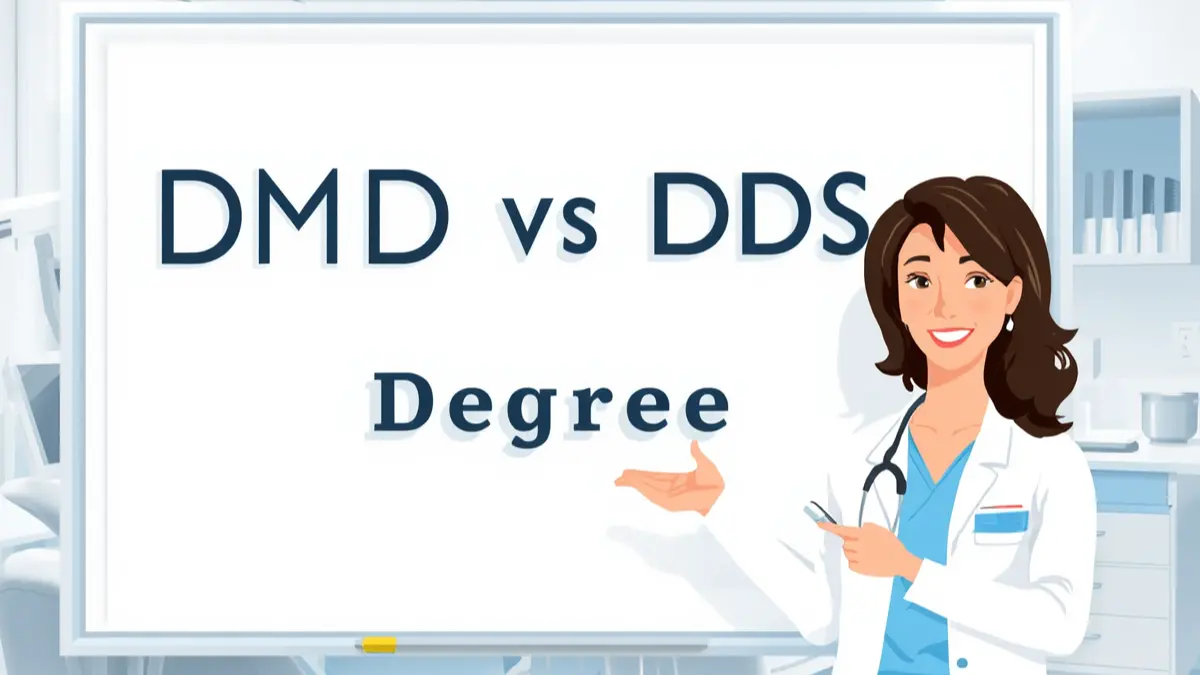
If you are looking for a dentist, applying to dental school, or researching dental careers, you may have noticed two different titles after a dentist’s name: DMD and DDS. This often creates confusion. Many people wonder whether one degree is better than the other, whether the training is different, or if one dentist is more qualified than another.
The good news is that the difference between a DMD or DDS degree is much simpler than most people think. Both degrees qualify graduates to become licensed dentists in the United States. They require the same education, clinical training, examinations, and professional standards.
People search for “DMD or DDS degree” because they want a quick answer before choosing a dentist or pursuing a dental career. The abbreviations look different, but their meaning is nearly identical.
This guide explains the history, meaning, usage, and common misunderstandings surrounding DMD and DDS degrees. By the end, you’ll know exactly what these titles mean and whether the difference matters at all.
DMD or DDS Degree – Quick Answer
A DMD (Doctor of Dental Medicine) and a DDS (Doctor of Dental Surgery) are equivalent dental degrees.
Both degrees:
- Allow graduates to practice dentistry
- Require the same dental school education
- Require the same licensing exams
- Provide the same legal qualifications
Example
- Dr. Smith, DDS = Licensed Dentist
- Dr. Johnson, DMD = Licensed Dentist
Neither degree is higher or better than the other.
Read more: Difference Between Truncate and Delete: Know When to Use Each
The Origin of DMD or DDS Degree
The DDS (Doctor of Dental Surgery) degree came first. It was awarded by the first dental school in the United States during the 1800s.
Later, some universities preferred the Latin phrase Dentariae Medicinae Doctor, which translates to Doctor of Dental Medicine (DMD).
Harvard University played a major role in introducing the DMD title. Because Harvard traditionally used Latin names for degrees, it chose DMD instead of DDS.
As more dental schools opened, some adopted DDS while others chose DMD.
The difference exists because of university tradition, not because of different training or qualifications.
British English vs American English Spelling
Unlike words such as “color” and “colour,” DMD and DDS are not spelling variations. They are separate degree titles used primarily in the United States.
In the United Kingdom and many Commonwealth countries, dentists usually earn different qualifications such as:
- BDS (Bachelor of Dental Surgery)
- BChD (Bachelor of Dental Surgery)
Read more: Difference Between Imodium and Pepto: Which Suits You Best
Comparison Table
| Region | Common Dental Degree |
| United States | DDS or DMD |
| United Kingdom | BDS |
| Canada | DDS or DMD |
| Australia | BDS or DMD |
| New Zealand | BDS |
Examples
| Country | Degree Example |
| USA | DDS, DMD |
| UK | BDS |
| Australia | BDS, DMD |
| Canada | DDS, DMD |
Therefore, the distinction is based on educational systems rather than spelling rules.
Which Spelling Should You Use?
When discussing a dentist’s credentials, always use the exact degree the dentist earned.
Use DDS When
- Referring to a dentist with a DDS degree
- Writing for audiences familiar with American dentistry
- Quoting professional credentials
Use DMD When
- Referring to a dentist who earned a DMD
- Writing university profiles
- Discussing dental medicine programs
For Global Audiences
You can write:
“DMD and DDS are equivalent dental degrees.”
This wording avoids confusion and is understood worldwide.
Common Mistakes with DMD or DDS Degree
Many people misunderstand these titles.
Mistake 1: Thinking DDS Is Higher Than DMD
❌ Incorrect
DDS is not superior to DMD.
✅ Correct
Both degrees are equal.
Mistake 2: Assuming Training Is Different
❌ Incorrect
DMD and DDS students do not receive different education.
✅ Correct
Accredited programs teach the same core curriculum.
Mistake 3: Believing One Degree Earns More Money
❌ Incorrect
Income depends on experience, location, and specialty.
✅ Correct
The degree title alone does not determine earnings.
Mistake 4: Using the Titles Interchangeably for Individuals
❌ Incorrect
Calling a DDS dentist a DMD dentist.
✅ Correct
Use the exact credential listed by the dentist.
DMD or DDS Degree in Everyday Examples
“Dr. Carter, DDS, will be available for appointments next week.”
News Article
“The clinic welcomed two new dentists, one holding a DDS degree and the other a DMD degree.”
Social Media
“Looking for a new dentist? Don’t worry—DMD and DDS degrees mean the same professional qualification.”
Formal Writing
“Applicants must hold a DDS or DMD degree from an accredited dental school.”
Healthcare Website
“Our dental team includes experienced professionals with DDS and DMD credentials.”
DMD or DDS Degree – Google Trends & Usage Data
Search interest in DMD or DDS degree remains steady because patients often notice these initials on clinic websites, business cards, and dental office signs.
Countries with Strong Interest
- United States
- Canada
- Australia
- United Kingdom
- New Zealand
Common Search Queries
- DMD vs DDS
- Is DMD better than DDS?
- What does DDS mean?
- What does DMD stand for?
- DMD or DDS degree difference
Typical Contexts
| Context | Usage |
| Dental school research | Very common |
| Choosing a dentist | Very common |
| Healthcare careers | Common |
| Professional credentials | Common |
| Academic discussions | Common |
Most searches are driven by curiosity rather than a meaningful difference between the degrees.
DMD vs DDS Comparison Table
| Feature | DMD | DDS |
| Full Form | Doctor of Dental Medicine | Doctor of Dental Surgery |
| Qualification Level | Same | Same |
| Dental School Training | Same | Same |
| Licensing Requirements | Same | Same |
| Ability to Practice Dentistry | Yes | Yes |
| Professional Recognition | Equal | Equal |
| Salary Potential | Similar | Similar |
| Clinical Skills | Same Standards | Same Standards |
FAQs About DMD or DDS Degree
1. Is a DMD degree better than a DDS degree?
No. Both degrees are considered equal professional qualifications.
2. Do DMD and DDS dentists receive the same training?
Yes. Accredited dental schools follow similar educational standards.
3. Can both DMD and DDS holders become specialists?
Yes. Both can pursue specialties such as orthodontics, oral surgery, and periodontics.
4. Why do some schools award DMD and others DDS?
The choice is based mainly on university tradition and naming preference.
5. Do patients receive different treatment from DMD and DDS dentists?
No. Treatment quality depends on the dentist, not the degree title.
6. Which degree earns more money?
Neither degree automatically earns more. Income depends on experience, location, and specialization.
7. Should I choose a dentist based on DMD or DDS?
No. Consider experience, reviews, communication skills, and services offered instead.
Conclusion
Understanding the difference between a DMD or DDS degree is easier than many people expect. Although the titles look different, they represent the same professional qualification. Both degrees require extensive education, clinical training, and licensing examinations before a dentist can practice legally.
The distinction exists mainly because of historical naming traditions. DDS stands for Doctor of Dental Surgery, while DMD stands for Doctor of Dental Medicine. Neither title provides greater authority, higher status, or better treatment outcomes. Patients can confidently receive care from dentists holding either credential.
When choosing a dentist, focus on factors that truly matter, such as experience, reputation, patient reviews, communication skills, and specialized training. The letters after a dentist’s name do not determine the quality of care.
For students considering dentistry, the choice between a DMD and DDS program should be based on the school itself rather than the degree title. In practice, both paths lead to the same profession and opportunities.

Hi, I’m DreamAnchor, the author behind GrammarCircle. I am passionate about language, writing, and helping people understand the small but important differences in English words and concepts. Through my work, I focus on explaining grammar rules, word comparisons, and language usage in a simple and practical way so that students, writers, and professionals can improve their communication skills.