The phrases flush out and flesh out sound very similar, but they have different meanings. Imagine a journalist investigating a major story. They may need to flush out hidden facts by asking tough questions. At the same time, they may need to flesh out the article by adding details, examples, and background information. Both actions are important, but they serve different purposes.
Many English learners and even experienced writers confuse flush out or flesh out because the phrases differ by only one letter in pronunciation. This confusion often appears in business writing, academic papers, journalism, and everyday communication. Understanding flush out or flesh out helps you express ideas clearly and avoid embarrassing mistakes.
If you are writing a report, preparing a presentation, or editing an article, knowing when to use flush out or flesh out can improve your communication skills significantly.
Before exploring the details, let’s first understand how these expressions differ and why their correct use matters.
Key Difference Between Flush Out and Flesh Out
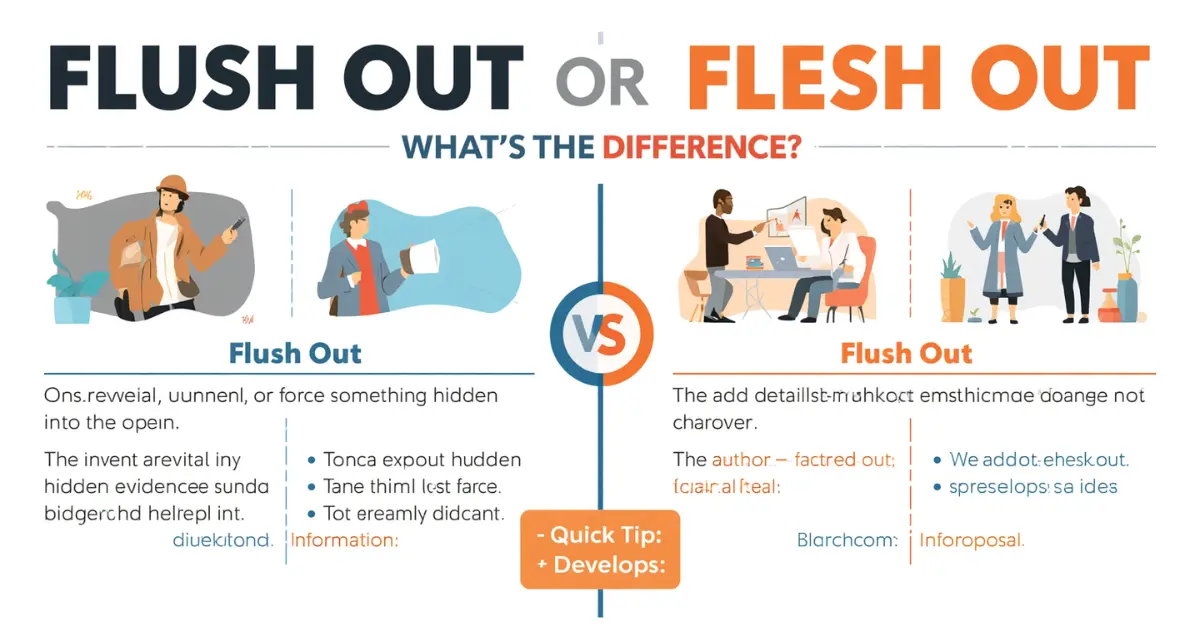
Flush out means to force something hidden to come into the open.
Flesh out means to add more detail or substance to something.
Examples
Flush Out
- The police worked to flush out the suspect.
- The audit helped flush out financial errors.
Flesh Out
- The writer needed to flesh out the main character.
- We should flesh out the proposal before presenting it.
Read more: Preform or Perform: Which Word Is Correct ?
Why Is Their Difference Necessary to Know?
Understanding the difference between these phrases is important for students, professionals, researchers, writers, and business leaders.
When someone says they want to flush out an issue, they mean they want to uncover something hidden. When they want to flesh out an idea, they mean they want to expand it with more information.
Using the wrong phrase can change the entire meaning of a sentence. In workplaces, schools, media, and government institutions, precise language helps avoid misunderstandings. Knowing the difference improves communication and strengthens credibility.
Pronunciation of Both (US & UK)
| Phrase | US Pronunciation | UK Pronunciation |
| Flush Out | /flʌʃ aʊt/ | /flʌʃ aʊt/ |
| Flesh Out | /flɛʃ aʊt/ | /flɛʃ aʊt/ |
The main difference is the vowel sound:
- Flush sounds like “rush.”
- Flesh sounds like “fresh.”
Now that we understand the basics, let’s explore their differences in detail.
Read more: Playing it by Year or Ear: Meaning, Correct Spelling
Difference Between Flush Out and Flesh Out
1. Core Meaning
Flush Out
Means to uncover, reveal, or force something hidden into the open.
Examples:
- Investigators flushed out new evidence.
- Reporters flushed out corruption.
Flesh Out
Means to expand or develop something.
Examples:
- The author fleshed out the story.
- The team fleshed out the project plan.
2. Primary Purpose
Flush Out
Used for discovery.
Examples:
- The review flushed out problems.
- Questions flushed out mistakes.
Flesh Out
Used for development.
Examples:
- The editor fleshed out the chapter.
- Designers fleshed out the concept.
3. Common Context
Flush Out
Often used in law enforcement, investigations, and audits.
Examples:
- Police flushed out criminals.
- Auditors flushed out fraud.
Flesh Out
Common in writing and planning.
Examples:
- Writers flesh out characters.
- Managers flesh out strategies.
4. Hidden vs Incomplete
Flush Out
Deals with hidden information.
Examples:
- The search flushed out evidence.
- The interview flushed out secrets.
Flesh Out
Deals with incomplete information.
Examples:
- The report needed fleshing out.
- The script needed fleshing out.
5. Emotional Tone
Flush Out
Can sound aggressive or forceful.
Examples:
- Soldiers flushed out enemies.
- Detectives flushed out suspects.
Flesh Out
Usually sounds constructive.
Examples:
- Teachers flesh out lessons.
- Authors flesh out ideas.
6. Business Usage
Flush Out
Finds problems.
Examples:
- The review flushed out risks.
- Testing flushed out defects.
Flesh Out
Develops solutions.
Examples:
- Teams fleshed out proposals.
- Managers fleshed out plans.
7. Writing Applications
Flush Out
Rare in creative writing.
Examples:
- Interviews flushed out facts.
- Research flushed out evidence.
Flesh Out
Very common in writing.
Examples:
- Novelists flesh out characters.
- Journalists flesh out stories.
8. Result Produced
Flush Out
Produces discoveries.
Examples:
- Investigations flushed out truth.
- Audits flushed out errors.
Flesh Out
Produces richer content.
Examples:
- Editing fleshed out arguments.
- Research fleshed out findings.
9. Relationship to Information
Flush Out
Reveals existing information.
Examples:
- Questions flushed out details.
- Reviews flushed out weaknesses.
Flesh Out
Adds new information.
Examples:
- Experts fleshed out recommendations.
- Authors fleshed out narratives.
10. Typical Verbs Nearby
Flush Out
Often paired with reveal, uncover, expose.
Examples:
- Expose and flush out corruption.
- Reveal and flush out errors.
Flesh Out
Often paired with expand, develop, elaborate.
Examples:
- Expand and flesh out ideas.
- Develop and flesh out concepts.
Nature and Behaviour of Both
Flush Out
- Investigative
- Revealing
- Problem-focused
- Direct
- Action-oriented
Flesh Out
- Creative
- Developmental
- Detail-focused
- Constructive
- Informative
Why People Are Confused About Their Use?
People confuse these phrases because:
- They sound very similar.
- Both end with “out.”
- Both involve information.
- Both appear in professional writing.
- Both are common idiomatic expressions.
However, their meanings are entirely different.
Difference and Similarity Table
| Feature | Flush Out | Flesh Out |
| Main Meaning | Reveal hidden things | Add details |
| Purpose | Discovery | Development |
| Tone | Investigative | Constructive |
| Common Use | Audits, investigations | Writing, planning |
| Focus | Hidden information | Incomplete information |
| Positive/Negative | Often neutral or negative | Usually positive |
| Similarity | Both improve understanding | Both improve understanding |
Which Is Better in What Situation?
When Flush Out Is Better
Use flush out when your goal is to discover information that is hidden or difficult to find. Investigations, audits, research projects, and interviews often require people to flush out facts. This phrase is ideal when uncovering problems, revealing mistakes, or exposing important details. In business, managers may flush out risks before launching a project. In journalism, reporters flush out evidence to support a story.
When Flesh Out Is Better
Use flesh out when you need to add detail and depth to an idea. Writers flesh out characters, businesses flesh out plans, and students flesh out essays. This phrase is appropriate when something already exists but needs more explanation. It helps transform simple concepts into complete and useful information.
How the Keywords Are Used in Metaphors and Similes
Flush Out
Metaphorical Example:
- The questions flushed out the truth like water flushing a hidden object from a pipe.
Flesh Out
Metaphorical Example:
- The writer fleshed out the character like an artist adding color to a sketch.
Connotative Meaning
Flush Out
Neutral to Negative
Examples:
- The investigation flushed out corruption.
- The review flushed out weaknesses.
Flesh Out
Positive to Neutral
Examples:
- The editor fleshed out the article.
- The architect fleshed out the design.
Idioms or Proverbs Related to the Words
Related to Flush Out
“Bring to light”
Example:
- The audit brought the issue to light.
“Leave no stone unturned”
Example:
- Detectives left no stone unturned to flush out evidence.
Related to Flesh Out
“Fill in the blanks”
Example:
- The manager fleshed out the proposal by filling in the blanks.
“Add flesh to the bones”
Example:
- The writer added flesh to the bones of the story.
Works in Literature Featuring Related Expressions
Flush Out
- All the President’s Men – Nonfiction, Bob Woodward & Carl Bernstein, 1974
- The Firm – Legal Thriller, John Grisham, 1991
Flesh Out
- On Writing – Writing Guide, Stephen King, 2000
- Bird by Bird – Writing Guide, Anne Lamott, 1994
Movies Related to the Concepts
Flush Out (Investigation Theme)
- Spotlight (2015, USA)
- All the President’s Men (1976, USA)
- Zodiac (2007, USA)
Flesh Out (Development Theme)
- Finding Forrester (2000, USA)
- Adaptation (2002, USA)
Frequently Asked Questions
1. Is flush out the same as flesh out?
No. Flush out means reveal hidden things, while flesh out means add details.
2. Which phrase is correct for developing an idea?
Flesh out.
3. Which phrase is correct for uncovering problems?
Flush out.
4. Are both phrases acceptable in formal writing?
Yes, both are widely accepted.
5. Why do people mix them up?
Because they sound similar and are often used in professional contexts.
How Both Are Useful for Surroundings
Flush out helps organizations uncover risks, mistakes, and hidden issues. This improves safety, transparency, and accountability.
Flesh out helps people communicate ideas clearly. It improves education, planning, storytelling, and teamwork.
Together, they contribute to better decision-making and stronger communication.
Final Words for Both
Flush out uncovers what is hidden.
Flesh out develops what already exists.
Remember: discover versus develop.
Conclusion
The difference between flush out and flesh out is simple once you understand their purposes. Flush out means to uncover something hidden, while flesh out means to expand or add detail to something. Although they sound alike, they serve very different functions in communication.
Writers, students, researchers, journalists, and business professionals benefit from using these expressions correctly. Choosing the right phrase improves clarity and prevents misunderstandings. If you are investigating, revealing, or exposing information, use flush out. If you are expanding, developing, or enriching ideas, use flesh out.
By mastering this distinction, you can communicate more accurately and confidently in both professional and everyday situations.

Hi, I’m LunarCrest, the author behind GrammarCircle. I’m passionate about language, writing, and helping people understand the finer details of English. Through my work, I focus on explaining grammar rules, word differences, and language concepts in a simple and practical way.