A student was writing an email to his teacher and typed, “A bird flys over my house every morning.” The teacher quickly corrected the sentence and explained that the correct spelling is flies, not flys.
This small mistake is very common because both words look similar. Many English learners and even experienced writers search for flys or flies to understand which form is correct.
The confusion around flys or flies often happens because English spelling rules can be tricky. While flies is usually the correct plural noun or verb form of fly, flys is a rare word used in specific situations.
Understanding flys or flies helps people write more accurately and communicate clearly. Whether you are a student, teacher, writer, or professional, knowing the difference between flys or flies can improve your English skills and prevent common spelling mistakes.
Key Difference Between Flys and Flies
The main difference is simple:
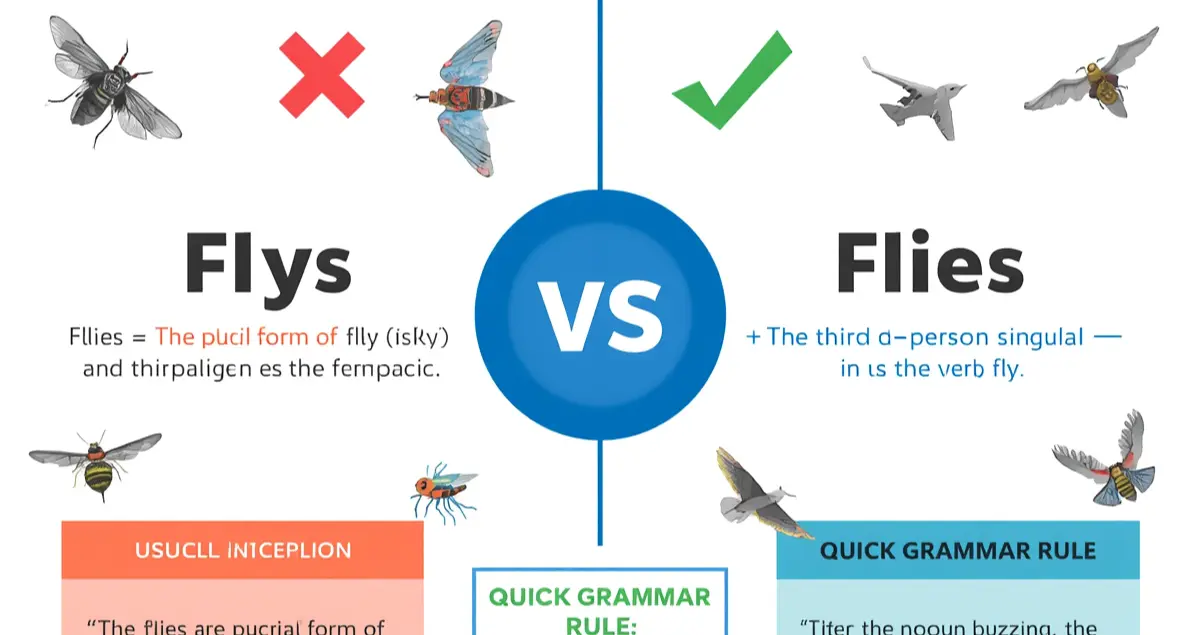
- Flies is the standard plural form of the noun fly and the third-person singular form of the verb fly.
- Flys is a rare noun that refers to parts of clothing, tents, or certain baseball terms.
Examples
Flies
- The flies are buzzing around the fruit.
- She flies to London every year.
Flys
- The tailor repaired the flys on several pairs of pants.
- The tent flys protected campers from rain.
Read more: Benefited or Benefitted: Which Spelling Is Correct?
Why Is Their Difference Necessary to Know for Learners and Experts?
Knowing the difference between flys and flies is important because correct spelling improves communication. In schools, students are judged by their writing accuracy. In workplaces, spelling mistakes can affect professional credibility.
Experts such as editors, teachers, journalists, and authors must use words correctly to maintain trust and clarity. Society depends on clear communication in education, business, media, and technology. Understanding the distinction between flys and flies helps prevent confusion and promotes better language skills for everyone.
Pronunciation of Flys and Flies
| Word | US Pronunciation | UK Pronunciation |
| Flys | /flaɪz/ | /flaɪz/ |
| Flies | /flaɪz/ | /flaɪz/ |
Both words are pronounced exactly the same.
Linking Hook
Now that we know the basic difference between these two words, let’s explore their meanings, usage, and unique characteristics in greater detail.
Read more: Healthcare or Health Care: Which Spelling Is Correct?
Difference Between Flys and Flies
1. Meaning
Flys
Refers to openings in garments or protective coverings.
Examples:
- The flys on old trousers needed repair.
- Several tent flys were replaced.
Flies
Refers to insects or the verb form of fly.
Examples:
- Flies gathered near the garbage.
- The eagle flies high above the mountains.
2. Frequency of Use
Flys
Rarely used.
Examples:
- The word flys appears in specialized texts.
- Most people rarely encounter flys.
Flies
Used every day.
Examples:
- Flies are common in summer.
- She flies for work each month.
3. Grammatical Function
Flys
Usually a noun.
Examples:
- The flys were repaired.
- Tent flys need maintenance.
Flies
Can be a noun or verb.
Examples:
- Flies landed on the table.
- He flies to New York weekly.
4. Common Context
Flys
Clothing and camping.
Examples:
- Jacket flys were inspected.
- Tent flys kept the rain away.
Flies
Animals and travel.
Examples:
- Flies are attracted to food.
- The pilot flies internationally.
5. Popularity
Flys
Very uncommon.
Examples:
- Few dictionaries highlight flys.
- Many readers never see flys.
Flies
Extremely common.
Examples:
- Flies appear in textbooks.
- News articles use flies regularly.
6. Educational Usage
Flys
Advanced vocabulary.
Examples:
- Language specialists know the term.
- Technical manuals may use flys.
Flies
Basic vocabulary.
Examples:
- Children learn flies early.
- Beginners often use flies.
7. Dictionary Presence
Flys
Limited definitions.
Examples:
- Some dictionaries list flys briefly.
- Specialized dictionaries explain flys.
Flies
Extensive definitions.
Examples:
- Dictionaries provide many meanings.
- Grammar books discuss flies often.
8. Writing Importance
Flys
Used in niche writing.
Examples:
- Tailoring guides mention flys.
- Camping manuals use flys.
Flies
Used in general writing.
Examples:
- Newspapers mention flies.
- Stories frequently use flies.
9. Reader Familiarity
Flys
Less familiar.
Examples:
- Readers may question the spelling.
- Students often misunderstand flys.
Flies
Highly familiar.
Examples:
- Most readers recognize flies.
- Children understand flies easily.
10. Search Popularity
Flys
Lower search volume.
Examples:
- Few people search for flys.
- Specialized users search for flys.
Flies
Higher search volume.
Examples:
- Many people search for flies.
- Educational websites discuss flies.
Nature and Behaviour of Both
Flys
Flys generally refers to objects rather than living things. They serve practical purposes in clothing, tents, and equipment. Their role is protective and functional.
Flies
Flies are living insects known for quick movement and adaptability. They play important roles in ecosystems by helping with decomposition and serving as food for other animals.
Why Are People Confused About Their Use?
People are confused because:
- Both words have the same pronunciation.
- They differ by only one letter.
- Most people know “flies” but not “flys.”
- English spelling rules change words ending in “y.”
- Spell-checkers sometimes fail to explain the difference.
Difference and Similarity Table
| Feature | Flys | Flies |
| Pronunciation | Same | Same |
| Part of Speech | Usually noun | Noun and verb |
| Frequency | Rare | Common |
| Refers to Insects | No | Yes |
| Refers to Flying Action | No | Yes |
| Used in Clothing | Yes | No |
| Used in Camping | Yes | No |
| Found in Daily Writing | Rarely | Frequently |
| English Word | Yes | Yes |
| Similar Sound | Yes | Yes |
Which Is Better in What Situation?
When Flys Is Better
The word flys is better when discussing clothing construction, tailoring, camping equipment, or technical subjects involving protective covers. In these specialized situations, flys is the accurate term. Using flies instead could create confusion because readers may think you are referring to insects or flying actions. Therefore, professionals in tailoring, manufacturing, and outdoor equipment industries may occasionally use flys.
When Flies Is Better
The word flies is better in almost every everyday situation. It is the correct choice when referring to insects, air travel, birds, airplanes, or the verb fly. Students, writers, teachers, journalists, and business professionals use flies far more often than flys. For most English learners, flies is the spelling they will need regularly in conversation and writing.
How the Keywords Are Used in Metaphors and Similes
Flies
Metaphor:
- Time flies when you are having fun.
Simile:
- He moved like flies around a picnic table.
Flys
Metaphorical use is uncommon because flys mainly refers to physical objects.
Example:
- The tent flys acted as shields against the storm.
Connotative Meaning of Both Keywords
| Word | Connotation |
| Flys | Neutral |
| Flies | Positive, Negative, or Neutral |
Positive Example
- Her imagination flies beyond limits.
Negative Example
- Flies covered the spoiled food.
Neutral Example
- Several flies entered the room.
Idioms and Proverbs Related to Flies
1. Time Flies
Meaning: Time passes quickly.
Example:
- Time flies when spending time with family.
2. Fly on the Wall
Meaning: An unnoticed observer.
Example:
- I wish I were a fly on the wall during the meeting.
3. Wouldn’t Hurt a Fly
Meaning: Very gentle person.
Example:
- She wouldn’t hurt a fly.
4. Flies in the Ointment
Meaning: A small problem in a good situation.
Example:
- The delayed shipment was the only fly in the ointment.
Works in Literature Containing the Keyword
Flies
- Lord of the Flies – Novel, William Golding, 1954
- His Dark Materials: The Amber Spyglass (references to flies) – Fantasy, Philip Pullman, 2000
Fly
- The Fly – Short Story, George Langelaan, 1957
Movie Names Based on the Keywords
Flies / Fly
- Lord of the Flies – 1963, United Kingdom
- Lord of the Flies – 1990, United States
- The Fly – 1958, United States
- The Fly – 1986, United States
- The Fly II – 1989, United States
Frequently Asked Questions
1. Is flies the correct plural of fly?
Yes. Flies is the standard plural form of the insect fly.
2. Is flys a real word?
Yes, but it is rare and used in specialized contexts.
3. Which word is more common?
Flies is much more common.
4. Why does fly become flies?
English grammar changes many nouns ending in consonant + y into ies.
5. Can flys refer to insects?
No. Insects are referred to as flies.
How Both Are Useful for Surroundings
Flys
Flys protect people from rain, wind, and environmental conditions through tents and clothing designs.
Flies
Flies help decompose organic matter and support food chains. Although sometimes considered pests, they contribute to ecological balance.
Final Words for Both
Flys is a specialized word with limited but important uses in technical fields.
Flies is a common English word used daily for insects and flying actions, making it far more important for general communication.
Conclusion
The debate over flys or flies is mainly a matter of usage and context. While both words exist in English, flies is the form most people need. It serves as both the plural of fly and the third-person singular verb form. In contrast, flys appears only in specialized fields such as tailoring and camping equipment.
Because both words sound identical, confusion is understandable. However, remembering that insects and flying actions use flies will help you avoid most mistakes. if you are a student, writer, teacher, or professional, mastering the difference between these words can improve your confidence and accuracy in English communication.

I’m BeaconRise, the author behind GrammarCircle, where I help readers understand English grammar, language differences, and writing concepts in a simple and practical way. I specialize in explaining confusing words, grammar rules, and “difference between” topics so learners can easily improve their writing and communication skills.