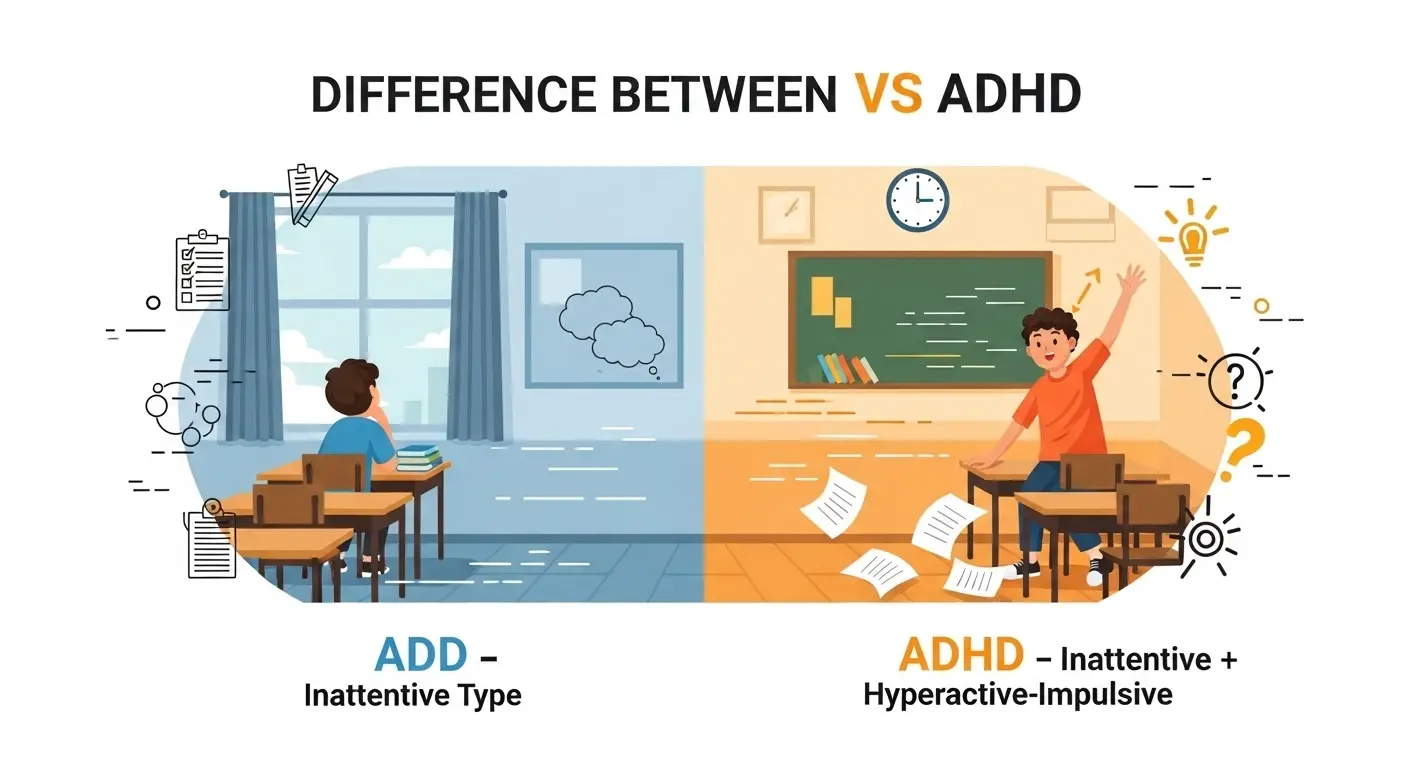
When Sarah’s 8-year-old son struggled to focus in class but never caused trouble, his teacher suggested he might have ADD. Meanwhile, her neighbor’s child was constantly restless, talking nonstop, and unable to sit still. Doctors called it ADHD.
This real-life example shows why many parents search for the difference between ADD and ADHD. The confusion around the difference between ADD and ADHD is common because both terms relate to attention disorders. However, understanding the difference between ADD and ADHD helps parents, teachers, and professionals provide the right support. In today’s world, knowing the difference between ADD and ADHD is essential for better awareness, accurate diagnosis, and effective treatment.
Key Difference Between the Both
The main difference is that ADD (Attention Deficit Disorder) refers to attention problems without hyperactivity, while ADHD (Attention Deficit Hyperactivity Disorder) includes hyperactivity and impulsive behavior along with attention difficulties.
Why Is Their Difference Necessary to Know for Learners and Experts?
Understanding this difference is important for:
- Teachers who need to manage classroom behavior effectively.
- Parents who want the right medical advice.
- Psychologists and doctors who diagnose conditions correctly.
- Society to reduce stigma and misunderstanding.
Knowing the correct term ensures proper treatment plans, medication choices, and educational strategies.
Pronunciation (US & UK)
- ADD
- US: /ˌeɪ.diːˈdiː/
- UK: /ˌeɪ.diːˈdiː/
- ADHD
- US: /ˌeɪ.diː.eɪtʃˈdiː/
- UK: /ˌeɪ.diː.eɪtʃˈdiː/
Now that we understand the basics, let’s explore the detailed difference between ADD and ADHD in depth.
Difference Between ADD and ADHD
1. Hyperactivity
ADD: No hyperactivity.
- Example 1: A child quietly daydreams in class.
- Example 2: An adult forgets meetings but sits calmly.
ADHD: Includes hyperactivity.
- Example 1: A child runs around during lessons.
- Example 2: An adult constantly taps feet during meetings.
2. Official Medical Term
ADD: Older term, not officially used now.
ADHD: Official medical diagnosis today.
- ADD Example: Old school report says “ADD symptoms.”
- ADHD Example: Doctor’s diagnosis states “ADHD – inattentive type.”
3. Types
ADD: Usually refers to inattentive type only.
ADHD: Three types – inattentive, hyperactive-impulsive, combined.
Examples included in classroom and workplace settings.
4. Impulsivity
ADD: Less impulsive behavior.
ADHD: High impulsivity.
- ADD: Person forgets homework.
- ADHD: Person interrupts conversations.
5. Behavioral Visibility
ADD: Symptoms are less noticeable.
ADHD: Symptoms are more obvious.
Examples: Quiet distraction vs loud disruption.
6. Diagnosis Era
ADD: Common term before 1994.
ADHD: Used after DSM updates in 1994.
7. Social Perception
ADD: Seen as “lazy” or “careless.”
ADHD: Seen as “naughty” or “hyper.”
8. Academic Impact
ADD: Poor concentration affects grades.
ADHD: Disruptions and poor focus affect grades.
9. Treatment Approach
ADD: Focus on concentration strategies.
ADHD: Includes behavior therapy and medication for hyperactivity.
10. Energy Levels
ADD: Low or normal energy.
ADHD: Excessive energy.
Nature and Behaviour
ADD Nature: Quiet, distracted, forgetful, introverted behavior.
ADHD Nature: Energetic, impulsive, restless, sometimes aggressive.
Why Are People Confused About Their Use?
- Both relate to attention problems.
- ADD is now part of ADHD diagnosis.
- The media still uses ADD informally.
- Many people don’t know about medical updates.
Table: Difference and Similarity Between ADD and ADHD
| Feature | ADD | ADHD |
| Hyperactivity | No | Yes |
| Official Term | No | Yes |
| Attention Issues | Yes | Yes |
| Impulsivity | Mild | Strong |
| Medical Category | Outdated term | Current diagnosis |
| Treatment | Similar methods | Similar + hyperactivity focus |
| Academic Issues | Yes | Yes |
| Social Impact | Yes | Yes |
Which Is Better in What Situation?
Neither ADD nor ADHD is “better.” However, people with ADD may appear calmer in structured environments like libraries or office settings. They may struggle silently but cause less disturbance.
People with ADHD may perform well in active environments like sports or creative fields. Their energy can be a strength if guided properly. The right support makes both manageable.
How the Keywords Are Used in Metaphors and Similes
- “His mind was like ADD drifting like clouds.”
- “She moved like ADHD energy as fast as lightning.”
Connotative Meaning
ADD: Neutral to slightly negative (forgetful).
- Example: “He’s so ADD today” (informal use).
ADHD: Often negative but increasingly neutral.
- Example: “Her ADHD gives her creative energy.”
Idioms or Proverbs Related
No direct idioms exist, but related expressions include:
- “A wandering mind.”
- “Full of beans” (energetic like ADHD).
Example: “He’s full of beans, just like a child with ADHD.”
Works in Literature
- Driven to Distraction (Non-fiction, Edward M. Hallowell & John J. Ratey, 1994)
- Delivered from Distraction (Non-fiction, Hallowell & Ratey, 2005)
Movies on ADHD
- The Disruptors (2022, USA)
- Front of the Class (2008, USA – related neurodevelopment topic)
Frequently Asked Questions
1. Is ADD still a medical term?
No, doctors now use ADHD.
2. Can someone have ADD without hyperactivity?
Yes, but it is called ADHD inattentive type now.
3. Are treatments different?
Mostly similar but ADHD may require hyperactivity control.
4. Is ADHD more serious than ADD?
Not necessarily; severity varies individually.
5. Can adults have both?
Yes, ADHD continues into adulthood.
How Both Are Useful for Surroundings
People with ADD may excel in deep thinking and creativity.
People with ADHD often bring energy, innovation, and enthusiasm to teams.
Final Words for Both
ADD and ADHD are not weaknesses but neurological differences. Understanding them creates empathy and better opportunities.
Conclusion
Understanding the difference between ADD and ADHD is essential for parents, teachers, and professionals. While ADD refers to attention issues without hyperactivity and is now considered an outdated term, ADHD is the official diagnosis covering multiple types.
Recognizing the difference between ADD and ADHD helps reduce stigma and ensures accurate treatment. With awareness, support, and proper guidance, individuals with either condition can thrive academically, socially, and professionally.

I’m BeaconRise, the author behind GrammarCircle, where I help readers understand English grammar, language differences, and writing concepts in a simple and practical way. I specialize in explaining confusing words, grammar rules, and “difference between” topics so learners can easily improve their writing and communication skills.