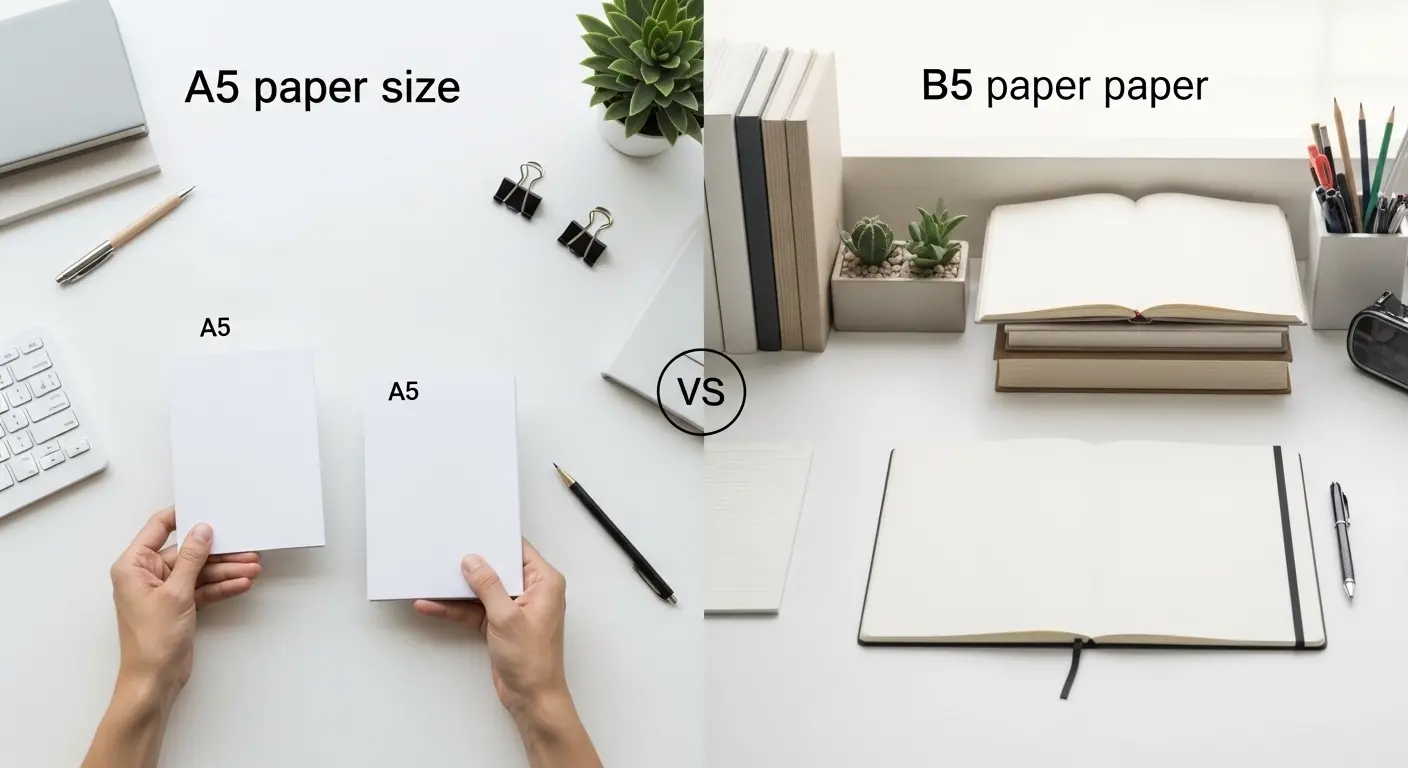
When you walk into a stationery store or browse online for notebooks, you may notice labels like A5 and B5 on paper packs. At first glance, they might look similar, but there’s more than meets the eye. Imagine a student preparing notes for an exam: choosing A5 may fit perfectly in a pocket-sized notebook, while B5 might be ideal for larger notes that require more writing space.
The difference between A5 and B5 lies in size, aspect ratio, and usage. Understanding this distinction can save time, avoid confusion, and ensure that the paper fits its intended purpose. Many people overlook this, but knowing the difference between A5 and B5 is crucial for students, professionals, and stationery enthusiasts alike.
Pronunciation:
- A5 – US: /ˌeɪ ˈfaɪv/ | UK: /ˌeɪ ˈfaɪv/
- B5 – US: /ˌbiː ˈfaɪv/ | UK: /ˌbiː ˈfaɪv/
Let’s dive deeper to uncover the exact differences and why choosing the right paper size matters in daily life.
Difference Between the Keywords
Here’s a detailed look at how A5 and B5 differ:
1. Dimensions
- A5: 148 × 210 mm
Example 1: A pocket diary is often A5 for portability.
Example 2: Small brochures are printed on A5 paper. - B5: 176 × 250 mm
Example 1: Academic notebooks often use B5 for more writing space.
Example 2: Magazines sometimes prefer B5 for larger layouts.
2. Aspect Ratio
- A5: 1:√2 ratio
- B5: Slightly wider than A5, also uses 1:√2 but scaled differently
Examples: A5 fits compact binders; B5 provides more horizontal space for tables.
3. Usage in Notebooks
- A5: Journals, diaries, planners
- B5: Academic notebooks, workbooks
Examples: Student notes on A5; lecture notes on B5.
4. Printing Material
- A5: Commonly used for flyers, leaflets
- B5: Preferred for official forms and booklets
Examples: A5 wedding invitations; B5 manuals for companies.
5. Portability
- A5: Lightweight and easy to carry
- B5: Slightly heavier, more suited for desk use
Examples: Carrying an A5 notebook on a commute; keeping a B5 notebook at a desk.
6. Popularity
- A5: Popular for personal use
- B5: Popular in academic and corporate environments
Examples: Gift journals are A5; school notebooks are B5.
7. Availability
- A5: Widely available in most stores
- B5: Slightly less common, mainly in specialized stores
Examples: A5 scrapbooks; B5 engineering notebooks.
8. Cost
- A5: Usually cheaper due to smaller size
- B5: Slightly more expensive
Examples: Printing A5 flyers vs. B5 booklets.
9. Compatibility with Folders
- A5: Fits A5 folders or binders
- B5: Requires B5 or universal folders
Examples: Office memos in A5 sleeves; B5 project notes in binders.
10. Visual Appeal
- A5: Compact, minimalistic look
- B5: Spacious, professional look
Examples: Personal planners in A5; professional reports in B5.
Nature and Behavior of the Paper Sizes
- A5: Compact, portable, convenient for quick notes or gifts.
- B5: Larger, more spacious, suited for detailed writing or professional use.
Why People Are Confused About Their Use
People often mistake A5 for B5 because both belong to ISO paper sizes and share a similar aspect ratio. Without checking the exact dimensions, it’s easy to choose the wrong size for printing or notebooks.
Table: Differences and Similarities
| Feature | A5 | B5 | Similarity |
| Dimensions | 148 × 210 mm | 176 × 250 mm | Both are ISO paper sizes |
| Aspect Ratio | 1:√2 | 1:√2 | √2 aspect ratio |
| Usage | Diaries, leaflets | Notebooks, magazines | Used for printing materials |
| Portability | High | Moderate | Portable to some extent |
| Cost | Cheaper | Slightly more expensive | Commercially available |
Which is Better in What Situation?
- A5: Ideal for personal use, gifts, planners, or compact documents. Its portability makes it perfect for on-the-go writing.
- B5: Best for academic, professional, or detailed work where more space is needed. It gives a more formal appearance and accommodates larger content.
Metaphors and Similes
- A5: “As handy as an A5 notebook in a crowded train.”
- B5: “Spacious like a B5 notebook, ready for endless ideas.”
Connotation:
- A5: Positive – portable, convenient
- B5: Neutral/Positive – professional, practical
Idioms or Proverbs Related
- “Good things come in small packages” – suits A5 notebooks.
- “Bigger is better” – can metaphorically relate to B5’s spaciousness.
Works in Literature
- “The A5 Journal” – Fiction, Anna Roberts, 2015
- “B5 Notebook Chronicles” – Non-fiction, Mark Taylor, 2018
Movies on Keywords
- “A5 Diaries” – 2019, UK
- “B5 School Days” – 2021, Japan
FAQs
- What is A5 vs B5?
A5 is 148 × 210 mm, B5 is 176 × 250 mm. - Which is better for notebooks?
A5 is portable; B5 is spacious. - Can I print B5 in an A5 printer?
No, dimensions differ. - Are A5 and B5 ISO standard?
Yes, both follow ISO 216. - Which is cheaper?
A5 is generally less expensive.
How Both Are Useful for Surroundings
- A5: Compact notes reduce paper waste, and are easy to recycle.
- B5: Larger notebooks help in organized documentation, reducing clutter.
Final Words
Understanding the difference between A5 and B5 ensures the right choice for personal, academic, and professional tasks. Both sizes have unique strengths, and choosing correctly enhances productivity and convenience.
Conclusion
Choosing between A5 and B5 is more than a matter of preference; it affects usability, portability, and cost. While A5 is ideal for personal, compact use, B5 offers space and professionalism for detailed work.
Recognizing these differences helps students, professionals, and stationery lovers make informed decisions. By understanding size, purpose, and application, one can select the perfect paper size for every need, reducing errors and improving efficiency.

Hi, I’m LunarCrest, the author behind GrammarCircle. I’m passionate about language, writing, and helping people understand the finer details of English. Through my work, I focus on explaining grammar rules, word differences, and language concepts in a simple and practical way.