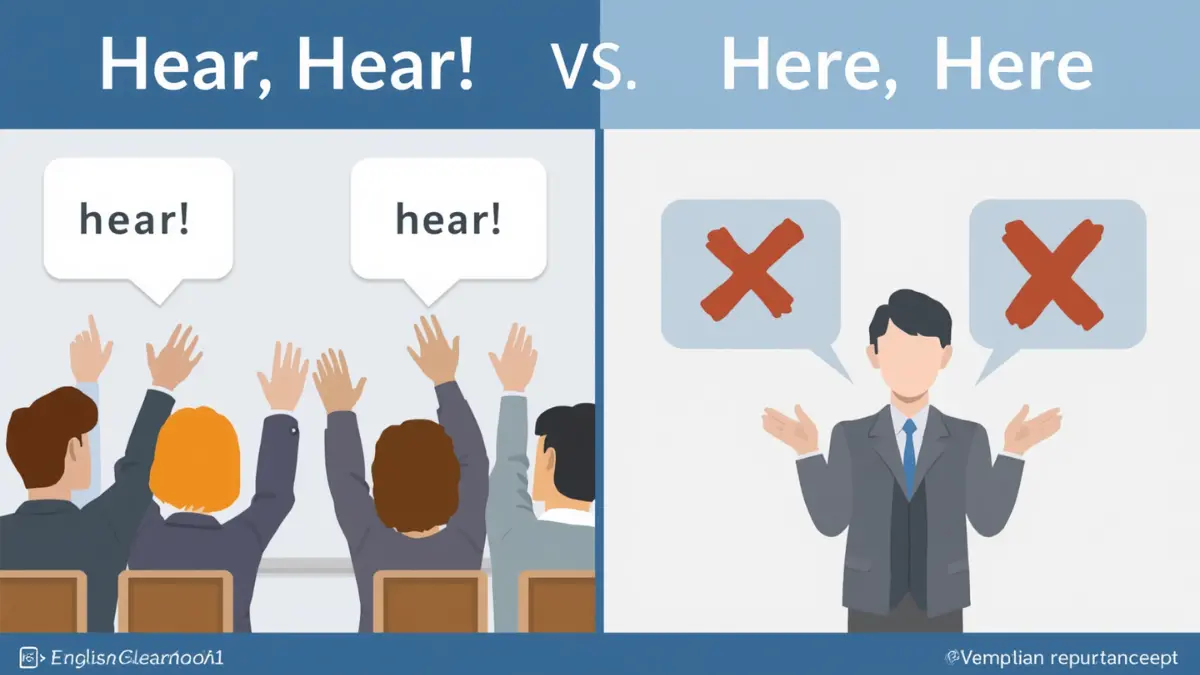
Many people get confused between hear hear or here here because both phrases sound exactly the same when spoken aloud. You may see someone write “here here” in a social media comment or message when they actually mean “hear hear.” Since English contains many words with similar sounds, this mistake happens often.
Imagine a meeting where one person gives a strong opinion. Another person loudly says, “Hear, hear!” to show agreement and support. Some listeners may think the phrase is “here here” because that spelling sounds identical. This confusion causes many people to search for hear hear or here here online.
The good news is that the correct phrase is easy to learn. “Hear, hear!” is the proper expression used to support or agree with someone’s statement. “Here here” is usually considered incorrect in this context. This guide explains the meaning, origin, spelling, examples, and common mistakes related to hear hear or here here so you can use the phrase correctly and confidently.
Hear Hear or Here Here – Quick Answer
Quick Rule
- Hear, hear! = correct phrase used to show agreement
- Here here = usually incorrect in this situation
Meaning of “Hear, Hear!”
The phrase means:
- “Listen to this!”
- “I agree strongly!”
- “Well said!”
Read moree: Stint or Stent: Meaning, Difference, and Correct Usage Explained
Examples
| Phrase | Correct Usage |
| Hear, hear! | “Hear, hear! That is a great idea.” |
| Here here | Incorrect in most agreement contexts |
The Origin of Hear Hear or Here Here
The phrase hear, hear! comes from British Parliament traditions. Long ago, members of Parliament would say:
- “Hear him!”
meaning: - “Listen to what he is saying!”
Over time, the phrase became shorter:
- “Hear, hear!”
People used it to support speeches and opinions during debates.
Historical Development
| Original Phrase | Modern Phrase |
| Hear him! | Hear, hear! |
The spelling “here here” developed because the words sound alike in spoken English.
British English vs American English Spelling
There is no major spelling difference between British and American English for this phrase.
Both versions use:
- Hear, hear!
However, the phrase is more traditional and common in British English because of its parliamentary history.
Comparison Table
| Region | Preferred Phrase |
| United Kingdom | Hear, hear! |
| United States | Hear, hear! |
Example Usage
| Context | Example |
| British debate | “Hear, hear!” |
| American meeting | “Hear, hear!” |
Which Spelling Should You Use?
Use “Hear, Hear!” If:
- You agree with someone strongly
- You support a statement publicly
- You want formal or correct English
Avoid “Here Here” If:
- You mean agreement or support
- You are writing professionally
Best Choice for Global Writing
Always use:
- Hear, hear!
It is the grammatically correct and historically accepted phrase.
Common Mistakes with Hear Hear or Here Here
Many writers make mistakes because the words sound identical.
| Incorrect | Correct |
| Here here! Great point. | Hear, hear! Great point. |
| I said here here in my essay. | I said hear, hear in my essay. |
| Hear here! | Hear, hear! |
Mistake 1: Writing the phrase by sound
People often spell it incorrectly because they only hear it spoken.
Mistake 2: Forgetting punctuation
The traditional form uses a comma:
- Hear, hear!
Mistake 3: Thinking “here” means location
The phrase is about listening, not location.
Hear Hear or Here Here in Everyday Examples
In Emails
- “Hear, hear! I fully support your idea.”
In News Writing
- “Several members shouted ‘Hear, hear!’ during the speech.”
On Social Media
- “Hear, hear! That needed to be said.”
In Formal Writing
- “The audience responded with cries of ‘Hear, hear!’”
Hear Hear or Here Here – Google Trends & Usage Data
Search trends show many people search for this phrase because:
- it sounds confusing
- both versions sound identical
- spelling mistakes are common online
Popular Searches
| Search Query | Purpose |
| hear hear meaning | Understanding the phrase |
| hear hear or here here | Correct spelling |
| hear hear example | Learning usage |
Country Popularity
| Country | Common Usage |
| United Kingdom | Very common |
| United States | Moderately common |
| Canada | Common in formal settings |
| Australia | Frequently used |
Online Trends
“Here here” appears often on social media because many users type the phrase based only on pronunciation.
Hear Hear vs Here Here Comparison Table
| Feature | Hear, Hear! | Here Here |
| Correct phrase | Yes | No |
| Meaning | Agreement/support | Usually incorrect |
| Historical usage | Yes | No |
| Formal writing | Accepted | Not accepted |
| Based on listening | Yes | No |
FAQs About Hear Hear or Here Here
1. Which is correct: hear hear or here here?
The correct phrase is:
- Hear, hear!
2. What does “hear, hear!” mean?
It means strong agreement or support.
3. Is “here here” ever correct?
Only if you literally mean location, not agreement.
4. Why do people spell it “here here”?
Because both phrases sound the same when spoken.
5. Is “hear, hear!” formal?
Yes. It is common in formal debates and speeches.
6. Does American English use “hear, hear”?
Yes, but it is more traditional in British English.
7. Should there be a comma?
Yes. The standard form is:
- Hear, hear!
Conclusion
Understanding hearor here here is simple once you know the history and meaning behind the phrase. The correct expression is hear, hear!, which is used to show agreement, approval, or support for someone’s statement. The phrase comes from British parliamentary traditions where people encouraged others to listen carefully to a speaker.
Many people mistakenly write “here here” because both phrases sound exactly alike in spoken English. However, “here here” is usually incorrect when expressing agreement. For professional writing, speeches, emails, and social media posts, it is best to use the traditional and accepted form: hear, hear!
Learning small differences like this improves grammar, writing confidence, and communication skills. It also helps your writing appear more polished and accurate. When someone makes a great point, now you can confidently respond with the correct phrase:
- “Hear, hear!”

Hi, I’m LunarCrest, the author behind GrammarCircle. I’m passionate about language, writing, and helping people understand the finer details of English. Through my work, I focus on explaining grammar rules, word differences, and language concepts in a simple and practical way.