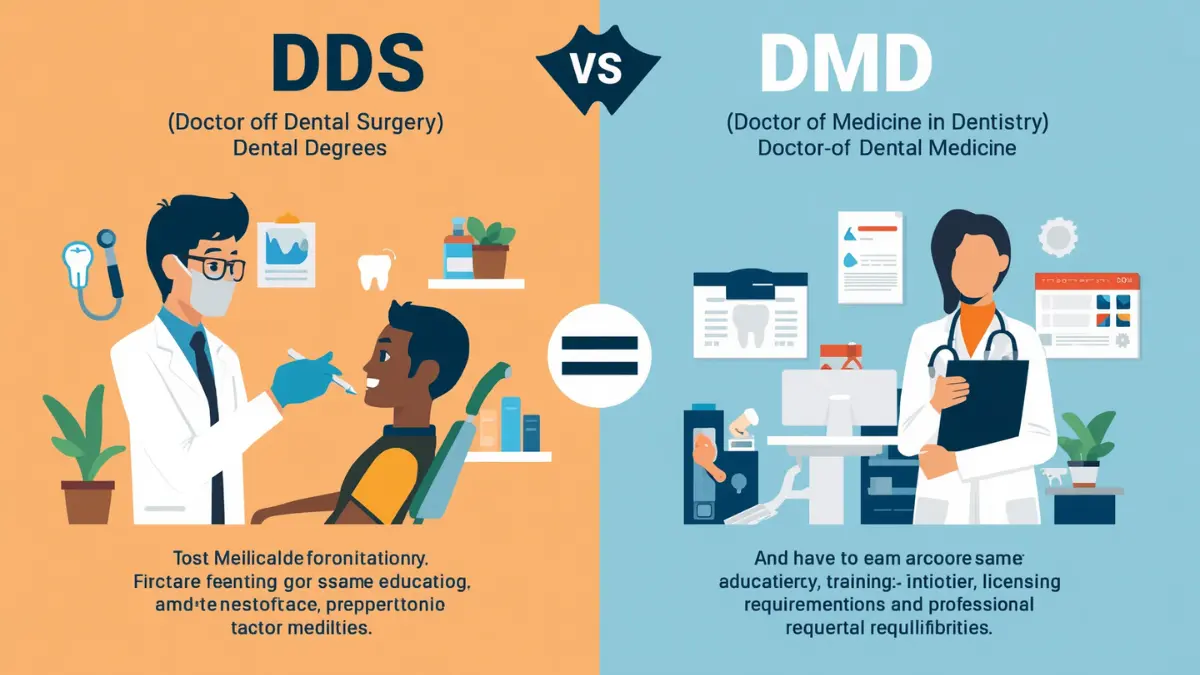
Many students searching for dentistry careers often get confused between DDS or DMD degrees. Both terms appear in universities, job listings, and dental licensing exams, but they look different enough to raise questions: Are they the same? Is one better than the other? Or do they lead to different careers?
This confusion is common because dental schools in different countries and even within the same country use different naming systems. Some universities award a Doctor of Dental Surgery (DDS), while others award a Doctor of Dental Medicine (DMD). Students worry that choosing the “wrong” degree might affect their career, salary, or license.
In reality, the difference is mostly in the name, not the education. Both degrees train students to become licensed dentists. However, understanding the origin, spelling, and usage of DDS and DMD helps students make smarter decisions when applying to dental schools, especially in the US and other English-speaking countries.
DDS or DMD Degree – Quick Answer
The DDS or DMD degree both mean the same thing: a professional dental degree that allows you to become a licensed dentist.
- DDS = Doctor of Dental Surgery
- DMD = Doctor of Dental Medicine
There is no difference in education, training, or career scope.
Example:
- Harvard University awards DMD
- Many US state universities award DDS
Both degrees require:
- 4 years of dental school
- Clinical training
- Licensing exams
Read more: Alum or Alumni: Which Word Is Correct?
The Origin of DDS or DMD Degree
The difference comes from history, not science.
- DDS (Doctor of Dental Surgery) was first used in early dental schools in the United States.
- DMD (Doctor of Dental Medicine) was introduced later by universities that preferred Latin naming traditions.
The Latin term for both translates closely to:
- “Dentariae Medicinae Doctor” → DMD meaning
- “Doctor of Dental Surgery” → DDS meaning
Over time, both titles became accepted in academic systems, even though they describe the same profession.
British English vs American English Spelling
In British English, dental degrees are usually not labeled DDS or DMD in the same formal way. Instead, the UK uses:
- BDS (Bachelor of Dental Surgery)
In American English:
- DDS and DMD are both standard postgraduate dental degrees.
Read more: Check in or Check-in: Meaning and Spelling Rules
Comparison Table
| Region | Common Degree | Meaning |
| USA | DDS / DMD | Doctor of Dental Surgery / Medicine |
| UK | BDS | Bachelor of Dental Surgery |
| Canada | DDS / DMD | Same as USA |
| Australia | BDS / DMD | Depends on university |
Which Spelling Should You Use?
Your choice depends on your location and audience:
- USA & Canada: Use DDS or DMD (both accepted)
- UK & Commonwealth countries: Use BDS
- International applications: Use the degree your university officially awards
Tip:
Always use the exact title given by your dental school in certificates and resumes.
Common Mistakes with DDS or DMD Degree
Many students make simple errors like:
- Thinking DDS is better than DMD ❌
- Believing they lead to different jobs ❌
- Mixing BDS with DDS/DMD incorrectly ❌
- Writing both degrees together (DDS/DMD) in formal documents ❌
Correct understanding:
- DDS = DMD (same level, same career path)
DDS or DMD Degree in Everyday Examples
Email Example:
- “I completed my DDS degree at the University of Michigan.”
News Example:
- “The dentist, who holds a DMD degree, opened a new clinic in Chicago.”
Social Media Example:
- “Proud to become a licensed dentist with my DDS!”
Formal Writing Example:
- “Dr. Smith, DMD, specializes in orthodontics.”
DDS or DMD Degree – Google Trends & Usage Data
Search data shows:
- High searches in the United States
- Moderate interest in Canada and India
- Low but growing searches in Middle East and Asia
Why?
- Many international students apply to US dental schools
- Confusion about degree naming systems
- Increasing global mobility in healthcare careers
DDS is slightly more searched than DMD, but both terms are often used interchangeably in professional contexts.
DDS vs DMD Degree Comparison Table
| Feature | DDS | DMD |
| Full Form | Doctor of Dental Surgery | Doctor of Dental Medicine |
| Education | Same | Same |
| Duration | 4 years | 4 years |
| Career Path | Dentist | Dentist |
| Universities | More common in public schools | More common in private/ivy schools |
FAQs about DDS or DMD Degree
1. Is DDS better than DMD?
No. Both are equal in education and career scope.
2. Can DDS and DMD graduates work in the same jobs?
Yes. Both become licensed dentists.
3. Why do some schools use DDS and others DMD?
It depends on university preference and historical naming.
4. Is DMD valid in all countries?
Yes, it is internationally recognized like DDS.
5. Which is harder, DDS or DMD?
Neither. The curriculum is the same.
6. Do I need both DDS and DMD degrees?
No. One dental degree is enough.
7. Which degree should I choose?
Choose the one offered by your dental school.
Conclusion
The confusion around DDS or DMD degree mainly comes from naming differences, not actual academic differences. Both degrees represent the same level of dental education and lead to the same career path: becoming a licensed dentist.
Whether a university offers DDS or DMD depends on its tradition, not on quality or difficulty. Students should focus on admission requirements, clinical training, and licensing exams instead of worrying about the title.
In global practice, both degrees are equally respected and accepted. What truly matters is your skills, experience, and ability to treat patients effectively. So, whether you see DDS or DMD, remember they both open the same professional door to dentistry.

Hi, I’m LunarCrest, the author behind GrammarCircle. I’m passionate about language, writing, and helping people understand the finer details of English. Through my work, I focus on explaining grammar rules, word differences, and language concepts in a simple and practical way.