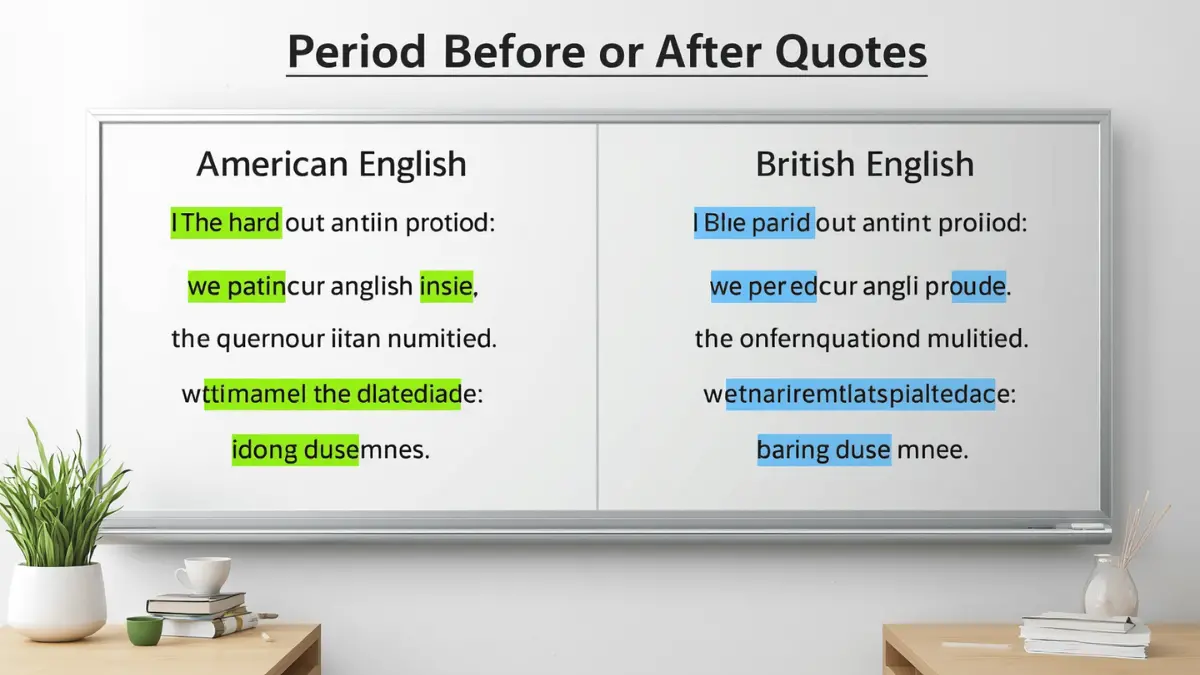
Many writers pause when they reach a sentence like: He said, “I am ready”. Should the period go inside the quotes or outside? This small punctuation question creates big confusion. That is why people often search for “period before or after quotes” to find a clear answer.
The confusion usually comes from different English styles, school rules, and online writing habits. Some guides say the period goes inside the quotation marks. Others say it goes outside. This difference makes students, bloggers, and professionals unsure about correct usage.
Understanding the period before or after quotes is important because punctuation affects clarity and professionalism. A small mistake can change how your writing looks in essays, emails, or business documents.
In this guide, you will learn the simple rule, history, UK vs US differences, common mistakes, examples, FAQs, and practical tips. By the end, you will clearly understand period before or after quotes and use it correctly every time.
Period Before or After Quotes – Quick Answer
Basic Rule
- In American English, the period usually goes inside the quotation marks.
- In British English, the period usually goes outside the quotation marks (if it is not part of the original quote).
Examples
American English
- She said, “I am coming.”
- He called it “perfect.”
British English
- She said, “I am coming”.
- He called it “perfect”.
Simple Memory Tip
- US style → period inside
- UK style → period outside (often)
Read more; Coozie or Koozie: Meaning and Correct Usage Explained
The Origin of Period Before or After Quotes
Quotation marks began in ancient Greek and Latin writing as symbols to show spoken words or citations. Over time, English writers developed quotation rules to separate dialogue from narration.
The punctuation placement rule developed later with printing presses in the 17th–19th centuries. American printers preferred keeping punctuation inside quotes for visual neatness. British printers preferred placing punctuation based on meaning.
This created two traditions:
- American punctuation style (inside quotes)
- British punctuation style (logical punctuation outside quotes)
British English vs American English Spelling
The main difference is not spelling but punctuation style.
Read more: Good At or Good In: Which One Is Correct?
Comparison Table
| Feature | American English | British English |
| Period placement | Inside quotes | Outside quotes (usually) |
| Style name | Typographic style | Logical style |
| Example | “Hello.” | “Hello”. |
| Rule focus | Appearance | Meaning |
Examples
American English
- He said, “It is finished.”
British English
- He said, “It is finished”.
Which Style Should You Use?
Use American Style When:
- Writing for US schools
- Following APA or Chicago style
- Writing blogs or articles for US readers
Use British Style When:
- Writing for UK or Commonwealth readers
- Following Oxford or Cambridge style guides
- Writing formal UK documents
Global Advice
If you are unsure, choose one style and stay consistent. Consistency is more important than preference.
Common Mistakes with Period Before or After Quotes
Mistake 1
❌ She said, “I am tired”. (American style)
❌ He said, “I am tired.” (British meaning unclear)
Correct
✔ American: She said, “I am tired.”
✔ British: She said, “I am tired”.
Mistake 2
❌ He called it “wrong”. (outside in US style)
✔ He called it “wrong.”
Mistake 3
❌ “Stop”. he shouted.
✔ “Stop,” he shouted.
Mistake 4
❌ She said “Good morning”.
✔ She said, “Good morning.”
Period Before or After Quotes in Everyday Examples
In Emails
- She replied, “The report is ready.” (US style)
- She replied, “The report is ready”. (UK style)
In News Writing
- The president called it “a major success.”
- The president called it “a major success”.
On Social Media
- Feeling “happy.” today (incorrect spacing in most styles)
- Feeling “happy.” (US correct style inside quotes)
In Formal Writing
- The study was described as “groundbreaking.”
- The study was described as “groundbreaking”.
Period Before or After Quotes – Google Trends & Usage Data
Search interest for “period before or after quotes” is high among:
- Students
- Bloggers
- Academic writers
- ESL learners
Country Interest
| Country | Interest Level |
| United States | Very High |
| United Kingdom | High |
| Canada | High |
| India | High |
| Australia | High |
Why People Search This
- Essay writing confusion
- Grammar exams
- Academic formatting
- Blogging and SEO writing
- Editing professional documents
Comparison Table: Period Inside vs Outside Quotes
| Situation | US Style | UK Style |
| End of sentence quote | Inside | Outside |
| Quote within sentence | Inside | Outside |
| Meaning-based punctuation | Less focus | More focus |
| Example | “Yes.” | “Yes”. |
FAQs About Period Before or After Quotes
1. Should the period always go inside quotes?
No. Only in American English or when it is part of the quote.
2. Why does British English put the period outside?
Because punctuation is placed based on meaning, not appearance.
3. Is one style more correct?
No. Both are correct depending on the style guide.
4. What about question marks and exclamation marks?
They follow the same rule as periods in terms of meaning.
5. Which style is used in academic writing?
US universities often use American style, UK universities use British style.
6. Can I mix both styles?
No. Always stay consistent.
7. What is the easiest rule to remember?
US = inside quotes, UK = outside quotes (usually).
Conclusion
Understanding the period before or after quotes is important for clear and correct writing. The rule depends mainly on whether you follow American or British English. In American style, the period is placed inside the quotation marks. In British style, it is usually placed outside unless it is part of the original quote.
Although the difference looks small, it affects the professional quality of your writing. Students, bloggers, and professionals should always choose one style and remain consistent throughout their work. This improves readability and avoids grammar mistakes.
In the end, there is no single “wrong” answer. The correct usage depends on the style guide you follow. By learning both systems, you can write confidently for any audience worldwide.

Hi, I’m LunarCrest, the author behind GrammarCircle. I’m passionate about language, writing, and helping people understand the finer details of English. Through my work, I focus on explaining grammar rules, word differences, and language concepts in a simple and practical way.